
Crystal Oscillator Selection: SPXO, TCXO, VCXO, OCXO, and MEMS Compared
Keywords: crystal oscillator selection, TCXO vs OCXO, MEMS oscillator vs quartz, SPXO stability, crystal oscillator ppm, clock source selection
Meta Description: SPXO, TCXO, VCXO, OCXO, or MEMS? How oscillator architectures differ on stability, jitter, power, and cost, and how to build a real stability budget.
The clock source is the quietest component on the bill of materials until it is wrong. A frequency error that looks trivial in the datasheet, a few parts per million, becomes a dropped GPS fix, a failed network synchronization lock, or an RTC that loses a minute a month. Crystal oscillator selection is therefore a system-budget exercise, not a part-number lookup, and the modern design has more architectures to choose among than ever: classic quartz in four compensation grades, ceramic resonators for the cost floor, and silicon MEMS oscillators that have moved from novelty to serious competition in a decade.
This guide compares the oscillator architectures, explains how to build a stability budget that survives reality, and maps the selection logic by application.
First: Crystal, Oscillator, Resonator, or MEMS?
Four component families get used interchangeably in conversation, and choosing the wrong one usually shows up as a bill-of-materials problem rather than a design problem.
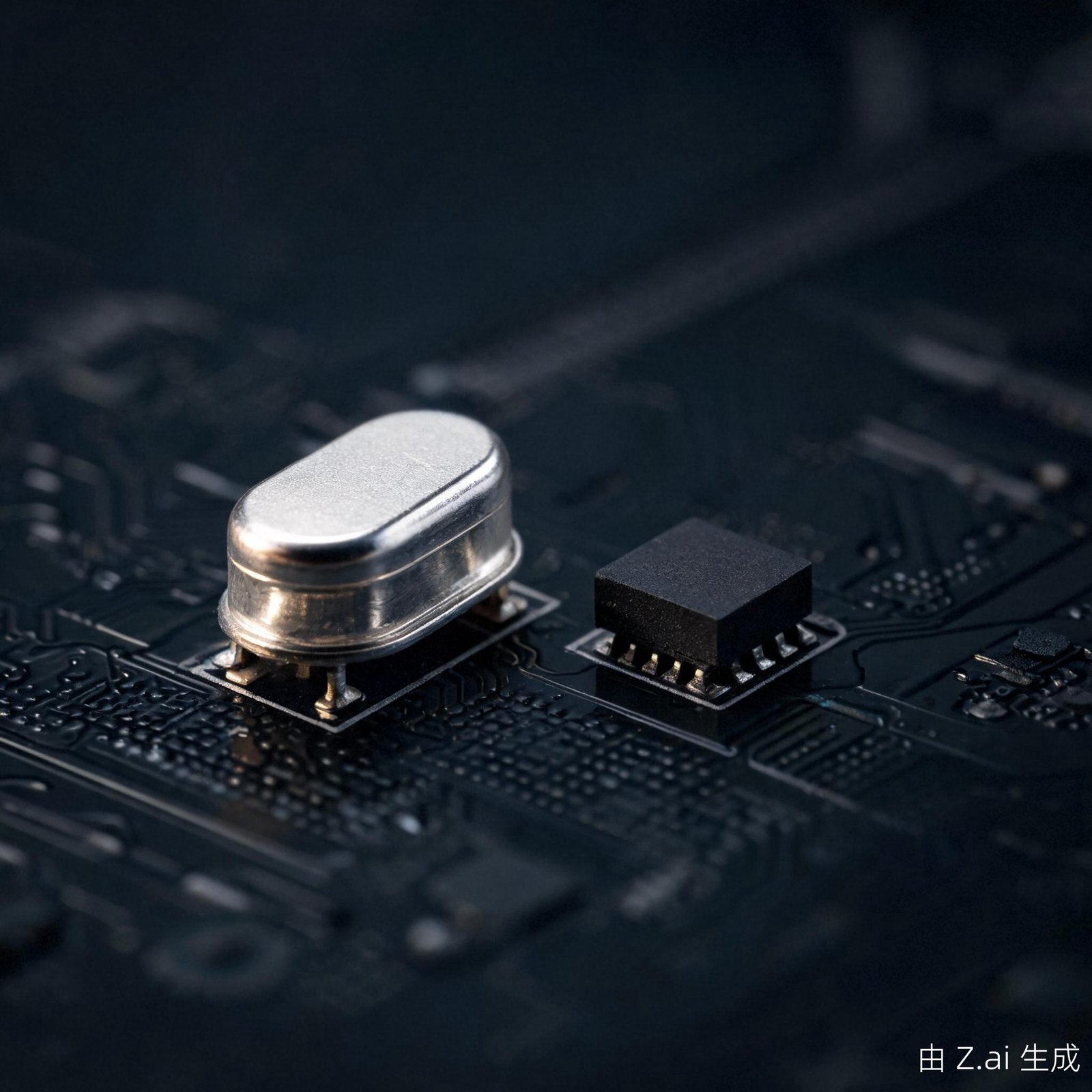
A bare crystal is a passive quartz unit: cheapest per part, but it needs an external oscillator circuit, load capacitors matched to the crystal's spec, and layout care, and the final accuracy in the circuit depends on the IC's oscillator behavior and board parasitics as much as on the crystal itself. A crystal oscillator (XO) integrates the crystal and its driving circuit in one active package: apply power, get a clock, with the manufacturer having already tuned the loop. Initial tolerances run roughly an order of magnitude tighter than bare crystals because the vendor calibrated the assembled unit. A ceramic resonator swaps quartz for a ceramic piezoelement: far cheaper and tolerant of assembly variation, but with frequency tolerance around plus or minus 0.5 percent, which relegates it to cost-sensitive, timing-uncritical applications. A MEMS oscillator replaces the vibrating quartz with a silicon resonator and packaged electronics: programmable to any frequency, dramatically more resistant to shock and vibration, and available through standard semiconductor supply chains.
| Component | Active or passive | External circuit | Typical initial tolerance | Best fit |
|---|---|---|---|---|
| Bare crystal (quartz unit) | Passive | Yes, tuned per design | About plus or minus 0.005 to 0.05 percent | Cost-sensitive designs with qualified oscillator circuits |
| Crystal oscillator (XO) | Active | No | About plus or minus 0.001 to 0.005 percent | Simplified design, faster time to market |
| Ceramic resonator | Passive | Sometimes | About plus or minus 0.5 percent | Non-critical timing, extreme cost sensitivity |
| MEMS oscillator | Active | No | About plus or minus 0.001 to 0.005 percent | Shock and vibration environments, programmable frequencies |
The Architecture Grades: SPXO, TCXO, VCXO, OCXO
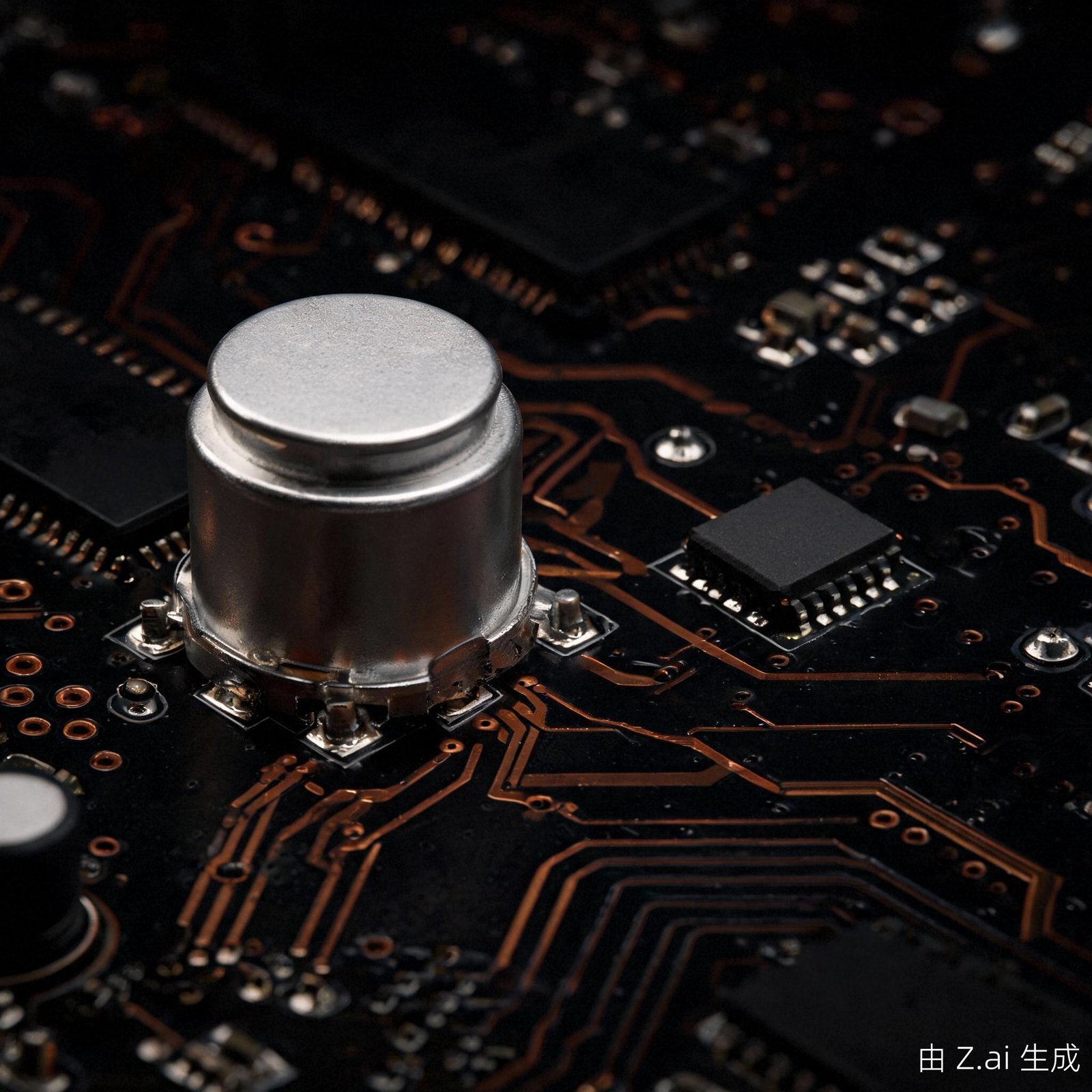
Within quartz XOs, the suffix alphabet describes how each architecture manages drift, and one common confusion is worth clearing first: VCXO is not a stability tier between TCXO and OCXO. VCXO describes voltage-tunable frequency control, a capability that can be combined with any of the compensation architectures.
An SPXO is the baseline: crystal plus driver with no temperature compensation, at the lowest cost, with drift of roughly 10 to 50 ppm across temperature. It suits microcontroller clocking and general digital logic where tens of ppm of wander is irrelevant. A TCXO measures or models temperature-induced frequency change and corrects it, traditionally with a thermistor-varactor network and increasingly with digital compensation around an integrated temperature sensor, tightening stability to roughly 0.5 to 2.5 ppm across an industrial range. That is why GPS receivers and portable communication devices specify TCXOs: they cannot assume a constant temperature. An OCXO holds the crystal in a small heated oven above the highest ambient, isolating it from environmental swings entirely, and reaches parts-per-billion stability at the cost of size, power, warm-up time of minutes, and price. Telecom infrastructure, precision instrumentation, and standalone reference clocks are its home.
A VCXO's output frequency moves across a specified pulling range with a control voltage, the mechanism inside PLLs and clock-recovery circuits, and its underlying stability is whatever base architecture sits beneath the tuning. Combinations such as TCVCXO and OCVCXO are common in telecom and instrumentation catalogs for exactly this reason.
| Architecture | Typical stability | Temperature handling | Frequency adjustment | Main trade-off |
|---|---|---|---|---|
| SPXO | Plus or minus 10 to 50 ppm | None | Normally fixed | Lowest cost, highest drift |
| TCXO | Plus or minus 0.5 to 2.5 ppm | Compensation circuit | Fixed or limited | Higher cost and complexity |
| VCXO | Depends on base architecture | Depends on base architecture | Voltage controlled | Needs a control loop or reference |
| OCXO | Plus or minus 0.001 to 0.05 ppm | Heated internal oven | Fixed, or OCVCXO | Power, size, cost, warm-up time |
Build a Stability Budget, Not a Number Hunt
The most useful selection habit is treating frequency stability as a budget with line items, because a datasheet headline ppm figure usually covers only temperature stability while the system accumulates error from everywhere.
The budget's line items: initial tolerance at assembly; drift across the operating temperature range; supply-voltage variation effects; load variation, which matters most for bare crystals whose load capacitors the designer chose; aging over the product's operating life, typically quoted in ppm per year; and reflow shift, the permanent frequency change the part exhibits after surviving the soldering profile. A part with a tight temperature spec can still drift past expectations once aging and reflow shift are added in. A microcontroller clock may tolerate 50 ppm total without consequence, while a network-synchronization link may need 2.5 ppm or tighter across the whole budget, and the budget, not the datasheet's best-case line, is what decides the architecture.
A second budget runs in parallel for high-speed designs: jitter and phase noise. Frequency stability describes slow drift; jitter describes short-term timing variation, and a part can meet its ppm spec while ruining a high-speed serial link or degrading an RF conversion. Networking equipment, high-speed serial links, and data converters check both budgets independently.
MEMS Versus Quartz: The Modern Competition
MEMS silicon oscillators have moved from curiosity to credible alternative, and the comparison now runs on real numbers rather than novelty. Silicon MEMS resonators are on the order of a thousand times smaller and lighter than quartz crystals, which makes them mechanically far more resilient to shock and vibration, and premium MEMS TCXOs now match quartz TCXO stability while adding programmability: one part configured to any frequency can replace several fixed quartz SKUs, which simplifies inventory and second-sourcing in ways quartz manufacturing, with its frequency-specific crystal cuts, cannot. Failure rates are specified below one defective part per million with mean time between failures in the billions of hours, an order of magnitude or more beyond quartz figures, and hermetic sealing processes protect the resonator from contamination over life. Power matters too: programmable output drive and frequency scaling features cut timing power significantly in battery products, and differential MEMS configurations claim tens of decibels better EMI immunity than quartz.
The honest boundaries: the most demanding RF and test-and-measurement applications still specify high-end quartz OCXOs for femtosecond-class phase noise and long-term aging performance, and lower-performance designs may stay with quartz on unit cost. The practical conclusion for most embedded designs is that MEMS deserves evaluation alongside quartz on every new design, particularly where shock, vibration, miniaturization, or supply-chain simplification weigh anything at all.
Selection Logic by Application
Microcontroller clocking and general logic: SPXO or bare crystal, chosen by whether the design inherits a qualified oscillator circuit; build the stability budget against the MCU's tolerance requirements, which are usually forgiving.
GPS receivers, portable radios, battery-powered communicators: TCXO, because position accuracy and radio link budgets depend on frequency accuracy across outdoor temperature swings, and the 0.5 to 2.5 ppm grade earns its premium. If the system disciplines against an external reference such as GPS itself, a mid-tier TCXO suffices because the reference corrects long-term drift.
PLLs, clock recovery, and frequency synthesis: VCXO on whichever base architecture the loop budget requires, with pulling range and slope linearity as the additional specifications.
Telecom infrastructure, test equipment, standalone references: OCXO, for parts-per-billion stability, holdover performance, and low phase noise, with warm-up time and power accepted as the price. And if the system disciplines against GPS or a network timing source, the earlier rule applies: a TCXO often suffices, because the external reference corrects whatever the TCXO drifts.
Automotive and shock-exposed products: evaluate MEMS alongside quartz, check the qualification standard per part number, because passive crystals typically qualify under AEC-Q200 while active oscillators may carry AEC-Q100, a combination, or the newer AEC-Q104, and assuming from category is a mistake the vendors themselves warn about.
Frequently Asked Questions
What is the difference between a crystal and a crystal oscillator?
A crystal is a passive quartz unit that needs an external oscillator circuit with load capacitors matched to its specification. A crystal oscillator is an active device with the crystal and driving circuit integrated in one package: apply power and it outputs a clock. The oscillator costs more per part but removes the circuit-tuning work and its associated design risk.
What is the difference between a TCXO and an OCXO?
A TCXO electronically compensates for temperature-induced frequency drift, reaching roughly plus or minus 0.5 to 2.5 ppm across an industrial range. An OCXO holds the crystal in a heated internal oven above ambient, reaching parts-per-billion stability, at the cost of higher power, larger size, and a warm-up period of minutes. TCXOs serve portable and GPS equipment; OCXOs serve infrastructure and standalone precision references.
Is a VCXO more accurate than a TCXO?
No, VCXO is not a stability tier. VCXO describes voltage-tunable frequency control, a capability that can be built on any base architecture: uncompensated, temperature-compensated, or oven-controlled. Its accuracy is whatever the underlying architecture provides, so check which base type the part uses rather than reading tunability as precision.
Are MEMS oscillators as accurate as quartz?
High-end MEMS oscillators now match or exceed quartz TCXO frequency stability, with real-time temperature compensation and digital tuning, and they exceed quartz dramatically in shock and vibration resilience, with vendor-specified failure rates an order of magnitude or more lower. The remaining quartz strongholds are ultra-low phase noise and long-term aging at the femtosecond and parts-per-billion extreme, where high-end OCXOs still lead.
What is a stability budget and how do I build one?
A stability budget sums every source of frequency error instead of relying on one headline ppm figure: initial tolerance, temperature drift, supply-voltage variation, load variation, aging over the product's life, and the permanent shift from the reflow soldering profile. Compare the total against the system's real requirement, such as 50 ppm for a microcontroller clock versus 2.5 ppm or tighter for network synchronization.
Why is jitter checked separately from frequency stability?
Frequency stability describes drift over seconds, minutes, and years; jitter describes short-term timing variation cycle to cycle, and the two are specified independently. A part can meet its ppm budget and still generate enough jitter to break a high-speed serial link, degrade an RF conversion, or violate a data converter's clock requirements, so high-speed and RF designs check both specifications.
Sources and Further Reading
- SiTime, "MEMS vs Quartz Crystal Oscillators: Benefits, Reliability & Applications" (MEMS technology comparison and application map): https://www.sitime.com/company/newsroom/blog/mems-vs-quartz-crystal-oscillators-benefits-reliability-applications
- Fly-Wing, "Crystal Oscillator Selection Guide: Types, Specs, and Packages" (architecture grades, stability budget, and sourcing): https://www.flywing-tech.com/blog/crystal-oscillator-selection-guide
- Epson Device Technology, crystal devices for 5G, IoT, and automotive markets: https://www.epsondevice.com/
- NVIDIA Technical Blog, "Building the 800 VDC Ecosystem for Efficient, Scalable AI Factories" (AI infrastructure timing and synchronization context): https://developer.nvidia.com/blog/building-the-800-vdc-ecosystem-for-efficient-scalable-ai-factories/
- Illuminious, "2026 Component Shortage Reality: DRAM Prices Surge as MCU Lead Times Stretch to 40 Weeks" (semiconductor supply context): https://www.illuminious.com/news/2026-component-shortage-dram-mcu
