
Component Market Intelligence | Updated 21 August 2026
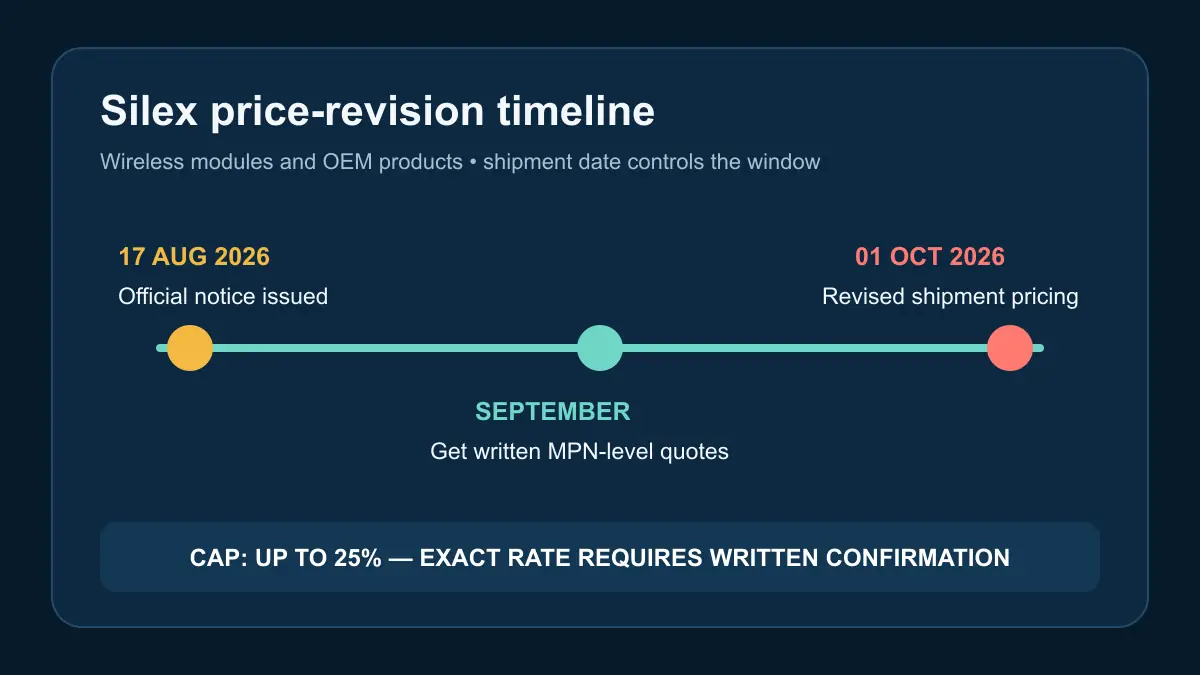
What changed: Silex Technology says pricing for its wireless modules and OEM products will be revised for shipments from October 1, 2026. The adjustment is up to 25%, and the actual rate will be communicated individually by sales. This is not a statement that every module will rise by 25%.
Who should act: Procurement teams with Silex modules on open quotations, scheduled releases, approved vendor lists or 2026–2027 production BOMs should open a price-change review now. Engineering should join only where the confirmed cost exposure could justify qualification work.
What to do next: Build an MPN-level exposure register, separate order date from shipment date, and obtain written commercial terms for every affected requirement. Do not update the PCBA cost, buy extra inventory or start a redesign from the category headline alone.
The decision brief
The Silex notice creates a commercial control problem, not an automatic supply emergency. Buyers need to answer three questions: which exact orderable parts are in current demand, which shipments fall on or after October 1, and what rate applies to each quoted requirement. Until those answers are documented, the program-level cost effect remains unknown.
The useful output is a controlled record that connects the manufacturer notice to actual demand. It should show exact MPN, quantity, supplier, purchase-order status, promised ship date, current unit price, revised unit price, quote expiry and responsible owner. This turns a broad announcement into a set of decisions that purchasing, engineering and program management can review.
What Silex has—and has not—confirmed
The Silex notice dated August 17, 2026 separates standard products from wireless modules and OEM products. The two groups have different public wording and different shipment effective dates.
| Official product group | Published adjustment | Applies to shipments from | Evidence needed for a BOM decision |
|---|---|---|---|
| Standard products | 25% | September 1, 2026 | Confirm that the ordered item belongs to this group before applying the stated rate. |
| Wireless modules and OEM products | Up to 25%; individual rate communicated by sales | October 1, 2026 | Obtain the exact MPN, quantity, shipment window and written revised price. |
Silex attributes the revision to rising costs for SoCs, Wi-Fi chipsets, memory and printed circuit boards. The public notice does not provide a per-MPN old-versus-new price table for wireless modules. It also does not publish a module-specific affected-parts file.
Several conclusions therefore remain outside the evidence. The notice does not establish that every wireless module receives the maximum adjustment. It does not establish that an order placed before October 1 retains the old price if shipment occurs later. Nor does it announce allocation, end of life, last-time buy or a broad product shortage.
Build a BOM exposure register before changing a forecast
A practical review begins with demand data, not the product catalog. Search current BOMs, quotation requests, approved vendor lists and open purchase orders for Silex model strings. Then add the commercial and production fields needed to decide what matters.
| Register field | Why it matters | Common error to avoid |
|---|---|---|
| Exact orderable MPN and suffix | Identifies the commercial configuration that must be quoted | Using only a family name |
| Required and confirmed ship dates | Shows whether the shipment crosses the October 1 boundary | Recording only the purchase-order date |
| Quantity by release | Lets the supplier apply the correct price break and MOQ | Using annual volume as if it were one shipment |
| Open inventory and purchase orders | Prevents double-counting the remaining exposure | Applying a new price to stock already owned |
| PCBA usage and build plan | Connects component pricing to finished-board cost and delivery | Reviewing the component in isolation |
| Customer or engineering approval constraints | Shows whether any substitution would require formal change control | Treating a purchasing cross as an approved replacement |
Once populated, extend the confirmed unit-price difference only across the uncovered quantity. For example, exclude usable inventory and firm releases already covered by an acknowledged price. Keep currency, freight, taxes and assembly overhead separate so that the module change is not confused with other PCBA quotation movements.
Use the 16-model lookup set correctly
The daily intelligence review mapped 16 model names to entries in Silex’s current wireless-module catalog. The set exists to help a buyer search internal BOMs. It is not an official affected-parts list, it is not proof of a final adjustment, and it is not presented as the entire Silex module portfolio.

- Wi-Fi HaLow / SDIO:
SX-SDMAH-R2 - PCIe Wi-Fi:
SX-PCEBE-AP,SX-PCEBE,SX-PCEAX-AP,SX-PCEAX-AP6E,SX-PCEAC-DB,SX-PCEAC,SX-PCEAN2 - Embedded and intelligent modules:
SX-ULPGN,IM-100,IM-100-SB,IM-100-RB,SX-59HLS,SX-590 - Bluetooth and USB:
SX-23BT,SX-USBAC
Official family pages for SX-PCEBE and SX-SDMAH help verify the catalog identity. They do not state the new transaction price. For OEM or customized configurations, the exact project definition is especially important; Silex describes that service scope on its OEM and customization page.
Normalize each supplier quotation before comparing it
A revised unit price is useful only when the surrounding terms are comparable. Ask every supplier to answer the same set of fields, then store the written reply with the exposure register.

- Exact MPN: include every suffix, option and commercial configuration.
- Shipment date: request the date the price applies, not only an estimated lead time.
- Unit price and adjustment: record currency, quantity break and whether the value is current or revised.
- Quote validity: obtain the expiry date and the event that locks the price.
- MOQ and NCNR terms: document minimum quantity, standard pack, cancellation and reschedule restrictions.
- Confirmed lead time: distinguish a supplier commitment from a catalog or factory estimate.
A concise request could read: “Please quote the exact MPN and quantity for the required shipment date, showing currency, unit price, quote validity, MOQ, standard pack, NCNR terms, confirmed lead time and the condition that secures the quoted price.” The request asks for facts without assuming that the ceiling applies.
Choose between timing, acceptance and engineering review
After written quotes arrive, most programs will face one of three decisions.
1. Adjust shipment timing only when demand supports it
An earlier shipment may reduce exposure if the supplier confirms the previous price, but it also increases inventory, cash and forecast risk. Compare the verified saving with carrying cost, storage life, cancellation exposure and the chance that demand changes. A headline should not become a panic-buy instruction.
2. Accept the confirmed change when redesign costs more
Wireless modules often sit inside a broader validation system: host interface, driver, firmware, antenna, enclosure, regulatory certification and production test. If the confirmed program impact is smaller than the cost and schedule risk of requalification, retaining the current design may be the controlled choice.
3. Start an engineering review only with a business case
Where the remaining lifecycle volume makes the price exposure material, engineering can evaluate alternatives. Every cross should remain a candidate that requires validation unless the original manufacturer explicitly identifies it as an approved replacement. Validation may include pinout, voltage and timing, RF performance, antenna requirements, mechanical envelope, firmware and drivers, security maintenance, regional radio approvals, lifecycle status and production-test changes.
For turnkey PCBA programs, record whether the part is customer-specified and whether a change requires end-customer consent. Procurement should not release a substitute merely because it appears similar in a distributor database.
Turn the notice into a verified BOM decision
If your BOM contains a Silex module, share the exact MPN, quantities by shipment, required delivery dates, destination country and current PCBA build plan. We can help organize an updated quotation, consolidate BOM exposure and identify which lines need engineering review. We will keep any proposed alternative at candidate status until your engineering and quality teams approve it.
Request an updated quotation, BOM review or PCBA engineering review. Include traceability, date-code, approved-vendor and customer-approval constraints so the response can be used in a real purchasing decision.
Frequently Asked Questions
Will every Silex wireless module rise by 25%?
No. Silex states that the adjustment for wireless modules and OEM products is up to 25%, with the individual rate communicated by sales. The maximum is not a confirmed MPN-level rate.
Is October 1 based on order placement or shipment?
The public notice refers to shipments from October 1, 2026. Ask the supplier in writing how an earlier purchase order scheduled to ship after that date will be priced.
Did Silex publish the 16 model names as an affected-parts list?
No. The 16 names are a working lookup set mapped from official product pages for BOM searching. The public price notice does not enumerate an affected module list.
Does the notice prove that the modules are in shortage or approaching EOL?
No. The notice is a price-revision announcement. It does not, by itself, establish allocation, shortage, end of life or last-time buy.
When is an alternative-module review worthwhile?
Review candidates after the actual commercial exposure is known and the remaining program volume can justify qualification. No candidate should be released without electrical, mechanical, software, RF, regulatory, lifecycle and production validation appropriate to the product.
Sources
- Silex Technology, official price-revision notice, August 17, 2026.
- Silex Technology, embedded wireless module catalog, independently reviewed August 21, 2026.
- Silex Technology, SX-PCEBE product-family page, independently reviewed August 21, 2026.
- Silex Technology, SX-SDMAH product-family page, independently reviewed August 21, 2026.
- Silex Technology, OEM and customization service page, independently reviewed August 21, 2026.
