
Component Lifecycle Intelligence | 24 August 2026
By Feifei Deng | Updated 24 August 2026
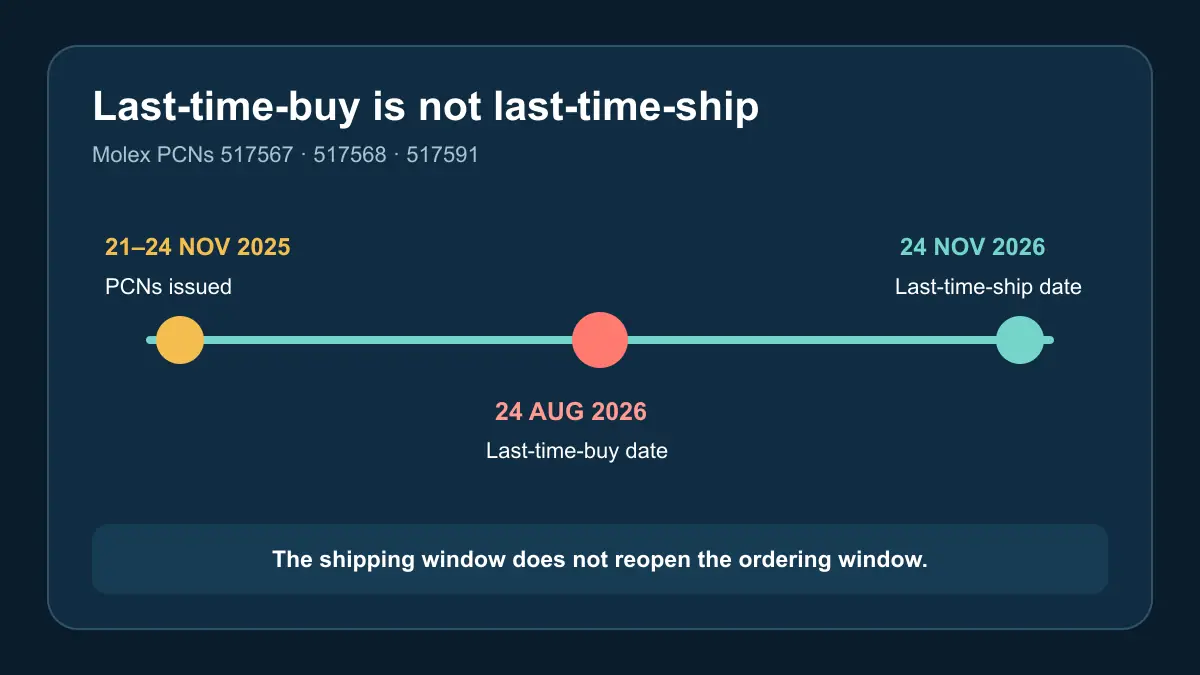
Direct answer: Molex PCNs 517567, 517568 and 517591 all set August 24, 2026 as the last-time-buy date and November 24, 2026 as the last-time-ship date. Our August 24 review contains 102 exact MPN records across the three notices: 45 under 517567, 46 under 517568 and 11 under 517591. Procurement teams should close the final-order decision now, obtain written order acceptance and request the official replacement attachments where available. November 24 is a shipping boundary; it is not an extra three months for placing orders.
The public PCN bodies do not give a complete, directly usable one-to-one replacement map for all 102 records. Any proposed alternative therefore remains a candidate that requires engineering validation. The immediate problem is not simply “find stock.” It is to calculate a defensible final quantity while protecting production, warranty obligations and redesign time.
Facts: what the three Molex PCNs confirm
All three documents are released Molex Product Change Notifications for obsolete parts. PCN 517567 and PCN 517568 were issued on November 24, 2025. PCN 517591 was issued on November 21, 2025.
| PCN | Issue date | Last-time-buy | Last-time-ship | Exact MPN records in our review set | Public replacement guidance |
|---|---|---|---|---|---|
| 517567 | November 24, 2025 | August 24, 2026 | November 24, 2026 | 45 | No directly usable replacement map in the public PDF body reviewed. |
| 517568 | November 24, 2025 | August 24, 2026 | November 24, 2026 | 46 | PDF body directs readers to an attached replacement-parts spreadsheet. |
| 517591 | November 21, 2025 | August 24, 2026 | November 24, 2026 | 11 | PDF body directs readers to an attached replacement-parts spreadsheet. |
Molex also states that after the last-time-ship date it will no longer manufacture the products in each notice and the related tooling will be decommissioned. That wording makes November 24 a real lifecycle boundary. It does not, however, guarantee that every requested final-order quantity will be accepted or that every shipment will arrive at the customer on that date.
Analysis: last-time-buy and last-time-ship are not the same event
The last-time-buy date answers, “By when must the final order decision be submitted?” The last-time-ship date answers, “How late may the manufacturer ship accepted orders?” Those questions sit at different points in the supply process.
A team that waits until November because “shipping continues” may find that the order window is already closed. Conversely, an order placed by the LTB date is not automatically a firm supply commitment. Procurement still needs written confirmation of accepted quantity, price, MOQ, NCNR terms and shipment schedule. If a supplier can accept only part of the requested quantity, that shortage must feed back into the service plan and redesign schedule immediately.
There is another terminology trap: the PCNs say last-time-ship, not customer delivery date. Freight time, consolidation, customs and distributor handling can move physical receipt beyond the manufacturer’s ship date. Build plans should use the confirmed delivery date from the supplier acknowledgement, not substitute November 24 for a dock date.
Judgment boundary: how to use the 102-MPN review set
The dated intelligence report and watchlist contain 102 unique full MPNs connected to the three PCNs: 45, 46 and 11 respectively. This compiled set is useful for screening BOMs and open purchase orders. It should not be represented as a replacement cross-reference published in the visible PDF text.

Start with an exact-string search against approved BOMs, AVL records, MRP demand, service-parts lists and open orders. Preserve leading zeros. A shortened family number can miss a record or create a false match. For each hit, capture the PCN number, end product, quantity per assembly, remaining production volume, service obligation, usable stock and current supplier status.
PCNs 517568 and 517591 direct readers to replacement spreadsheets. Ask Molex or an authorized distributor for the attachment tied to the exact PCN revision. Do not reconstruct a cross from similar product names or assume that two connectors in the same family share footprint, plating, keying or qualification status.
Recommendation: calculate the final quantity from obligations, not fear
A last-time-buy quantity should cover the period until an approved replacement or product retirement, without turning uncertain forecasts into unusable inventory. Use a separate calculation for every exact MPN and program.

Net last-buy quantity = production demand until redesign approval + service demand + justified risk reserve − usable on-hand stock − firm accepted open orders.
- Production demand: use the latest approved build plan through the expected qualification and change-implementation date. Add assembly usage and realistic yield, not an arbitrary percentage.
- Service demand: translate warranty, regulatory and customer-support obligations into annual unit requirements. Separate contractual obligations from optional buffer stock.
- Risk reserve: document the reason for each increment—scrap, incoming rejection, forecast error or field failure. A reserve without a stated basis is difficult to approve and easy to overbuy.
- Usable inventory: count only stock allocated to the program and fit for use. Quarantined, damaged, expired or wrong-revision material should not reduce the requirement.
- Open orders: subtract only quantities the supplier has accepted with a credible shipment schedule. An RFQ, unconfirmed purchase order or marketplace listing is not firm coverage.
Run at least three demand cases—base, downside and extended-service—then show the cash and excess-inventory exposure for each. Management can choose the risk position explicitly instead of hiding it inside a single inflated forecast.
Recommendation: obtain written commercial acceptance
Submitting a final order is only the beginning. The supplier response must be specific enough to support production planning and financial approval. Request the following for every MPN:
- exact MPN and accepted quantity;
- unit price, currency, price validity and any expedite charge;
- MOQ, standard pack and order-multiple rules;
- NCNR, cancellation and reschedule terms;
- confirmed ship schedule and expected delivery schedule;
- date code, packaging, traceability and certificate requirements;
- whether partial acceptance or allocation applies;
- the PCN-specific replacement attachment or written confirmation that no replacement is offered.
Do not let urgency reduce traceability. End-of-life demand often attracts independent and marketplace offers. If an authorized source cannot cover the need, define inspection, authenticity, date-code, packaging, return and warranty requirements before evaluating secondary supply. A low-price listing without verifiable chain of custody is not equivalent to an accepted last-time-buy order.
Recommendation: treat every replacement as a validation project
A spreadsheet cross is a starting point, not an engineering release. Connectors and cable assemblies can differ in contact layout, keying, mating compatibility, plating, current rating, voltage, impedance, shielding, sealing, temperature range, flammability, agency approvals and assembly tooling.
For board-mounted parts, compare the product drawing with the PCB footprint, keep-out, hole pattern, solder process and enclosure stack-up. If the candidate changes land pattern or mechanical alignment, update the Gerber package, assembly drawing, AVL and inspection criteria under formal revision control. For crimped or cabled products, validate terminals, applicators, pull force, wire range and the complete mating system.
Any alternative in a quotation should be labelled candidate / requires validation unless Molex explicitly confirms otherwise and your engineering team accepts the change. The validation plan should name the owner, samples, tests, customer-approval requirement and target release date. Without that plan, the last-buy quantity cannot be tied to a credible redesign finish.
Need help closing the Molex lifecycle gap?
Send the exact Molex MPNs, annual and service quantities, open-order status, destination, required dates and the relevant BOM. For PCBA programs, include the Gerber files, placement data, approved-vendor rules and any customer-controlled specifications. We can help structure an updated quotation, reconcile last-buy coverage and flag candidate replacements that need engineering review.
Request a Molex quotation, BOM review or PCBA engineering review. We will not present an unverified cross as a drop-in replacement.
Frequently Asked Questions
Can we still place a Molex final order during the November shipping window?
Do not assume so. The three PCNs set August 24, 2026 as last-time-buy and November 24, 2026 as last-time-ship. The later shipping date is for accepted orders; it does not extend the stated ordering deadline.
Does November 24 mean the parts will arrive at our factory that day?
No. The notices state a last-time-ship date. Customer receipt depends on the accepted shipment schedule, distributor handling, freight and customs. Use the supplier-confirmed delivery date for production planning.
Are all 102 MPNs listed with replacements in the public PDFs?
No. The 102 count comes from the dated intelligence report and watchlist. The public PDF bodies reviewed do not provide a complete one-to-one map for every MPN; PCNs 517568 and 517591 direct readers to replacement spreadsheets.
How much safety stock should we add to a last-time-buy?
Use a documented reserve tied to yield, scrap, forecast error or field-failure assumptions. Calculate base, downside and extended-service cases, then approve the inventory and cash risk explicitly rather than applying an arbitrary percentage.
Can a distributor-suggested Molex cross be released directly to PCBA production?
No. Treat it as a candidate requiring validation. Check electrical, mechanical, mating, material, environmental, regulatory, tooling, PCB and production-test requirements before changing the AVL, Gerber package or assembly documentation.
Sources
- Molex Product Change Notification 517567, issued November 24, 2025; independently reviewed August 24, 2026.
- Molex Product Change Notification 517568, issued November 24, 2025; independently reviewed August 24, 2026.
- Molex Product Change Notification 517591, issued November 21, 2025; independently reviewed August 24, 2026.
