
Capacitor Technology Selection: MLCC, Tantalum, Aluminum, and Polymer Compared
Keywords: capacitor technology selection, MLCC vs tantalum, tantalum polymer capacitor, aluminum electrolytic lifetime, polymer aluminum capacitor ESR, bulk capacitor derating
Meta Description: MLCC, tantalum, aluminum, or polymer? ESR, derating, lifetime, failure modes, and 2026 supply realities for the bulk-capacitance decision.
The bulk capacitance decision, everything from a few microfarads of local decoupling to millifarads of energy storage on a power rail, spans four competing technologies: multilayer ceramic (MLCC), tantalum, polymer, and wet aluminum electrolytic. Each occupies a position in the trade space of ESR, volumetric efficiency, lifetime, failure mode, and cost, and choosing wrong shows up as either a field failure or a bill of materials that costs more than it should. This guide compares the technologies on the parameters that actually decide designs and maps the selection onto real rail types.
The Four Technologies at a Glance
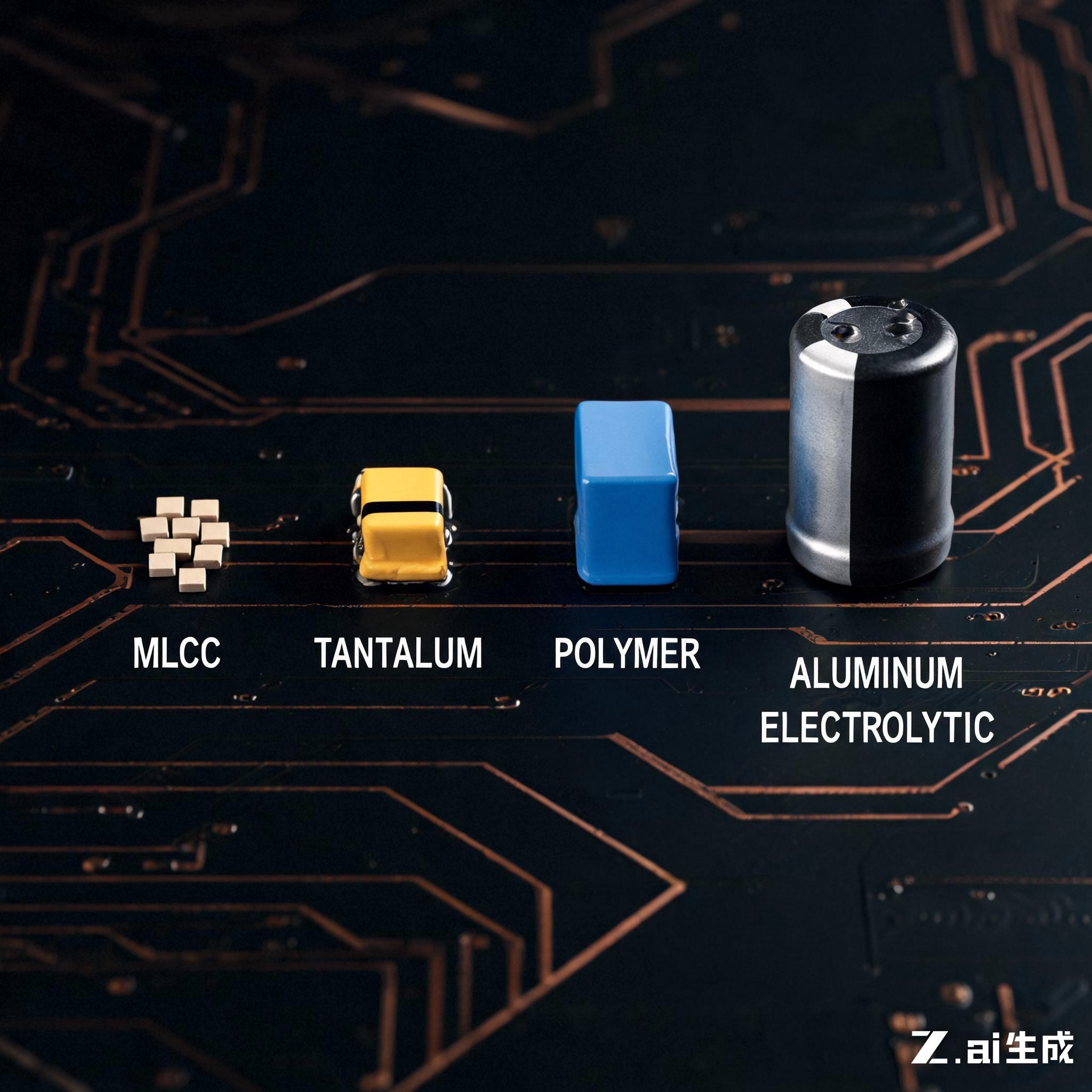
The chemistry name refers to the anode material plus how the cathode contact is made, and that physical detail drives every electrical and lifetime number.
Wet aluminum electrolytic uses etched aluminum foil with an aluminum-oxide dielectric and a liquid electrolyte as cathode contact: cheapest per microfarad and highest capacitance per volume in absolute terms, but with unimpressive ESR, polarity, and an electrolyte that dries out over life. Polymer aluminum replaces the wet electrolyte with a solid conductive polymer, typically PEDOT, dropping ESR by roughly an order of magnitude and eliminating dry-out. Tantalum sints tantalum metal into a porous pellet with a tantalum-oxide dielectric, contacted either by manganese dioxide (the legacy chemistry) or by conductive polymer; its signature is volumetric efficiency at moderate ESR. MLCC, covered in depth in our dielectric guide, remains the high-frequency default: lowest ESR, smallest at low voltages, non-polarized, and immune to dry-out, with Class 2 derating behavior as its main caveat.
| Parameter | MLCC (X7R) | Ta MnO2 | Ta polymer | Al polymer | Al wet |
|---|---|---|---|---|---|
| ESR at 100 kHz, 100 uF class | A few mOhms | About 75 mOhms | About 9 mOhms | About 12 mOhms | About 150 mOhms |
| Voltage derating rule | Bias-curve based | 50 percent of rating | About 40 percent | 80 percent | 80 percent |
| Endurance at rated temp | Effectively unlimited | 2,000 h at 125 C | 2,000 h at 125 C | 5,000 h at 105 C | 1,000-2,000 h at 105 C |
| Failure mode | Value drift, cracking | Short, ignition risk | Short, benign | Open | Open, dry-out |
| Polarized | No | Yes | Yes | Yes | Yes |
Ceramic: The High-Frequency Default, With Limits
MLCCs have been replacing electrolytics in smoothing and decoupling applications as capacitance values climb, and the advantages are structural: smaller size and lower profile, reduced ripple voltage because output ripple tracks ESR directly, and improved reliability because self-heating falls. The self-heating math is unforgiving to the old technologies: dissipated power equals ESR times the square of the ripple current, so a part with an order of magnitude lower ESR heats an order of magnitude less for the same ripple, and since electrolytic lifetime roughly halves for every 10 degrees C of operating temperature, that thermal difference compounds directly into service life. Notably, adding capacitance is the weak lever: measurements across 47, 100, and 330 microfarad aluminum parts show ripple voltage falling only marginally as capacitance rises, because ESR dominates the ripple equation.
The limits come with the physics. Class 2 ceramics lose capacitance under DC bias and age, so the nameplate value is a starting point, not a guarantee, and the bias curve must be checked at the actual operating voltage. Low ESR itself can backfire: a converter's feedback loop tuned around a higher-ESR electrolytic can oscillate when the output capacitor changes to an MLCC, requiring phase-compensation review, and parallel MLCCs with different self-resonant frequencies can form anti-resonance impedance peaks that degrade noise rejection. None of these are disqualifiers; all of them are checks.
Aluminum Electrolytic: The Bulk-Reservoir Workhorse
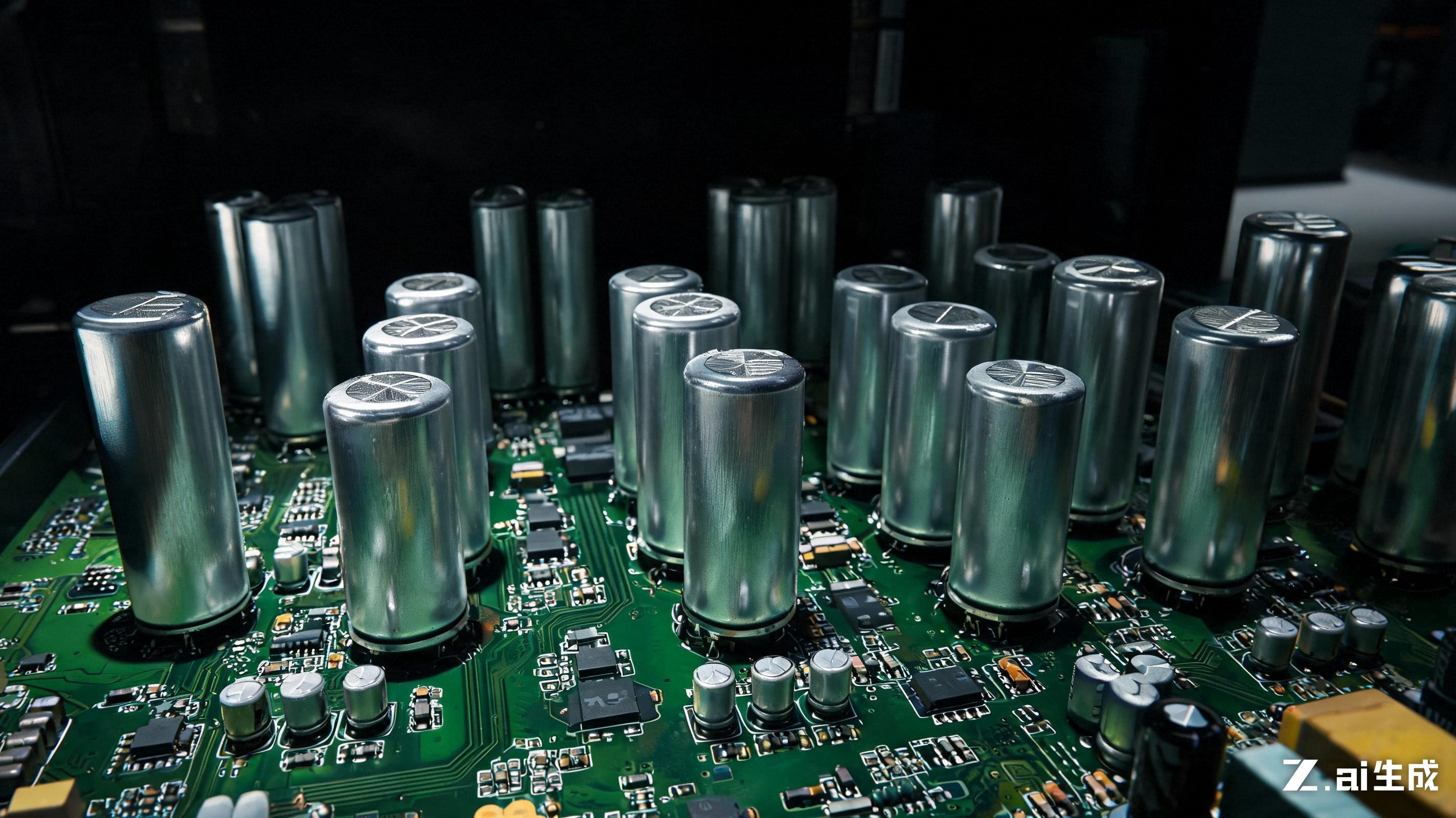
Wet aluminum remains the cheapest capacitance per microfarad and dominates the bulk rails of AC-DC supplies, drives, and anything with a DC-link stage. Its cost position is unbeatable where the microfarad count is high and the frequency demands are low, and its oxide layer self-heals after mild overvoltage events, a genuinely useful property.
Its costs are equally structural. The wet electrolyte evaporates over life, following the Arrhenius law: every 10 degrees C increase halves service life, so a 2,000-hour-at-105-degrees part runs roughly 32,000 hours at 65 degrees, about 3.6 years of continuous operation, marginal for a 10-year industrial product running hot. The part is polarized, and reverse voltage raises internal pressure to destruction. Large ESR means high ripple-driven self-heating, and both capacitance and ESR swing substantially at low temperature, which matters for cold-crank and outdoor applications. Snap-in and screw-terminal formats take the technology into high-ripple DC-link and inverter territory where no other chemistry competes on cost.
Tantalum and Tantalum Polymer: Efficiency With Rules
Tantalum's killer feature is volumetric efficiency: a 100 microfarad, 16-volt legacy tantalum fits a case a fraction the size of the equivalent wet aluminum, which is why tantalum owns space-constrained bulk sockets. It has no electrolyte to dry out, so endurance is bounded by dielectric integrity rather than wear-out, with 2,000-hour ratings at 125 degrees C, effectively a use-until-something-else-fails part in cooler service.
The discipline is derating. Tantalum fails short, and in the legacy manganese-dioxide chemistry that failure can ignite, a small but real fire risk that is why the industry rule is 50 percent voltage derating on any normal rail: a 12-volt rail demands at least a 25-volt-rated part, with conservative designs using 35 volts, and higher-voltage parts cost and size up accordingly. Polymer-cathode tantalum is more benign on failure and roughly 8 times lower in ESR than the legacy chemistry at the same capacitance-voltage product, with derating relaxed to around 40 percent, but the surge sensitivity underlying the rule persists. Swaps between the chemistries are not drop-in: surge response, ripple rating, and failure behavior all differ, and converter loop response plus surge testing must be re-run.
Polymer Aluminum: The Middle Path
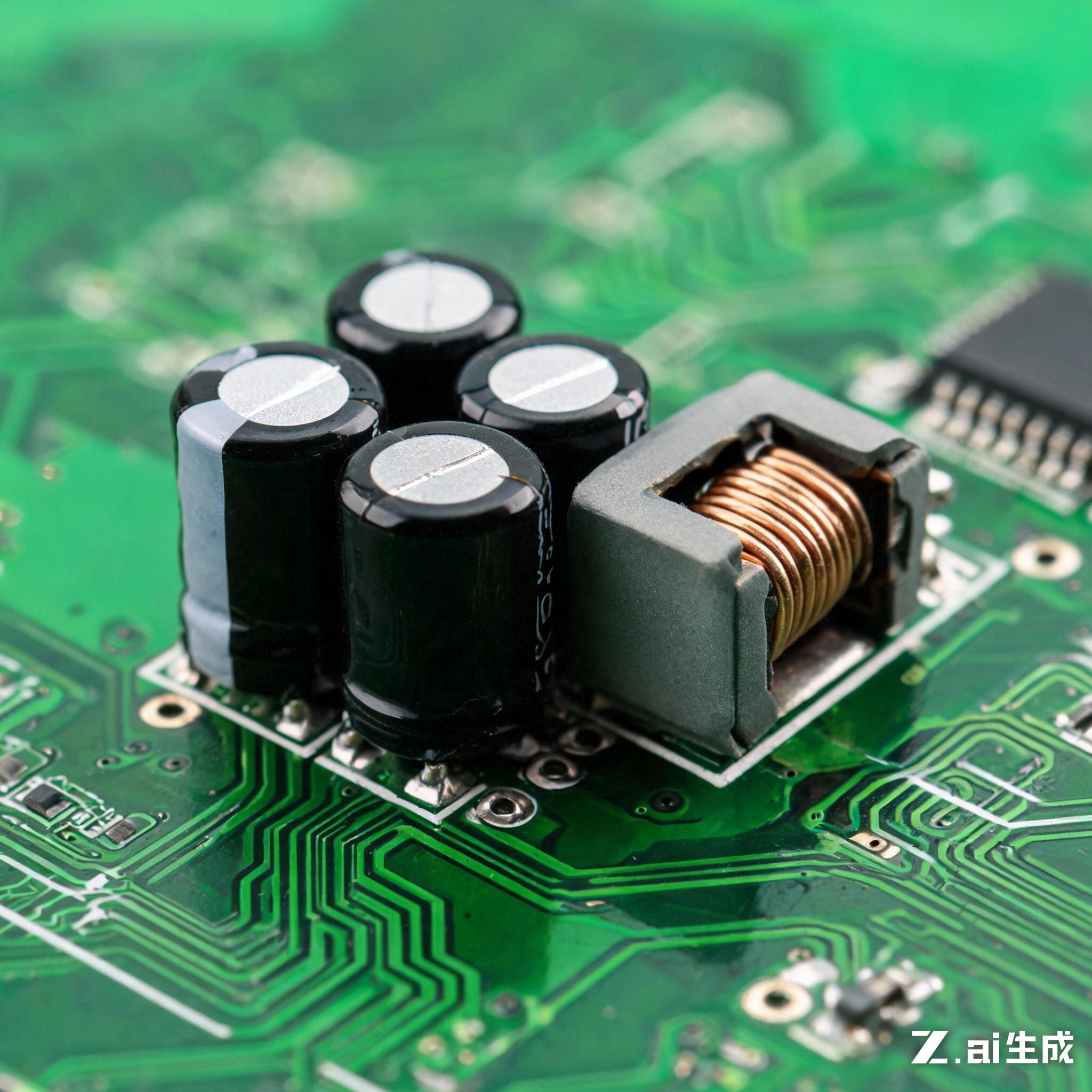
Polymer aluminum takes the same oxide dielectric as wet aluminum and substitutes the conductive polymer cathode, cutting ESR by roughly a decade, raising ripple current ratings several-fold at the same size, and removing the dry-out failure mode entirely: endurance ratings of 5,000 hours at 105 degrees C against 1,000 to 2,000 for equivalent wet series, with the lifetime curve flattening above roughly 70 degrees ambient. Failure mode is open circuit, which suits designs that can tolerate a degraded rail more gracefully than a short.
The caveats: polymer parts cost more per microfarad and run slightly larger than wet equivalents, and the ESR drop changes converter loop compensation in some regulators, so a wet-to-polymer swap needs the same stability review as a swap to MLCC. Where a design is paralleling three or more wet aluminum capacitors purely to meet a ripple-driven temperature budget, one polymer aluminum frequently does the job at lower assembled cost and less board area.
Selection Logic by Rail
| Rail or socket | Default winner | Why |
|---|---|---|
| Point-of-load 5 V to 1.2 V buck output | Ta polymer or MLCC | ESR and size dominate |
| 12 to 24 V industrial bulk decoupling | Al polymer | ESR plus lifetime, tantalum second |
| 48 V AC-DC bulk reservoir | Wet aluminum | No other chemistry reaches the microfarads per dollar |
| Automotive 14 V cold-crank | Ta polymer or Al polymer | Wet aluminum struggles with AEC-Q200 cycling |
| Audio signal path | MLCC (C0G) or film | Microphonics and loss |
| High-ripple DC-link, inverters | Wet aluminum, snap-in | Ripple handling per dollar |
The meta-rule from working designs: when ripple-driven heating forces more than about three wet aluminum parts in parallel, redo the math with a single polymer part, because the per-microfarad cost advantage of the wet chemistry usually evaporates once assembly, area, and lifetime enter the calculation.
Supply and Procurement in 2026
Two 2025 events bent the bulk-capacitor market into 2026. Tantalum mining disruptions drove spot prices up roughly 30 percent, and tantalum capacitor pricing followed with an 8 to 14 percent increase in early 2026, with polymer tantalum absorbing less of the increase because polymer-cathode parts use less tantalum metal per microfarad. Meanwhile AI server power supply and EV onboard-charger production consumed Japanese wet-aluminum capacity, stretching lead times on major series past 26 weeks with allocation, while polymer aluminum capacity held healthier 12 to 18 week positions. Chinese wet-aluminum brands fill cost-sensitive consumer demand at shorter lead times but rarely cross-qualify into automotive or telecom bills of materials without re-validation. Tantalum buyers also carry conflict-minerals obligations: tantalum is one of the four 3TG metals under the OECD due-diligence guidance, and sourcing from manufacturers that publish annual CMRT disclosures matters for customers subject to the SEC and EU conflict-minerals rules.
Frequently Asked Questions
When should I use a tantalum polymer capacitor instead of an aluminum electrolytic?
When board area matters more than unit cost, when ripple-driven heating forces you to parallel three or more wet aluminum parts, or when operating temperature pushes wet-aluminum lifetime below your product's service life. Polymer tantalum's roughly 8 times lower ESR versus legacy tantalum and vastly lower ESR versus wet aluminum at 100 kHz means one part often replaces a whole bank.
Why do tantalum capacitors need 50 percent voltage derating?
Tantalum dielectric is surge-sensitive and fails short; in legacy MnO2 chemistry the failure can ignite the cathode. The industry rule of 50 percent derating in normal operation brings field failure rates into the acceptable range, so a 12-volt rail needs at least a 25-volt part. Polymer tantalum allows roughly 40 percent derating but the rule still applies on higher-voltage rails.
Can I replace an aluminum electrolytic with an MLCC one for one?
Increasingly yes at low and medium voltages, with real benefits in size, ripple, self-heating, and lifetime, since MLCC self-heating scales with ESR and their lifetime is not Arrhenius-limited by electrolyte dry-out. But check the DC-bias capacitance curve at your operating voltage, review the converter's loop compensation because very low ESR can destabilize a loop tuned for a higher-ESR electrolytic, and watch for anti-resonance when paralleling MLCCs of different values.
Is polymer aluminum a drop-in replacement for wet aluminum?
Often for capacitance, never automatically for behavior. Polymer aluminum has much lower ESR, which improves ripple but changes loop compensation in some buck regulators, no leakage rise over life, and an open-circuit failure mode instead of dry-out. Re-verify loop response and surge behavior before swapping, especially in regulators that rely on the capacitor's ESR for stability.
Which capacitor technology lasts longest?
MLCC and tantalum are effectively wear-out-free: tantalum has no electrolyte to lose and carries 2,000-hour ratings at 125 degrees C, while MLCC lifetime is limited by mechanical and bias-related effects rather than dry-out. Polymer aluminum raises wet-aluminum endurance from 1,000-2,000 hours at 105 degrees to about 5,000. Wet aluminum remains the shortest-lived technology and its Arrhenius curve means every 10 degrees C of operating temperature halves its life.
Are tantalum capacitors affected by conflict mineral rules?
Yes. Tantalum is one of the four 3TG metals regulated under the OECD due-diligence guidance, and SEC Rule 13p-1 plus the EU Conflict Minerals Regulation require origin reporting for affected customers. Western manufacturers publish annual CMRT disclosures naming their smelters; not all brands do, so make CMRT availability part of the sourcing decision when reporting obligations apply.
Sources and Further Reading
- Cosolvic, "Tantalum vs Aluminum vs Polymer Capacitor Guide" (ESR numbers, derating rules, lifetime math, 2026 supply and lead times): https://cosolvic.com/blog/tantalum-vs-aluminum-vs-polymer-capacitor-selection-2026
- TDK, "Replacing Electrolytic Capacitors with MLCCs" solution guide (feature comparison, self-heating equation, oscillation and anti-resonance cautions): https://product.tdk.com/en/techlibrary/solutionguide/mlcc_replace-guide.html
- TDK Tech-Mag, "Electrolytic Capacitors" primer (Arrhenius lifetime, polarity, self-healing, temperature behavior): https://www.tdk.com/en/tech-mag/electronics_primer/10
- Utmel, "Ceramic Capacitor Dielectrics Explained: C0G, X7R, Y5V" (MLCC class behavior and derating context): https://www.utmel.com/blog/categories/capacitors/what-are-the-types-and-dielectric-of-ceramic-capacitors
- All About Circuits, "X7R, X5R, C0G...: A Concise Guide to Ceramic Capacitor Types" (ceramic code system and volume efficiency): https://www.allaboutcircuits.com/technical-articles/x7r-x5r-c0g...-a-concise-guide-to-ceramic-capacitor-types
