
The short answer: Bourns released five custom magnetic components on September 30, 2026 for Texas Instruments’ TIDA-010938 GaN string-inverter and battery-energy-storage reference design. The affected teams are power-conversion engineers, component engineers, buyers and contract manufacturers considering MAG-3002411, MAG-3002515, MAG-3002516, MAG-3002933 or MAG-3002432. Treat all five as engineering-sample candidates, not production-ready stock: freeze the TI design revision, request separate written quotations for each full MPN, and validate electrical, thermal, EMI, insulation and manufacturability requirements before any BOM release.
What changed on September 30
Bourns added five full part numbers to its 2026 new-product list under a release for single-phase string-inverter and battery-energy-storage applications. The manufacturer’s dated new-products index identifies the release date as September 30, 2026 and lists all five MPNs individually. The accompanying Bourns IC26148 release bulletin maps each device to a specific role in TI’s reference design and says the components are available as engineering samples.
That distinction matters. A sample program can support design evaluation, but it does not establish regional inventory, MOQ, packaging, production lead time, price breaks, change-control terms or a committed ramp date. None of those commercial fields was published in the reviewed primary material. Buyers should therefore record “contact for quote” rather than entering a guessed cost or lead time, and engineering should keep the parts behind a validation gate.
TI’s current TIDA-010938 reference-design page describes a 10 kW GaN-based single-phase string inverter with bidirectional battery power conversion. It includes two PV string inputs, a battery port and a configurable grid converter. That architecture explains why the five magnetics are not a simple family of interchangeable inductors: they sit in different current paths and solve different energy-storage or noise-control problems.
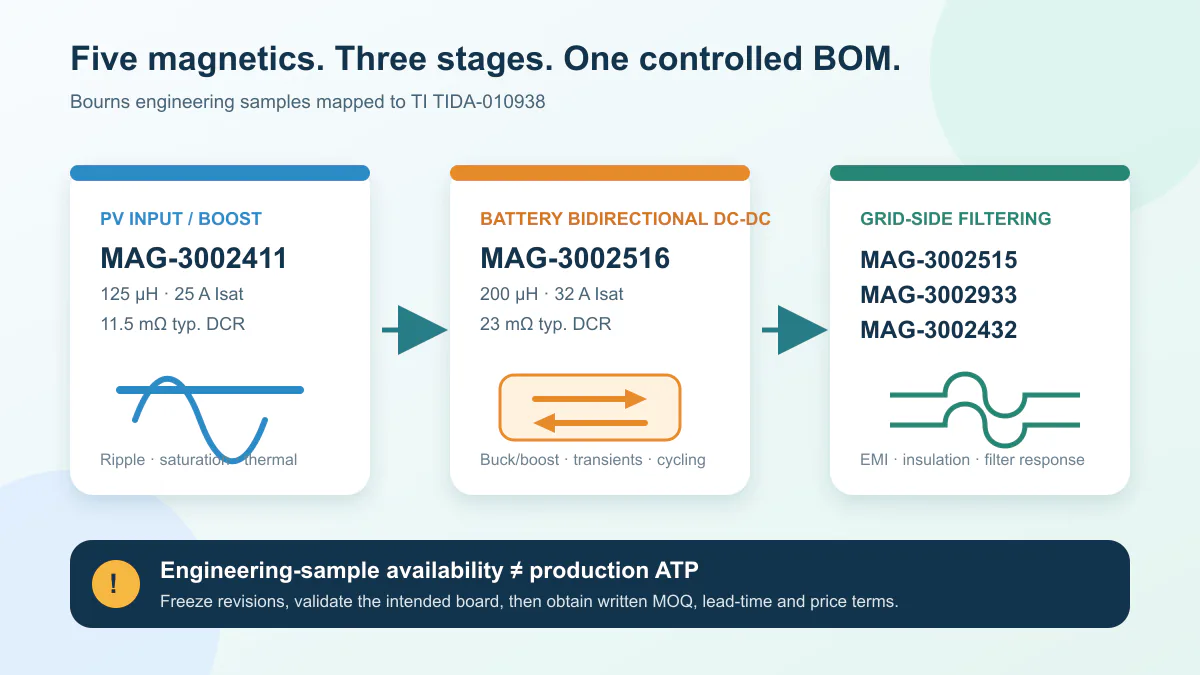
Five MPNs, five different jobs
The safest BOM treatment is one line per full MPN, with the function and qualification evidence attached to that line. Do not shorten the numbers to a “MAG-3002xxx” family label, and do not infer equivalence from similar physical appearance or from a shared reference-design association.
| Exact MPN | Published role | Key published values at 25°C | First validation focus |
|---|---|---|---|
MAG-3002411 |
PFC/boost inductor for the PV DC-DC stage | 125 µH nominal, ±10%; 120 µH typical at 20 A; 25 A saturation current; 11.5 mΩ typical DCR | Ripple-current margin, core loss, temperature rise and saturation across the operating envelope |
MAG-3002515 |
Multiwinding EMI-filter inductor for the DC-AC output stage | 25 µH nominal; 22 µH typical at 35 A; ±10%; 35 A saturation current; 5.0 mΩ typical DCR | Common- and differential-mode attenuation, winding balance, conducted emissions and thermal performance |
MAG-3002516 |
Inductor for the bidirectional battery DC-DC stage | 200 µH nominal; 182 µH typical at 23.5 A; ±10%; 32 A saturation current; 23 mΩ typical DCR | Buck/boost energy transfer, current ripple, transient saturation and charge/discharge thermal cycling |
MAG-3002933 |
Two-phase common-mode choke | 4 mH nominal, ±35%; 12 mΩ maximum DCR; 2.5 kVAC for 60 seconds; −40°C to +125°C | Insulation plan, hipot procedure, leakage, common-mode attenuation and creepage/clearance integration |
MAG-3002432 |
Split-configured inductor for the inverter/filter stage | 90 µH nominal; 87 µH typical at 25 A; ±10%; 35 A saturation current; 13 mΩ typical DCR; 1 kVAC for 1 second | Split-inductor implementation, filter response, current sharing, insulation and temperature rise |
These values are useful screening inputs, not a complete approval record. The bulletin itself directs readers to the official datasheets or Bourns for additional details and notes that custom configurations are possible. A project-specific candidate may therefore differ from the public sample configuration. Require a controlled drawing, revision identifier and written confirmation of the quoted configuration before a PCBA build is treated as representative of production.

Resolve the document-version mismatch before freezing the BOM
Independent readback found a material document-alignment issue. The Bourns September 30 bulletin describes an 80–500 V battery range, up to 7.2 kW from the string inputs to storage and up to 3.6 kW into a 230 V grid connection. TI’s current TIDA-010938 page instead states a 50–500 V battery range, up to 10 kW from the strings to the BESS and up to 4.6 kW into a 230 V grid connection. The TI page also shows multiple output configurations and dates its current Rev. C design guide July 20, 2026.
The final page of the Bourns bulletin also says the components were validated in a high-power “STMicroelectronics” reference-design platform, even though the rest of the release repeatedly names Texas Instruments TIDA-010938. That isolated line conflicts with the document title and body. It should be treated as a documentation discrepancy requiring manufacturer clarification, not as evidence of a second validated platform.
The engineering consequence is straightforward: do not merge these statements or choose whichever rating is more convenient. Put the exact TI design-guide revision, board revision, operating configuration and Bourns drawing revision on the qualification cover sheet. Ask Bourns to confirm which TIDA-010938 configuration and revision supported each sample’s validation. Until that answer is documented, the five parts remain candidates that require validation.

A practical qualification and sourcing plan
- Lock identities and revisions. Create five independent BOM lines. Record the full MPN, Bourns drawing revision, TI design-guide revision, board variant, application stage and source-document date. Ask whether the sample label and future production label will remain identical.
- Request an updated quotation for each MPN. The RFQ should state target region, annual and pilot quantities, required sample quantity, packaging, lot traceability, MOQ, price breaks, sample lead time, production lead time, change-notification terms and the transition path from engineering sample to production.
- Define electrical pass/fail limits. Use the public values only as a starting point. Confirm the relevant test current, frequency, temperature, tolerance and saturation-drop definition. For the two filter parts, include conducted-emissions limits; for the common-mode choke and split inductor, include the project’s insulation and hipot requirements.
- Run thermal and functional testing on the intended PCBA. Measure winding and core temperature rise under minimum, nominal and maximum input conditions, both battery power-flow directions where applicable, overload transients and the intended cooling arrangement. Check that layout and nearby heat sources match the production design.
- Close the manufacturing evidence. Confirm footprint, keep-outs, mass, mounting process, soldering exposure, handling, incoming inspection and traceability. If an alternate is proposed later, treat it as a candidate that requires validation unless the original manufacturer explicitly establishes equivalence.
- Release only against written production terms. Engineering-sample success is necessary but not sufficient. The final sourcing decision needs an approved technical file plus a supplier quotation that names the same controlled part configuration.
If your team is evaluating these parts, send the exact five-line BOM, target volumes, board stage and required test evidence through our electronic components sourcing page. Informic can help structure the manufacturer RFQ, updated quotation and engineering review; it cannot replace the component qualification or finished-product compliance work.
Facts, judgment and recommendation boundaries
Verified facts: Bourns’ dated index and release identify the five exact MPNs and their reference-design roles. The bulletin publishes the electrical values summarized above and labels the parts as engineering samples. TI’s current page describes TIDA-010938 as a 10 kW GaN-based single-phase string-inverter/BESS reference design and publishes the current system figures cited here.
Engineering judgment: The differences between the Bourns bulletin and TI’s current page create revision-control risk. This is an interpretation of conflicting primary documents, not a manufacturer statement that either document is wrong.
Recommendations: Separate RFQs, controlled revisions, application testing and written production terms are risk-management actions. They are not claims of shortage, rising demand, available stock or a guaranteed production schedule. No public ATP, MOQ, lead time or comparable price history for these custom samples was found in the allowed evidence set.
Frequently Asked Questions
Are the five Bourns MAG parts available for production orders now?
The reviewed Bourns bulletin says they are available as engineering samples. It does not publish production ATP, MOQ, packaging, production lead time or price. Request written production terms for each full MPN.
Can MAG-3002411 and MAG-3002432 be treated as interchangeable PFC inductors?
No. They have different nominal inductance, loaded-inductance points, DCR values, roles and structures. Any substitution is a candidate that requires circuit, thermal, mechanical and compliance validation unless Bourns explicitly establishes equivalence.
Which system specification should a qualification plan use?
Use the exact controlled TI design-guide and board revision selected by the project. The public Bourns bulletin and current TI page contain different system-level ranges and power figures, so the project should obtain written alignment before freezing limits.
Does inclusion in TIDA-010938 mean the part is approved for every inverter or BESS?
No. A reference-design association does not approve a component for every topology, environment, safety standard or production process. Validate the part in the intended product and operating envelope.
What should a useful RFQ include?
Include the full MPN, target region, sample and annual quantities, controlled drawing revision, packaging, traceability, MOQ, price breaks, sample and production lead times, change-notification terms and required qualification documents.
Sources
- Bourns IC26148 — custom magnetics for single-phase string inverter and battery energy storage applications, issued September 30, 2026; verified October 1, 2026.
- Bourns New Products index, showing the September 30, 2026 release and all five full MPNs; verified October 1, 2026.
- Texas Instruments TIDA-010938 reference-design page, current architecture, operating ranges and documentation revision; verified October 1, 2026.
