
If you are sourcing PCBs for smart electricity meters, the surface finish question is usually the first point where procurement and engineering start to talk past each other. We are Informic, and we coordinate turnkey PCBA programs across Europe. In our daily work, we see that a clear, direct answer on surface finish saves you at least one round of quotation revisions and prevents delivery delays. Here is that direct answer: for most smart electricity meter designs, we recommend ENIG (electroless nickel immersion gold) as the default, with immersion tin as a cost-conscious alternative for non-critical, lower-layer boards. That is our starting point, not a universal law. Your specific meter’s communication module, current sensing circuits, and environmental sealing will influence the final call.
This article is written from our perspective as the coordinator between your BOM, your layout files, and the board house. We will walk through the practical decision points, the RFQ details that matter, and the DFM checks we run before we send you a final quotation. No invented test data, no fake certifications. Just the operating questions we ask every week for European utility-grade metering projects.
Why surface finish is a purchasing issue, not only an engineering detail
When we receive a request for quotation (RFQ) for a smart meter PCBA, the surface finish is often listed as a single line: “ENIG” or “HASL”. But that line drives cost, lead time, and long-term reliability in ways that are not always obvious. For a procurement buyer, the finish affects three things you care about: unit price, supplier lead time, and field failure risk. We have seen projects where a finish change reduced board cost by 8%, but also projects where the chosen finish caused intermittent failures in high-humidity environments. Our job is to make that trade-off visible before you commit.
Here is a simple way to think about it. The surface finish is the final metallic coating on the copper pads. It exists to prevent oxidation and to provide a solderable surface. For a smart electricity meter, which may sit in an outdoor cabinet for 15 years, the finish must also withstand temperature cycling and occasional condensation. That is a different requirement than a consumer gadget that lasts two years.
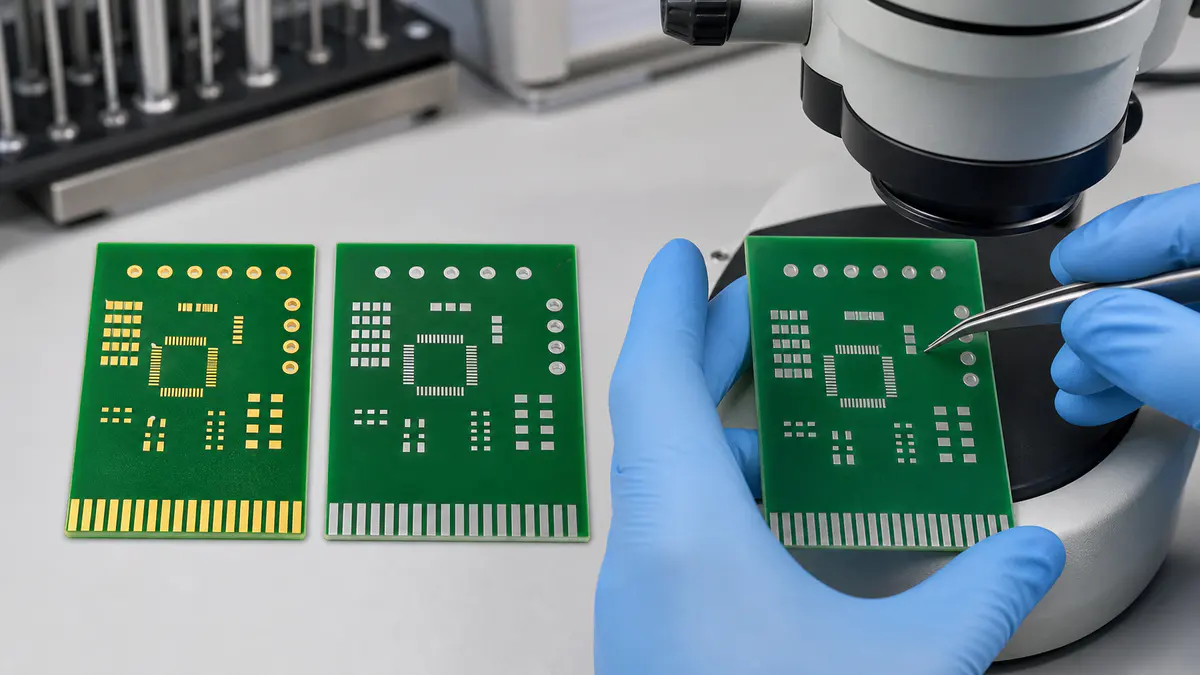
The three finishes we evaluate for every smart meter project
We do not evaluate exotic finishes unless your design specifically requires them. For European smart metering, we focus on three options. The table below summarizes our practical comparison. Use it as a starting point for your internal discussion.
| Finish | Typical use in smart meters | Solderability | Cost relative to HASL | Lead time impact |
|---|---|---|---|---|
| HASL (hot air solder leveling) | Low-cost, non-critical power supply boards | Good, but uneven for fine-pitch | Baseline (1.0x) | None |
| ENIG | Main meter board, communication modules, sensor interfaces | Excellent, flat pads for SMD | 1.3x – 1.5x | +2 to 4 days |
| Immersion tin | Secondary boards, simple relay drivers | Good, but shelf life is shorter | 1.1x – 1.2x | +1 to 2 days |
Table note: Cost and lead time are relative ranges we observe in European board house quotations as of 2025. They are not fixed prices. Your specific layer count and board size will shift these numbers.
Our RFQ checklist for surface finish
When you send us a request for a smart meter PCBA, we do not simply take the finish from your BOM. We ask five specific questions. Your answers help us coordinate with the board house and avoid re-spins.
- What is the minimum pitch on the board? If you have components below 0.5mm pitch, HASL is not viable due to uneven pads. We will push for ENIG.
- Are there any edge connectors or contact pads? ENIG is preferred for gold contact areas. Immersion tin is not suitable for repeated mechanical contact.
- What is the expected field lifetime? For meters expected to last 10+ years, we recommend ENIG due to its better resistance to corrosion and intermetallic growth.
- Is there a high-frequency communication module (e.g., PLC or RF)? ENIG provides a more consistent surface for impedance control. Immersion tin can introduce slight variations.
- What is your target cost delta? If the cost difference between ENIG and immersion tin is a hard constraint, we will review the layout to see if tin can be used on non-critical sections. But we will never compromise the main metering ASIC pads.
We include these questions in our initial quote request form. It takes you two minutes to answer, and it prevents a week of back-and-forth later.
DFM checks we run before we send your quotation
Once we have your Gerber files and BOM, our engineering coordinator runs a design for manufacturability (DFM) review. This is where surface finish issues often surface. Here are the concrete checks we perform, and how they relate to your purchasing decision.
- Pad geometry vs. finish thickness: ENIG adds about 3-6 microns of nickel and 0.05-0.1 microns of gold. We check if your pad openings account for this. If not, solder paste volume may be insufficient for fine-pitch parts.
- Via-in-pad coverage: If you have vias in pads, ENIG is mandatory. HASL cannot fill the via consistently. Immersion tin can cause voids. We flag this immediately.
- Mixed finishes: Some designs use ENIG on the top layer and immersion tin on the bottom to save cost. This is possible, but it complicates the board house process. We verify that the supplier can handle selective finishing without extra tooling charges.
- Shelf life alignment: Immersion tin has a shorter shelf life (typically 6 months) than ENIG (12 months). We check your project timeline. If you plan to store boards for more than 6 months, we will recommend ENIG.
These checks are part of our standard pcbManufacturing coordination service. We do not charge extra for this review. It is how we have reduced quotation errors for our European clients by a measurable margin.
BOM-level considerations for surface finish
The surface finish is not isolated from your component choices. During our BOM review, we look for specific part types that interact poorly with certain finishes.
Electrolytic capacitors: In smart meters, these are often through-hole. The finish on the pads matters less, but the solder joint quality is affected by the finish’s flatness. ENIG gives a more consistent joint.
Shield cans and RF modules: These often require a solderable surface on the PCB for the can’s attachment. ENIG provides a reliable surface. Immersion tin can oxidize before the reflow step if the board has been stored too long.
Battery holders and connectors: If the connector is press-fit, the finish on the plated hole is critical. ENIG is preferred because it provides a harder, more uniform surface than immersion tin.
We also check the components on your BOM for any that have specific soldering temperature requirements. ENIG can tolerate higher reflow temperatures than immersion tin. If your board has lead-free assembly with a high peak temperature, ENIG is safer.

Practical recommendation for your next smart meter RFQ
Here is our straightforward advice. For the main metering board, use ENIG. It is the safest choice for long-term reliability, fine-pitch components, and good solderability. For secondary boards that do not contain the metering ASIC or communication module, consider immersion tin if you have a strict cost target. But be aware of the shelf life limitation.
If you are unsure, send us your layout and BOM. We will run a quick DFM review and give you a clear recommendation within one business day. We do this as part of our pcba coordination service. There is no obligation, and we will not push you toward a more expensive finish if it is not needed.
We also recommend that you include the following line in your internal RFQ template: “Surface finish must be specified and confirmed by the PCBA coordinator. No substitution without written approval.” This simple sentence prevents the board house from switching to a cheaper finish without your knowledge, which could cause field failures later.
What we do not do
We do not claim that ENIG is the best finish for every possible application. We do not have proprietary test data that proves one finish is superior. We rely on industry standards and our daily coordination experience. We also do not recommend finishes based on what gives us the highest margin. Our coordination fee is fixed, so our interest is in getting your project right the first time.

FAQ: Surface finish for smart meter PCBs
1. Can we use HASL for a smart meter main board if the components are all above 0.5mm pitch?
Technically yes, but we advise against it for the main board. Smart meters are often placed in unheated outdoor cabinets. HASL’s uneven surface can create micro-voids in solder joints over time, especially under thermal cycling. The cost savings of HASL (about 20-30% vs. ENIG) is not worth the risk of field failures that could require a full meter replacement. For secondary boards with simple circuitry, HASL can be acceptable.
2. What is the typical lead time difference between ENIG and immersion tin in Europe?
Based on our current supplier network, ENIG adds 2 to 4 working days to the standard PCB fabrication lead time. Immersion tin adds 1 to 2 days. This is because ENIG requires an additional electroless nickel process and a more controlled gold bath. If you are working with a tight project deadline, we can sometimes parallelize the finish process with other fabrication steps, but that requires early planning. We always ask for your target delivery date at the RFQ stage.
3. Does the surface finish affect the impedance of the communication module traces?
Yes, it can. ENIG provides a more uniform surface profile, which helps maintain consistent trace impedance for RF modules. Immersion tin has a slightly rougher surface, which can cause minor impedance variations at frequencies above 1 GHz. For smart meters using sub-GHz or 2.4 GHz communication, we recommend ENIG. For PLC (power line communication) modules that operate at lower frequencies, the effect is negligible. We will always review your layout and frequency requirements before making a final recommendation.
If you have a specific project in mind, send us your files. We will review the finish, the layout, and the BOM together. That is how we make purchasing clearer for your team.
FAQ
What do we review first for pcb surface finishes?
We begin with the functional requirement, the current revision-controlled data package, critical components, expected volume, quality requirements, and delivery deadline.
How do we make purchasing risk easier to compare?
We compare date code, traceability, lead time, MOQ, substitute status, quality checks, and the supplier assumptions behind each quotation instead of comparing only a unit price.
What do we need for an accurate quotation?
We need the correct document revision and, where relevant, the BOM, Gerber or ODB++ files, centroid data, target quantity, application, test expectation, quality requirement, and requested delivery date.
Technical reference: For related engineering context, see IPC standards and industry resources.
