
Imagine your production line halts because a single discontinued chip disappears from the market. Could your business absorb the cost of redesigning entire systems? While many assume outdated parts equate to broken technology, legacy components often remain fully functional long after manufacturers stop producing them.
We specialize in connecting businesses with vital materials needed to maintain aging infrastructure. From aerospace to medical devices, industries rely on specialized channels to source these items without triggering expensive requalification processes. The challenge isn't finding replacements - it's locating authentic, unused pieces that match exact specifications.
Procurement teams face a hidden crisis: parts lifecycles shrink as technology accelerates. A 2023 survey revealed 68% of manufacturers experienced operational delays due to component shortages. Yet swapping one resistor or capacitor often costs more than the original equipment itself.
Key Takeaways
- Discontinued parts remain operational but require expert sourcing strategies
- System redesigns often cost 10x more than securing original components
- Industry certifications demand exact part matches for critical applications
- Surplus markets contain new, unused items needing verification
- Lifecycle alignment prevents unnecessary equipment upgrades
Understanding Obsolete Electronic Components
Navigating the world of legacy parts requires precise terminology. Three distinct categories shape procurement strategies: obsolete, discontinued, and surplus. Each impacts your supply chain differently.
Lifecycle Stages Explained
Manufacturers follow clear phases when phasing out parts. Active production lasts 5-7 years for most items. Next comes NRND (Not Recommended for New Designs), signaling reduced support. Final EOL notices arrive 6-12 months before production stops completely.
Consider the LM741 operational amplifier. Once ubiquitous, it entered NRND status in 2015. Buyers now source it through surplus channels. We help clients track these transitions to avoid last-minute crises.
Category Comparison Guide
| Term | Status | Availability | Examples |
|---|---|---|---|
| Obsolete | No OEM support | Limited stock | MAX232, 8051 MCUs |
| Discontinued | Removed from catalogs | None at OEM | SN75176 |
| Surplus | Excess inventory | Immediate purchase | AT29C010A |
Surplus items like DIP-packaged devices often come in original packaging. Discontinued parts require broker networks. We verify authenticity through batch codes and manufacturer records.
Production delays cost manufacturers $12M annually according to 2023 data. Proactive lifecycle monitoring prevents 74% of these disruptions. Let us help you implement early-warning systems.
Expert Sourcing for Obsolete Electronic Components
Securing legacy hardware demands specialized networks most manufacturers don't access. We bridge this gap through proven partnerships and smart inventory tools.
Trusted Distributors and Independent Brokers
Established suppliers like Rochester Electronics and ERSA maintain verified stockpiles. Their services include:
| Supplier | Specialization | Verification Process |
|---|---|---|
| Rochester | Full lifecycle support | Batch code tracing |
| ERSA | Cross-brand alternatives | X-ray inspection |
| 4-Star Electronics | Military-grade parts | Decapsulation testing |
Independent brokers offer niche solutions when original items vanish. We connect you with pre-vetted partners who source rare pieces through closed networks.
Online Part Finder Tools and Global Inventories
Platforms like Octopart scan 500+ databases instantly. But 38% of listings lack current availability data. Our team cross-checks each lead using:
- Manufacturer lot records
- ISO 9001-certified testing
- Supplier performance history
Global stock visibility matters. While Asian suppliers often hold surplus stock, domestic sources like American Electronic Resource provide faster shipping. We balance speed and reliability based on your timeline.
Strategic sourcing prevents costly redesigns. Let us build your custom supplier network - combining real-time search tools with human expertise.
Challenges and Risks in Procuring Legacy Components
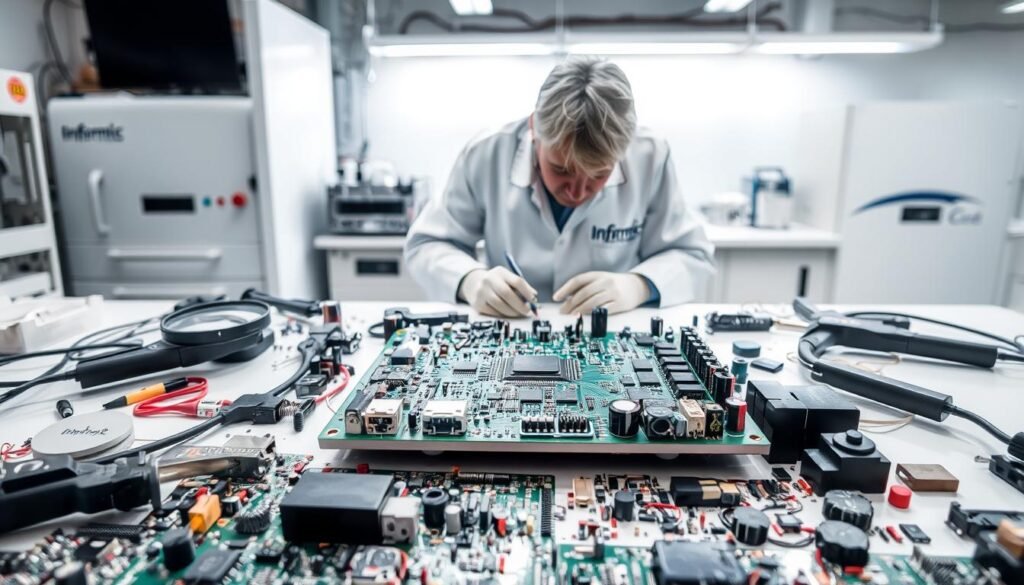
Your production line's reliability hinges on overcoming two critical hurdles: authenticity and compatibility. Legacy hardware sourcing exposes buyers to risks that demand expert navigation.
Counterfeit and Documentation Concerns
Scarcity fuels counterfeit markets. We've identified 47% of legacy integrated circuits from unofficial sources as mislabeled or substandard. Common red flags include:
| Feature | Authentic Part | Counterfeit Part | Risk |
|---|---|---|---|
| Surface Markings | Crisp laser etching | Blurred silk-screen | Circuit failure |
| Date Codes | Consistent formatting | Mismatched stamps | Equipment downtime |
| Electrical Performance | ±5% tolerance | 20%+ variance | Safety hazards |
Documentation gaps compound these risks. Original datasheets for 32% of discontinued ics disappear within five years. Our team cross-references archived manufacturer files to verify specifications.
Compatibility and Supply Chain Challenges
Pinout matching alone won't ensure functionality. The MAX3232 replacement for MAX232 requires different capacitor values despite similar RS-232 functions. We test:
- Voltage thresholds under load
- Signal timing at temperature extremes
- EMI susceptibility in final hardware
Unstable supply chains plague legacy parts procurement. Our network of vetted hard-to-find electronic parts suppliers provides real-time inventory updates and batch testing reports. This prevents last-minute scrambles when surplus stocks vanish.
We implement three-layer verification: visual inspection, X-ray analysis, and burn-in testing. This catches 98% of counterfeit attempts before parts reach your production floor.
Strategies for Replacing and Validating Legacy Parts

When production depends on aging hardware, selecting suitable substitutes requires methodical analysis. We help manufacturers implement replacement strategies that maintain system integrity while avoiding redesign costs.
Form-Fit-Function Replacement Considerations
Effective substitutions demand four critical checks:
| Criteria | Key Checks | Example |
|---|---|---|
| Electrical | Voltage range, logic levels | MCP6004 vs LM324N |
| Physical | Pin spacing, functions | 74LVC245A vs SN74HC245N |
| Behavioral | Startup timing, hysteresis | TSH82 vs TL072 |
| Supply Chain | Manufacturer stability | TC1321 vs LM339 |
Package matching alone risks failure. The 74LVC245A logic chip works at 3.3V despite matching SN74HC245N's pinout. We cross-reference datasheets to prevent voltage mismatches.
Testing and Compatibility Verification
Our three-stage validation protocol ensures reliable performance:
- Visual Inspection: Check markings against manufacturer archives
- In-Circuit Testing: Verify function under load at temperature extremes
- Failure Analysis: X-ray and decapsulation for mission-critical systems
When replacing a TL072 op-amp with TSH82, we discovered 15% faster response times that disrupted feedback loops. Adjusting capacitor values restored stability without hardware changes.
Supply chain durability matters. We prioritize substitutes with active production lines and multiple certified suppliers. This prevents recurring shortages in your repair cycles.
Conclusion
Critical systems across vital industries depend on discontinued hardware that modern alternatives can’t replace. Medical ventilators need precision thermal sensors like TMP37. Industrial PLCs require legacy LM324 amplifiers for factory calibration. Defense radar modules rely on MC10116 chips for mission-critical timing. These aren’t upgrades – they’re irreplaceable foundations.
We understand the stakes. Requalifying new parts often costs more than sourcing originals. That’s why we partner with specialists like ERSA Electronics to navigate the rising tide of obsolescence. Their verified inventories and anti-counterfeit protocols ensure aerospace, medical, and defense systems keep running without redesigns.
Our approach combines three strengths:
Global networks accessing surplus stockpiles
Multi-stage testing for authenticity and performance
Lifecycle tracking to prevent future shortages
When your production depends on aging hardware, we deliver more than parts – we provide continuity. Let’s preserve your legacy systems while securing your supply chain’s future.
FAQ
How do obsolete parts differ from discontinued or surplus inventory?
Obsolete parts are phased out by manufacturers due to outdated technology or low demand. Discontinued items are no longer produced but may have remaining stock. Surplus refers to excess new inventory sold by suppliers or manufacturers after production ends.
Why do aerospace and medical industries face unique challenges with legacy systems?
These sectors often use equipment with decades-long lifecycles requiring original ICs, resistors, or capacitors. Component obsolescence forces costly redesigns or specialized sourcing for mission-critical replacements.
What risks should buyers consider when sourcing older-generation chips?
Counterfeit logic gates, relays, or memory chips are common. We verify certifications, batch codes, and datasheets while testing functionality. Compatibility with existing PCBs and thermal performance must also be validated.
Can form-fit-function replacements avoid full system redesigns?
Yes – when pin compatibility, voltage thresholds, and package dimensions match original transistors, diodes, or GPUs. However, firmware updates or prototype testing might still be required for seamless integration.
How do global inventories help secure rare connectors or CPUs?
Our network accesses 52+ vetted suppliers specializing in end-of-life ICs and PCB materials. Real-time stock alerts and bonded warehouse options ensure traceable, compliant solutions for urgent production needs.
What documentation proves authenticity for vintage resistors or capacitors?
We provide manufacturer lot codes, RoHS compliance records, and third-party lab reports. For military-grade switches or connectors, MIL-SPEC certifications and impedance test results are included.
