
When we sit down with a design team building the next generation of AI or data-center servers, the conversation rarely starts with the schematic. It starts with the component list. The bill of materials (BOM) is where performance targets meet market reality, and for high-density compute, that meeting is often tense. We do not promise magic inventory. We promise a process that surfaces risk before it becomes a schedule delay. Here is the direct answer: we lower sourcing risk by applying a structured engineering checklist to every part number, from the initial RFQ through to the final PCBA assembly handoff.
Our role is not to be a passive order-taker. We act as an extension of your engineering team, reviewing the BOM with the same scrutiny we would apply to our own designs. This means asking hard questions about lead times, lifecycle status, and thermal performance before we ever talk about price. For AI servers, where a single GPU or high-bandwidth memory part can dominate the board cost and schedule, the margin for error is zero. We treat every component as a potential single point of failure until proven otherwise.
The Engineering Checklist: Our Starting Point for Every Server BOM
We have developed a practical checklist that we run on every AI and data-center server project. It is not a theoretical exercise. It is a set of operating questions that determine whether we can build your board to spec, on time, without surprise substitutions. Below is the core of that checklist, which we use during the sourcing and design review phases.
Technical reference: For related engineering context, see IPC standards and industry resources.
| Checklist Item | Specific Operating Question We Ask | Why It Matters for AI/Data-Center |
|---|---|---|
| Lifecycle Status | Is the part in active production, or is it nearing end-of-life (EOL)? | Prevents a redesign six months after launch; high-density boards are costly to respin. |
| Lead Time Variance | What is the true factory lead time, not the distributor stock level? | AI server demand spikes can drain stock; we need a factory commitment, not a shelf promise. |
| Thermal Profile | Does the component's maximum junction temperature align with your airflow design? | Power density in AI servers is extreme; a 10°C margin error can cause field failures. |
| Alternate Part Validation | If the primary part is unavailable, is there a drop-in equivalent we can test? | Provides a rescue path without a full board redesign; we need your approval to test it. |
| Moisture Sensitivity Level (MSL) | What is the MSL rating, and does your assembly partner have the right baking ovens? | Large BGA packages in servers are often MSL 3 or higher; improper handling causes latent solder joint defects. |
This table is not a substitute for your own DFM review, but it is the lens we use when we first see your components list. We run this checklist before we quote, and we run it again when we place the order. The goal is to eliminate surprises, not to create paperwork.
RFQ Phase: Asking the Right Questions Before the Price Quote
When you send us a request for quote (RFQ), we do not immediately jump to a spreadsheet. We read the BOM line by line. We look for part numbers that are known to be in short supply, such as certain power management ICs or high-speed connectors used in PCIe Gen 5 and Gen 6 systems. We also flag any component that appears on our internal "watch list" for allocation or price volatility.
We ask you for three things at this stage. First, the target annual volume and the expected ramp curve. Second, the acceptable alternate part list, if you have one. Third, the revision level of the schematic and layout, because we need to know if the BOM matches the board. If you only need a prototype run of ten boards, we will source differently than if you are planning a 10,000-unit deployment. The RFQ is not a formality; it is the first technical review.
We also review the pcbManufacturing stack-up at this stage. A component may be perfectly good, but if its package footprint does not align with the copper weight or via structure of your board, we need to know that before we commit to a price. We have seen designs where a fine-pitch QFN package was placed over a buried via that created a solder void risk. Catching that at RFQ saves a week of debugging later.
BOM Analysis and Risk Scoring: Where We Add Engineering Value
Once the RFQ is accepted, we perform a detailed risk scoring on the BOM. We categorize every line item into three buckets: low risk, medium risk, and high risk. Low risk parts are commodity passives and standard logic that we can source from multiple manufacturers. Medium risk parts might have a single source or a lead time of more than 12 weeks. High risk parts are those with allocation, a known EOL notice, or a thermal specification that is borderline for your application.
For high-risk parts, we do not only tell you there is a problem. We offer a mitigation plan. This might involve suggesting a specific alternate part that we have already verified in a similar design. It might involve recommending a design change, such as adding a footprint for a second source on the PCB. We do not make these changes without your approval, but we present them with data and a clear rationale. Our goal is to keep your design intact while reducing the chance of a stop-ship event.
We also look at the overall board assembly process during this analysis. For example, if the BOM calls for a mix of through-hole and surface-mount components, we check whether the wave solder step is compatible with the thermal limits of the nearby SMD parts. We consider the pcba process as a whole, not only the component sourcing. A part that is easy to source but hard to assemble is not a win.
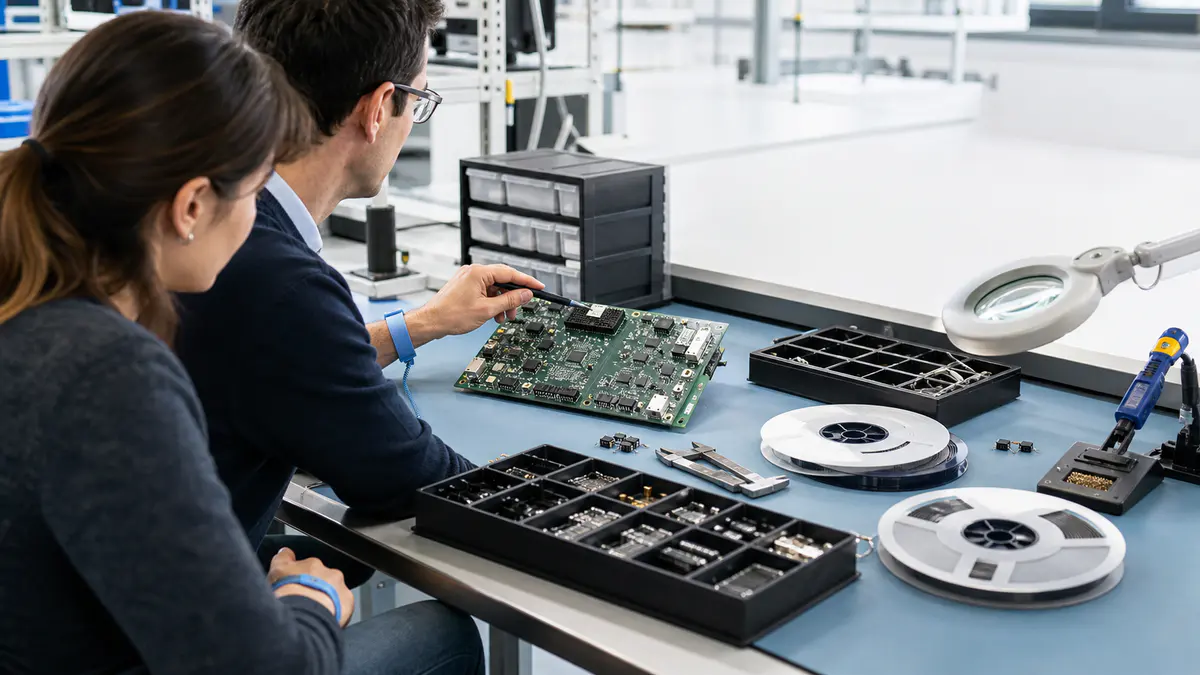
Figure 1: A typical AI server motherboard layout showing the dense component placement that requires careful thermal and sourcing review.
DFM Feedback: Catching Issues Before the Board is Built
Our design for manufacturability (DFM) feedback is not a generic list of common errors. It is specific to your board and your BOM. We send you a report that highlights any potential issues we see, such as insufficient clearance around a large connector, a via-in-pad that may require plugging, or a component orientation that could cause shadowing during reflow. We prioritize the feedback based on risk to yield and reliability.
One area we focus on is the power delivery network (PDN) for high-current processors. We check whether the bulk capacitors are placed close enough to the load, and whether the PCB copper thickness is adequate for the expected current. If we see a potential hot spot, we will flag it. We are not designing your board for you, but we are applying our experience from hundreds of server builds to prevent known failure modes.
We also review the test strategy. If your board has no test points for critical signals, we will suggest adding them. If you plan to use boundary scan, we verify that the JTAG chain is correctly configured. These details are not glamorous, but they are the difference between a smooth production run and a costly debug session. We would rather ask a question now than have you ask us why a board failed in the field.
Supply Chain Execution: From Order to Delivery
After the design review is complete and the BOM is finalized, we move into execution. We place orders with our vetted supplier network, not only with whoever has stock on a shelf. For critical parts, we request factory allocation and a confirmed ship date. We do not rely on a distributor's website showing "in stock" if we know that stock is shared across many customers.
We provide you with a weekly status report that shows the status of every line item. If a part slips, we tell you immediately and offer options: expedite, substitute, or redesign. We do not wait until the due date to break bad news. This transparency is the core of our service. We are not a fulfillment center; we are a partner in your supply chain.
During assembly, we monitor the solder paste inspection (SPI) and automated optical inspection (AOI) data. If we see a trend of insufficient solder on a specific pin, we investigate the root cause. It could be a stencil design issue, a component coplanarity problem, or a reflow profile setting. We fix the cause, not the symptom. This is the difference between a low defect rate and a zero defect rate.

Figure 2: Automated optical inspection in progress, verifying solder joint quality on a high-density server board.
Post-Assembly Verification and Continuous Improvement
Once the boards are assembled, we do not only ship them out of the door. We run a sample of the production units through functional test, and we review the test logs for any anomalies. If we see a pattern of failures on a specific circuit, we go back to the design and the BOM to find the root cause. We document every lesson learned and apply it to the next project.
We also track the field performance of our boards, when our customers share that data with us. This feedback loop is essential for improving our sourcing and DFM guidelines. For example, if a specific brand of electrolytic capacitor shows a higher than expected failure rate after 18 months in service, we will stop recommending that brand and suggest an alternative. We are always learning from real-world data, not from marketing brochures.
Our final step is a post-project review with your team. We discuss what went well, what could have gone better, and what we will do differently next time. This is not a sales call; it is an engineering review. We want to know if our assumptions were correct and if our process added value. If we missed something, we want to hear about it so we can improve.
FAQ: Common Questions We Hear from Server Design Teams
How early should we involve you in the design process?
As early as possible. Ideally, we see the BOM and schematic during the initial layout phase, before the PCB is routed. This allows us to flag long-lead-time parts and suggest alternates without requiring a board respin. If you wait until the design is frozen, you may be forced to accept a longer schedule or a costly redesign. A quick call at the start of the project can save weeks later.
What is the most common sourcing mistake we see in AI server designs?
Specifying a single-source component without checking its lifecycle status. Many high-performance parts are custom to one manufacturer, and if that manufacturer decides to EOL the part or has an allocation issue, you have no alternative. We always recommend that you have a qualified second source or a clear plan for a design change if the primary part becomes unavailable. This is not only a procurement issue; it is a reliability issue.
Can you help us if we already have a board in production and are facing a component shortage?
Yes, in many cases we can. We will review the BOM to identify the shortage part and look for a drop-in equivalent that matches the electrical and thermal specifications. We will also check the PCB footprint to ensure the alternate part is compatible. If a drop-in is not available, we can discuss a minor board modification that would allow a different part. The key is to act quickly before the production line stops.

Figure 3: A technician reviewing a server board's power delivery network with a thermal camera to verify performance.
We believe that the best way to reduce risk is to be proactive. We do not wait for problems to appear; we look for them in the design and the BOM before they cost you time and money. If you are starting a new AI server design or are facing a sourcing challenge on an existing one, we invite you to quote your project with us. We will bring the same engineering discipline to your project that we bring to our own work.
FAQ
What do we review first for electronic component sourcing?
We begin with the functional requirement, the current revision-controlled data package, critical components, expected volume, quality requirements, and delivery deadline.
How do we reduce technical sourcing risk?
We treat availability, lifecycle status, approved alternates, traceability, and lead time as engineering inputs. We ask customers to qualify an alternate before a shortage stops production.
What do we need for an accurate quotation?
We need the correct document revision and, where relevant, the BOM, Gerber or ODB++ files, centroid data, target quantity, application, test expectation, quality requirement, and requested delivery date.
