
When we send a PCBA DFM review to an automotive OE electronics buyer, we are not only checking if the board can be built. We are checking if the quotation you receive will survive contact with your production line. For procurement teams in African manufacturing markets, the distance between a component supplier and a final assembly line can be thousands of kilometers. A DFM review is the first filter that separates a workable quote from a costly surprise.
Let us walk you through exactly how we handle this process, what questions we ask of your files, and why a good DFM review makes your purchasing decision clearer before you ever sign a purchase order.
The direct answer: DFM review is a quotation accuracy tool
A DFM (Design for Manufacturing) review is our engineering team’s check of your PCB layout, BOM, and assembly notes against our actual production capabilities. For you, the buyer, it means the quote we send is based on a board we know we can build, not a best guess. We use it to identify missing parts, impossible tolerances, and expensive assembly steps before they become change orders or line stoppages.
Technical reference: For related engineering context, see IPC standards and industry resources.
For automotive OE electronics, this matters more than for consumer goods. Your parts must meet thermal, vibration, and longevity standards. If a DFM review catches a component that is obsolete or a pad size that will crack under thermal cycling, that is a purchasing problem solved early, not a field failure discovered later.
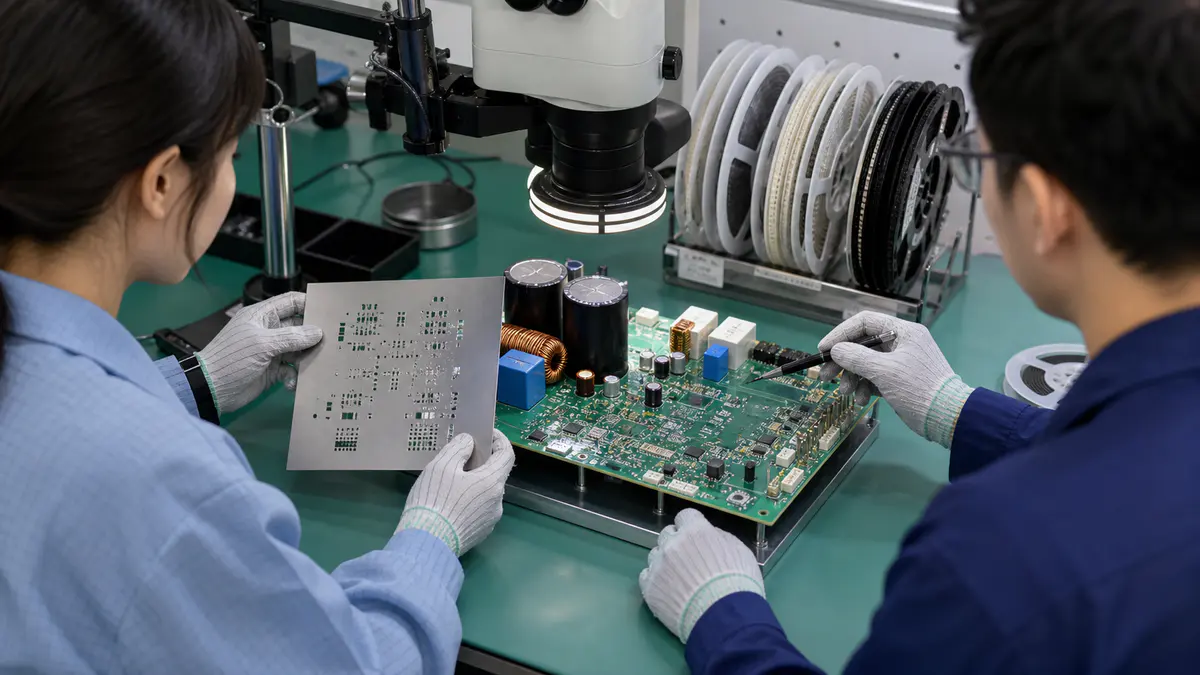
What we actually look at in your RFQ package
When you send us a request for quotation (RFQ), we do not start with pricing. We start with a list of operational questions. The answers determine whether we can give you a fixed price or a range with assumptions.
Here are the first five things we check:
- Layer count and stack-up: A 2-layer board is straightforward. A 10-layer board with controlled impedance requires more process steps and longer lead times. We need to know if your design has blind or buried vias.
- Minimum trace width and spacing: Standard is 6/6 mil. If you need 4/4 mil, that is a different process window and a different yield rate. We will ask if your design can be adjusted to avoid tight tolerances.
- Component package types: Through-hole is easier to assemble but slower. Fine-pitch QFP or BGA packages require stencil printing and X-ray inspection. We count these parts because they drive cycle time.
- BOM completeness: Do you have manufacturer part numbers (MPNs) for every line item? Do you have alternates approved? A BOM with only descriptions like "capacitor 100nF" will delay the quote.
- Special process requirements: Conformal coating, edge plating, press-fit pins, or selective soldering. Each of these adds a handling step and a potential point of failure.
We do not assume you know all this by heart. Our job is to ask the right questions and translate your answers into a clear quotation document.
How a DFM review changes the quotation process
Most buyers expect a DFM review to happen after a quote is accepted. We do it before. This is a deliberate choice. It costs us a few hours of engineering time, but it saves you from receiving a quote that is either too high (because we padded for unknown risks) or too low (because we missed a detail).
Here is a practical example. You send us a BOM with a microcontroller that is listed as "active" at one distributor. Our DFM check flags that the same part has a 52-week lead time from the manufacturer. We do not only quote the part at a higher price. We ask you if you have an approved alternate. If you do, we quote both options side by side. If you do not, we show you the lead time risk in the quotation notes.
That is the kind of clarity we want you to have when you present the quote to your internal stakeholders. You are not only buying a board. You are buying a supply chain position.
The DFM review checklist we use for automotive OE boards
We have condensed our internal review into a practical table. You can use this as a checklist when you prepare your next RFQ package. It will help you gather the right files before you contact us.
| Checkpoint | What we verify | Why it matters to your quote |
|---|---|---|
| Gerber files | Copper layers, solder mask, silkscreen, drill files | Missing layers cause quote delays and rework |
| BOM format | MPN, manufacturer, quantity, reference designators | Incomplete data leads to alternate part assumptions |
| Component lifecycle | Active, obsolete, or end-of-life status | Affects lead time and minimum order quantities |
| Panelization | Board size, scoring, or tab routing | Determines how many boards fit on a standard panel |
| Thermal management | Copper pours, thermal vias, heatsink pads | Impacts soldering profile and long-term reliability |
| Test requirements | ICT, flying probe, or functional test points | Adds time and cost to the assembly process |
We do not expect you to be a DFM expert. That is our role. But when you bring this checklist to the conversation, you will understand our questions faster and make better decisions when we present options.
Specific DFM issues we see in automotive OE designs
Automotive electronics often push the limits of standard PCBA processes. Here are three recurring issues we see in our daily work, and how we handle them in a quotation.
1. Component placement near board edges
Components placed too close to the board edge can be damaged during depaneling. If we see this in your Gerbers, we will not only flag it. We will ask if you can move the part, or we will suggest adding a routing tab to protect it. This affects the panel layout and could change the unit price slightly. We want you to know that cost before you commit.
2. Mixed technology assembly
A board with both through-hole connectors and surface-mount components is common in automotive control units. But if the through-hole parts are on the same side as dense SMT components, the assembly sequence becomes more complex. We will quote this accurately by separating the process steps in our cost model. You will see a line item for wave soldering or selective soldering, not a hidden charge.
3. Obsolete or hard-to-find components
This is the most frequent problem we solve. Your design may be solid, but a key IC may have been discontinued. We do not only tell you it is unavailable. We work with our components sourcing team to find a replacement or an approved alternate. Then we quote the alternate with a clear note on any electrical or mechanical differences. This keeps your purchasing process moving without sacrificing quality.

How we turn DFM findings into a clear quotation
After our review, you receive a quotation document that is structured for decision making, not only for pricing. We separate the document into three parts:
- Buildable as submitted: This is the price if you accept our standard process recommendations.
- Required changes: Any DFM issue that must be fixed before we can build. We list these as specific design changes, not general warnings.
- Optional improvements: Changes that are not required but would improve yield or reliability. These are quoted as options so you can decide based on your budget.
This structure gives you a clear path forward. You are not left guessing whether the quote is final or conditional. You know exactly what we need from you to proceed.
Why this matters for African manufacturing markets
We understand that procurement teams in African markets often face longer lead times and less direct access to component manufacturers. A DFM review that catches a sourcing issue early is not a nice-to-have. It can be the difference between a successful product launch and a six-month delay.
When we coordinate your pcba project, we act as your local engineering and sourcing bridge. We review the design, confirm the parts are available, and then we handle the manufacturing coordination. This is turnkey PCBA coordination in the truest sense. You send us your design, and we return a working board.
Practical steps for your next RFQ
The next time you prepare an RFQ for automotive OE electronics, follow these steps. They will shorten the quotation cycle and reduce the number of follow-up questions.
- Export your Gerbers and drill files in a standard format, preferably RS-274X.
- Create a BOM with full MPNs, not only descriptions. Include quantities and reference designators.
- Check your component lifecycle status. Flag any parts with long lead times or obsolescence warnings.
- Send us your assembly drawings and any special test requirements.
- Include your target volume and expected delivery date.
If you have questions about your pcbManufacturing files, we are happy to review them before you finalize the RFQ. A quick conversation now can save days of back-and-forth later.

FAQ: DFM review and quotation for automotive PCBA
What is the difference between a DFM review and a standard quote?
A standard quote is often based only on the BOM and basic board specifications. A DFM review adds an engineering check of the actual layout and assembly process. We verify that the board can be manufactured within standard tolerances, that the components are available, and that the assembly steps are efficient. The result is a quote that reflects the real cost of production, not an estimate.
How long does a DFM review take before we receive a quotation?
For a typical automotive OE board, we complete the DFM review and return a detailed quotation within three to five business days. If the design is complex or the BOM has missing information, we will contact you with specific questions. The fastest way to get a quote is to send a complete package, including Gerbers, BOM, and assembly drawings, in your first message.
Can you quote an alternate component if our original part is obsolete?
Yes. Our sourcing team checks the availability of every component on your BOM. If a part is obsolete or has an unacceptable lead time, we will propose an alternate. We will provide the alternate part number and note any differences in specifications. The quotation will show both the original part and the alternate, so you can make an informed decision. You can also quote directly with us to discuss your specific BOM needs.
We believe a quotation should be a clear statement of what is possible, not a starting point for negotiation based on hidden risks. Our DFM review process is how we deliver that clarity for automotive OE electronics teams across Africa. Send us your files, and we will show you what we mean.
FAQ
What do we review first for pcba dfm review?
We begin with the functional requirement, the current revision-controlled data package, critical components, expected volume, quality requirements, and delivery deadline.
How do we make purchasing risk easier to compare?
We compare date code, traceability, lead time, MOQ, substitute status, quality checks, and the supplier assumptions behind each quotation instead of comparing only a unit price.
What do we need for an accurate quotation?
We need the correct document revision and, where relevant, the BOM, Gerber or ODB++ files, centroid data, target quantity, application, test expectation, quality requirement, and requested delivery date.
