
Component intelligence · 7 October 2026 · Feifei Deng
The short answer: Magnachip announced its 15-device Gen6 E6 super-junction MOSFET expansion on 5 October 2026 and says the portfolio is in mass production. Its official 500 V selector now lists MMFA50R280E6ZTH in TO-220FA and MMD50R380E6ZRH in TO-252. The announcement is relevant to buyers and engineers working on TV power supplies, notebook adapters, PC power supplies, and other sub-1 kW designs. It does not establish regional stock, MOQ, lead time, date code, or price for either exact MPN. Keep the two BOM identities separate, request written availability for each, and complete electrical, thermal, EMI, and mechanical validation before design release.
What happened
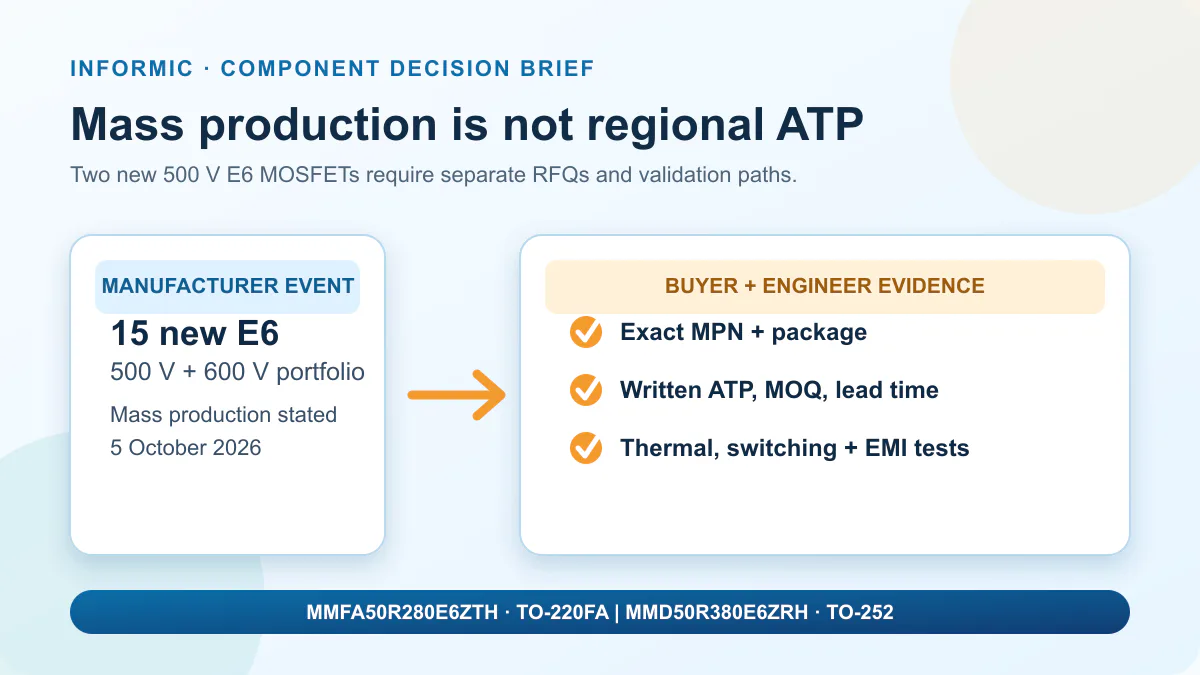
Magnachip's 5 October manufacturer announcement introduced 15 new sixth-generation E6 super-junction MOSFETs across 500 V and 600 V ratings. The company positions the range around the combined thermal, switching, and EMI constraints that appear when power supplies become smaller. It names TV switch-mode power supplies, notebook adapters, PC power supplies, and consumer or industrial power applications below 1 kW as target uses, and states that the MOSFETs are now in mass production.
That is useful product-status evidence, especially for teams screening new high-voltage silicon MOSFETs. It still needs to be translated into two separate workstreams. Procurement must determine whether the exact orderable part is available in the required region, quantity, packaging, and delivery window. Engineering must determine whether the chosen device is suitable in the actual topology, switching conditions, thermal path, protection scheme, and PCB layout. Neither workstream can be closed by a portfolio-level press release.
The most defensible response today is therefore measured: add the exact MPNs to an RFQ and engineering-review queue, but do not convert the manufacturer's mass-production statement into a claim of distributor stock or a production-ready alternate.
The two exact MPNs are not interchangeable
Magnachip's official 500 V selection page lists both parts, but it assigns different packages, current ratings, and maximum on-resistance values. Those differences are large enough to preserve the complete ordering codes throughout BOM, AVL, quotation, and engineering records.
| Exact MPN | Manufacturer-listed boundary | Immediate decision consequence |
|---|---|---|
| MMFA50R280E6ZTH | 500 V, 13 A at 25 °C, 280 mΩ maximum RDS(on) at VGS = 10 V, TO-220FA | Treat as a through-hole, insulated-package BOM identity; confirm mounting, creepage, cooling, lead forming, and assembly process. |
| MMD50R380E6ZRH | 500 V, 11 A at 25 °C, 380 mΩ maximum RDS(on) at VGS = 10 V, TO-252 | Treat as a surface-mount BOM identity; confirm footprint, copper area, reflow profile, thermal spreading, and production inspection. |
The shared 500 V and E6 labels do not make these devices drop-in alternatives. Package geometry changes the mechanical interface and thermal path. The different current and resistance values affect conduction loss and temperature rise. Parasitics can also change switching behaviour and EMI. A comparison may be worth running at the system level, but either device would be only a candidate requiring validation for a design originally released around the other.

What the evidence proves—and what it does not
The evidence is strong for a narrow set of claims. The release date is 5 October 2026. Magnachip announced 15 E6 devices and says the portfolio is in mass production. The 500 V selector exposes the exact two MPNs and the four parameters quoted above. Magnachip also maintains a distinct 600 V selection page, which reinforces why voltage rating and suffix must remain part of the full part identity rather than being shortened to an E6 family label.
The same evidence does not disclose target-region ATP, franchised-channel inventory, packaging quantity, MOQ, lead time, date code, price breaks, allocation status, or non-cancellable terms for either 500 V MPN. No comparable historical channel snapshot is available, so there is no defensible basis for saying stock improved, tightened, or moved in price. “Mass production” means the manufacturer reports a production milestone; it does not mean a buyer can obtain the requested quantity for a particular build date.
The application statements are also portfolio-level positioning. They do not qualify either MPN for automotive, safety-critical, or higher-reliability use, and they do not prove suitability above the stated sub-1 kW target range. Any use outside the named applications needs device-level documentation and a project-specific engineering decision.
A practical RFQ and engineering checklist
1. Request supply evidence for each full MPN
Issue separate RFQs for MMFA50R280E6ZTH and MMD50R380E6ZRH. Ask the manufacturer or an authorized channel to state the sales region, available-to-promise quantity, packaging form and multiple, MOQ, lead time, date code, manufacturing location where available, quote validity, price breaks, allocation rules, and cancellation terms. Do not accept a response that quietly substitutes a shortened base number or a different voltage, package, resistance class, or suffix.
2. Freeze the BOM identity before commercial comparison
Compare quotations only when currency, quantity break, packaging, region, delivery basis, and quote date are aligned. A low unit price attached to the wrong package or an unconfirmed lead time is not a usable saving. Record the manufacturer MPN exactly in the BOM and maintain any proposed alternate as a separate candidate line until validation and approval are complete.
3. Review the circuit, not just the headline ratings
For the intended switching topology, review steady-state and transient drain voltage, current waveform, switching frequency, gate-drive voltage and resistance, reverse-recovery behaviour where relevant, avalanche and surge margin, junction-temperature target, heat-sinking or copper-spreading assumptions, and fault protection. Then verify switching loss, case or board temperature, waveform overshoot, ringing, and EMI on representative hardware. The manufacturer's statement about balanced thermal, switching, and EMI performance is a reason to test; it is not the result of your test.
4. Close the mechanical and PCBA path
TO-220FA and TO-252 demand different footprints, placement and soldering processes, heat-flow models, inspection criteria, and often different enclosure or airflow assumptions. Update the land pattern, creepage review, thermal model, assembly notes, and inspection plan before treating a candidate as releasable. Where a board revision is necessary, include the exact MPN, package drawings, BOM revision, and PCBA build quantity in the updated quotation request.

If either part is entering a live design or sourcing review, send the full BOM, target quantity, delivery region, build schedule, existing device, schematic context, and PCBA constraints for an updated quotation and engineering review. That gives sourcing and engineering one shared evidence package instead of two disconnected assumptions.
Facts, judgments, and recommendations
- Verified facts: the announcement date, 15-device portfolio statement, mass-production statement, named application range, and the exact 500 V selector values for the two MPNs come from Magnachip's public pages.
- Editorial judgment: the most important operational risk is confusing a portfolio production milestone with exact-MPN, region-specific supply. This is an interpretation of the evidence, not a manufacturer claim.
- Recommendations: use separate RFQs, preserve full suffixes and packages, request written ATP and commercial terms, and complete system-level validation. These are prudent procurement and engineering actions, not guarantees of supply or performance.
No alternate is presented here as manufacturer-approved. Any replacement or cross-reference mentioned in a future review must remain a candidate requiring validation unless Magnachip explicitly documents the substitution.
FAQ
Are MMFA50R280E6ZTH and MMD50R380E6ZRH available from stock?
The reviewed public manufacturer sources do not disclose regional ATP, distributor stock, MOQ, lead time, or price for either exact MPN. Request written availability for the required region and quantity.
Does “mass production” mean the parts are ready for our build?
No. It confirms a manufacturer portfolio milestone, not the quantity, packaging, date code, commercial terms, or delivery date needed for a specific build.
Can the TO-220FA and TO-252 devices replace one another?
Do not treat them as drop-in replacements. Their packages, current ratings, maximum on-resistance values, assembly routes, thermal paths, and parasitics differ, so any comparison requires mechanical, electrical, thermal, EMI, and PCBA validation.
What should be included in the RFQ?
Use the complete MPN and request sales region, ATP, packaging and multiples, MOQ, lead time, date code, manufacturing location where available, quote validity, price breaks, allocation terms, and cancellation terms.
What evidence is needed before BOM release?
Combine exact-MPN supply evidence with a reviewed datasheet or device specification, footprint and thermal checks, switching and protection analysis, representative hardware measurements, EMI review, and documented engineering approval.
Sources
- Magnachip: “Magnachip Launches 15 New Gen6 E6 Super-Junction MOSFETs”, published 5 October 2026.
- Magnachip official 500 V SJ MOSFET selector, independently checked 7 October 2026.
- Magnachip official 600 V SJ MOSFET selector, independently checked 7 October 2026.
