
Choosing the right microcontroller can define the success of your embedded projects. Texas Instruments offers a range of microcontrollers that excel in consumption efficiency and performance scalability. In our comprehensive review, we will explore what makes ‘microcontroller TI’ a preferred choice for designers, from their renowned low-power modes to their ability to seamlessly integrate various analog components in a single chip. Get ready to uncover the capabilities, key applications, and development tools that solidify TI’s position in the microcontroller market.
Key Takeaways
- TI microcontrollers offer ultra-low power consumption and quick transition from low-power modes to active mode, with integrated precision analog components such as ADCs, DACs, and op-amps, which reduce system costs and enhance performance.
- The integration of multiple functions into single-chip solutions like the TM4C129x microcontroller streamlines system design, reduces complexity, and achieves cost savings, while efficient interrupt request management via the Vectored Interrupt Module allows for prioritized and nested interrupts.
- TI microcontrollers are used in a wide range of applications, from personal computing to industrial and automotive systems, with an architecture that supports rapid context switching, flexible coding, and data access, backed by robust tools and resources including Code Composer Studio and LaunchPad development kits.
The Power of Texas Instruments Microcontrollers
TI microcontrollers, particularly the MSP430 series, are celebrated for their features:
- Ultra-low power consumption
- Multiple low-power modes for efficient energy management
- High-performance profile, with quick transition from low-power modes to active mode in less than 6 microseconds
These features ensure both energy efficiency and quick response times for essential operations.
A key feature that sets TI microcontrollers apart is the integration of precision analog components. These include:
- ADCs
- DACs
- Op-amps
- Various other peripherals, including USB and LCD drivers
This integration significantly contributes to reducing system costs, enhancing functional safety and performance, and promoting corporate synergy.
Furthermore, Texas Instruments provides versatile single-chip solutions that streamline embedded system design. Incorporating a wide range of embedded processing technologies, these solutions cater to the requirements of various applications. A testament to TI’s commitment to product reliability and longevity, these microcontrollers are designed to provide sustainable, durable solutions.
Single-Chip Solutions
One of the key advantages of TI microcontrollers is their ability to provide single-chip solutions. The TM4C129x microcontroller is a perfect example of this. It integrates multiple features such as:
- Ethernet PHY
- USB High-Speed support
- Security peripheral
- LCD controller
- EPI
This consolidation of multiple functions into one chip, overseen by the general manager, helps to streamline system design and reduce complexity.
The concept of single-chip solutions is indeed a game-changer. When multiple functions are integrated into one chip, it simplifies the system design, reduces the bill of materials, and ultimately leads to cost savings. This is just what industries, including one company, need in today’s fast-paced and cost-conscious business environment.
Interrupt Request Management
An important aspect of any microprocessor is its ability to manage interrupt requests efficiently. TI microcontrollers, such as the TMS570 series, excel in this area. They facilitate interrupt management through a Vectored Interrupt Module (VIM) that allows prioritization of interrupt requests. This enables the configuration of nested interrupts with different priorities, ensuring quick response times for essential operations.
Further, the configuration of VIM in TI microcontrollers is flexible, allowing developers to adjust the prioritization of interrupt channels. This is crucial in systems where certain interrupt-driven tasks must take precedence over others. Plus, there’s a clear distinction between Fast Interrupt Requests (FIQ) and standard IRQs in TI microcontroller architecture, offering considerations for performance impact when using FIQ for high-frequency interrupts.
The Evolution of TI's Microcontroller Family
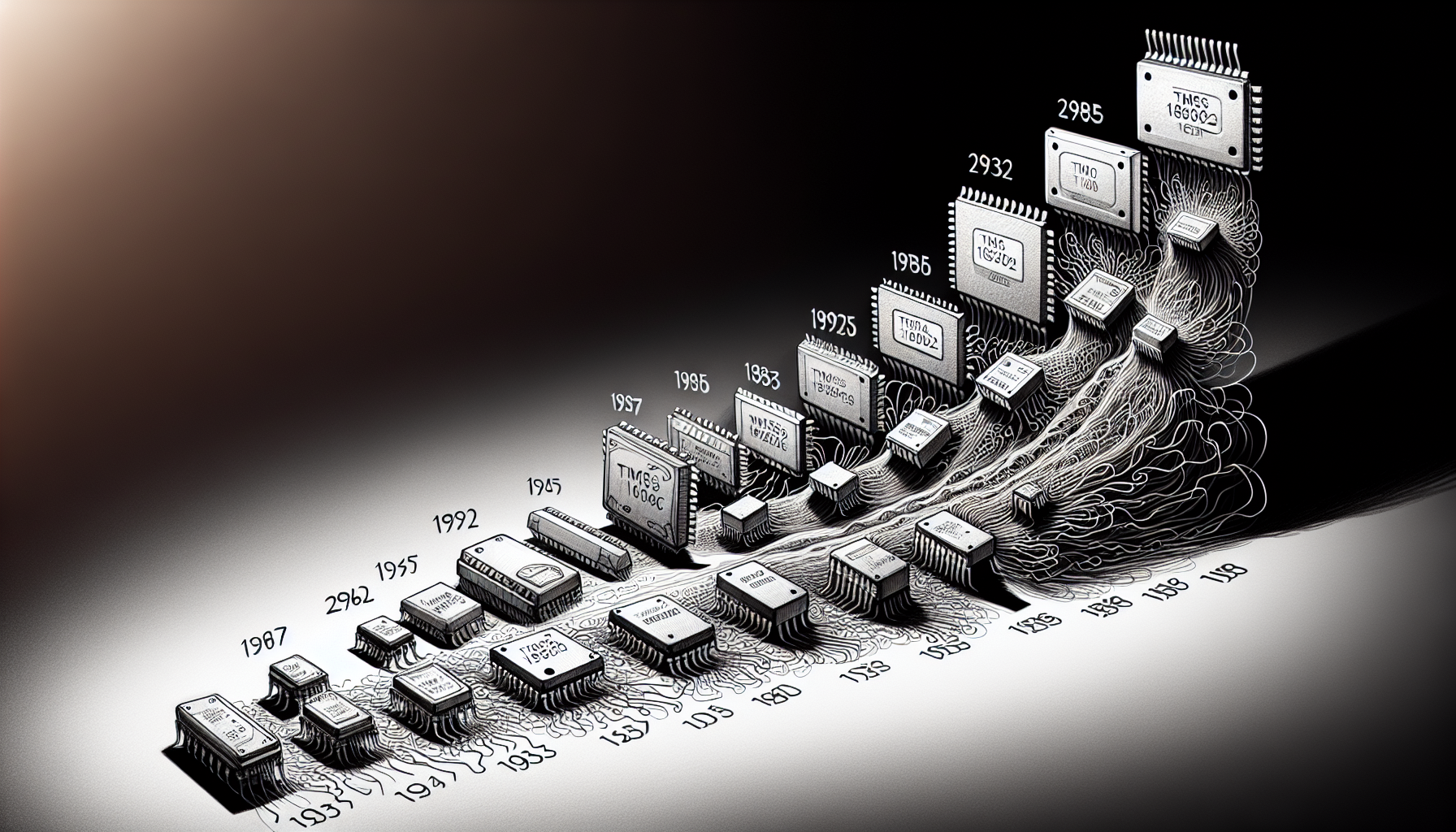
The journey of TI’s microcontroller family is a fascinating one. It all started with the TMS1802NC, created in 1971 by Texas Instruments engineers. Considered the first microcontroller, it laid the groundwork for the development of the TMS 0100 series.
In 1974, TI released the TMS1000, a complete single-chip computer that integrated a CPU, ROM, RAM, and I/O lines, marking a significant early milestone in microcontroller technology. The TMS1000 family was diversified with variants offering different ROM and RAM sizes, I/O line counts, and ROMless versions for development purposes. This catered to a wide range of embedded system applications,.
TI’s foray into the ARM microcontroller market started with the acquisition of Luminary Micro and the LM3S series. This laid the groundwork for subsequent product lines like the Tiva-C series. The transition from Luminary Micro to ‘Tiva-C’ represented a major milestone as TI started releasing microcontrollers with production Cortex M4F cores, enhancing the capabilities of their microcontroller product line,.
Pioneering Personal Computer Architecture
TI’s microcontrollers have not only revolutionized the embedded systems industry but have also made significant contributions to personal computer architecture. The TMS9995 microprocessor, for instance, was integrated into home computing systems like the Tomy Tutor and the Geneve 9640. It also formed the basis for the project published in Electronics Today: the Powertran Cortex.
The integration of TI’s TMS9995 microprocessor into personal computing systems was a testament to the versatility and potential of TI microcontrollers. It showcased how these microcontrollers could be applied beyond traditional embedded systems, opening up new possibilities and inspiring innovations in the world of personal computing.
Expanding the Range with Automotive and Industrial Solutions
The versatility of TI microcontrollers extends to the automotive and industrial sectors as well. They are designed to comply with functional safety standards such as ISO 26262 and IEC 61508, ensuring reliable operation in safety-critical applications.
TI offers a portfolio of semiconductor isolation technologies along with sensing and real-time processing features. This enables compliance with functional safety standards for industrial and automotive motor control applications. Thus, TI microcontrollers are instrumental in developing solutions for a safer, more connected, and intelligent world,.
Understanding TI Microcontroller Architecture
To fully appreciate the power and potential of TI microcontrollers, it’s essential to delve into their architecture. TI microcontrollers, including the TMS9900, are equipped with three internal 16-bit registers. These registers are the program counter, status register, and workspace pointer register. The MSP430 includes a 16-bit RISC CPU. All these contribute to rapid context switching and a focus on high-efficiency code.
The TMS9900 has the following features:
- 15-bit address bus
- 16-bit data bus
- Address space of 65,536 bytes
- Specialized 16-bit shift register for interfacing with external devices
- Flow control achieved through an unconditional jump instruction and a series of conditional jumps
- Branch and Load Workspace Pointer instruction for subroutine calls and managing return address
This one computer architecture is carefully designed to ensure efficient code execution and hardware resource management. It embodies TI’s commitment to providing robust, versatile solutions that cater to the diverse needs of embedded system applications.
Register Organization and Context Switching
TI microcontrollers are designed for efficient multitasking. The TMS9900 microcontroller architecture enables rapid context switching by only requiring a change to the single workspace register when entering a subroutine. This enhances multitasking efficiency and ensures smooth operation, even in complex systems with multiple tasks running concurrently.
Moreover, TI’s microcontrollers incorporate a safety architecture with hardware features such as redundancy and support for software execution. This allows them to adhere to high safety integrity levels, ensuring reliable operation in safety-critical applications.
Flexible Addressing and Data Access
TI microcontrollers are designed to provide flexibility in coding and system efficiency. They support a variety of addressing modes, including:
- Direct
- Indirect
- Indexed
- Relative
Each of these modes serves different programming needs and optimization strategies, providing programmers with the flexibility they need in hardware resource management, just as IBM chose to do in their systems.
Another key feature of TI microcontrollers is Direct Memory Access (DMA). This allows peripheral devices to access the main system memory without processor intervention. Not only does this enhance data throughput, but it also improves system efficiency, making TI microcontrollers an ideal choice for complex, data-intensive applications.
Tools and Resources for Developing with TI Microcontrollers
Developing with TI microcontrollers is made easy with a range of tools and resources offered by TI. Code Composer Studio, TI’s central integrated development environment, features an optimizing C/C++ compiler, source-code editor, project build environment, debugger, profiler, and more. This comprehensive suite of tools simplifies the development process and helps developers get the most out of TI microcontrollers.
In addition to software tools, TI supports hardware prototyping for MSP430 microcontrollers through a modular ecosystem. This includes LaunchPad development kits, BoosterPack plug-in modules, and application-specific evaluation modules (EVMs). These resources provide a hands-on experience with TI microcontrollers, enabling developers to quickly prototype and test their designs.
TI also believes in the power of education and community engagement. They offer:
- Downloadable course materials from their workshops for educators
- A range of video series designed as educational resources
- The open-source community platform Connexions, which houses over 150 educational modules on TI processor-related content that can be freely accessed, modified, or printed on demand.
Debugging and Programming Support
TI provides robust debugging and programming support for its microcontrollers. The MSP-FET, a powerful emulation development tool, supports programming and real-time debugging of MSP low-power microcontrollers via JTAG and SBW interfaces.
Moreover, TI offers the MSP-GANG production programmer, capable of programming up to eight identical MSP430 or MSP432 devices simultaneously. For on-chip flash programming, UniFlash, a software tool, is available with both graphical and command-line interfaces.
Compatibility for the MSP-FET with integrated development environments (IDEs) includes Code Composer Studio version 7.0 and IAR Embedded Workbench versions 7.1 and 8.10.
Training and Community Engagement
In addition to their tools and resources, TI also offers practical workshops tailored to provide hands-on experience with their microcontrollers. These include the MSP430 One-Day Workshop and the C2000 Piccolo Multi-Day Workshop. These workshops offer valuable insights into the practical usage of TI microcontrollers and provide a platform for developers to enhance their skills.
TI also engages with the developer community through a range of video series designed as educational resources. These videos elaborate on:
- microcontroller cores
- communication protocols
- timing
- control features
Furthermore, the open-source community platform Connexions houses over 150 educational modules on TI processor-related content that can be freely accessed, modified, or printed on demand.
Shenzhen Informic Electronics and TI Microcontrollers
Shenzhen Informic Electronics is a leading distributor of TI microcontrollers. Established in 2012, this company provides semiconductor solutions, including electronic components from Texas Instruments, to various sectors encompassing:
- Communication
- Computing
- Industrial systems
- Automotive
- Consumer electronics
All electronic components provided by Shenzhen Informic Electronics are assured to be 100% original, ensuring premium performance and dependability for their products. With a substantial inventory of over 5 million components, the company commits to rapid shipping, typically accomplished within 1-3 business days. Additionally, to instill customer confidence, Shenzhen Informic Electronics offers a 3-year warranty on all original electronic components,,,,.
Real-World Applications of TI Microcontrollers
TI microcontrollers have found their way into various real-world applications. MSP430 microcontrollers, for instance, are instrumental in simplifying embedded system designs, leading to lower costs and fewer components in the bill of materials.
The TMS1000 microcontroller series set a precedent for versatile integration in applications such as automotive systems, home appliances, and measurement instruments.
Wireless Communication Solutions

In the realm of wireless communication, TI microcontrollers have been instrumental in enhancing efficient connections for IoT devices. Utilizing the latest standards like Wi-Fi 6 and Bluetooth Low Energy 5.3, they ensure reliable communication in various environments.
The CC2340 family of TI wireless MCUs is specifically designed to enable the integration of Bluetooth Low Energy into diverse applications. They offer high-quality RF and power efficiency, making them an ideal choice for IoT devices that require reliable, energy-efficient wireless communication.
Consumer Electronics Integration
Historically, TI microcontrollers have played a significant role in the consumer electronics industry. The TMS1000 microcontroller, for instance, was incorporated into commercial products such as the Speak & Spell toy, the Big Trak vehicle, and the electronic game Simon. This showcases the versatility of TI microcontrollers and their potential for integration into a wide array of consumer electronics products.
Summary
As we have seen throughout this blog post, Texas Instruments’ microcontrollers are at the forefront of the embedded systems industry. Their low power consumption, high performance, and versatility make them a preferred choice for a wide array of applications. From single-chip solutions to efficient interrupt management, from pioneering personal computer architecture to expanding the range with automotive and industrial solutions, TI microcontrollers have made significant contributions to the technological landscape.
With robust tools and resources for development, comprehensive debugging and programming support, and a strong commitment to training and community engagement, Texas Instruments continues to shape the future of embedded systems. As we look forward, it’s clear that TI microcontrollers will continue to play a pivotal role in shaping the future of technology, driving innovation, and transforming the way we interact with the world.
Frequently Asked Questions
What is a microcontroller in IoT?
A microcontroller in IoT is a compact integrated circuit that controls a specific operation within an embedded system, typically containing a processor, memory, and I/O peripherals on a single chip. It is a small, self-contained computer dedicated to a single function and often embedded in other devices.
Does TI make processors?
Yes, TI offers a large portfolio of Arm-based application processors for various devices, including automotive, industrial, and internet of things.
What are the key features of Texas Instruments microcontrollers?
Texas Instruments microcontrollers are known for their ultra-low power consumption, precise analog components, high performance, and versatile single-chip solutions. These features make them a popular choice for various applications.
How do TI microcontrollers manage interrupt requests?
TI microcontrollers manage interrupt requests through a Vectored Interrupt Module (VIM) that prioritizes interrupt requests and distinguishes between Fast Interrupt Requests (FIQ) and standard IRQs. This ensures efficient and organized handling of interrupts.
What tools and resources does TI offer for developers?
TI offers a range of tools and resources including Code Composer Studio, hardware prototyping ecosystems, educational materials, debugging and programming support, as well as practical workshops and video series for community engagement. These resources are designed to support developers in their projects and learning.
