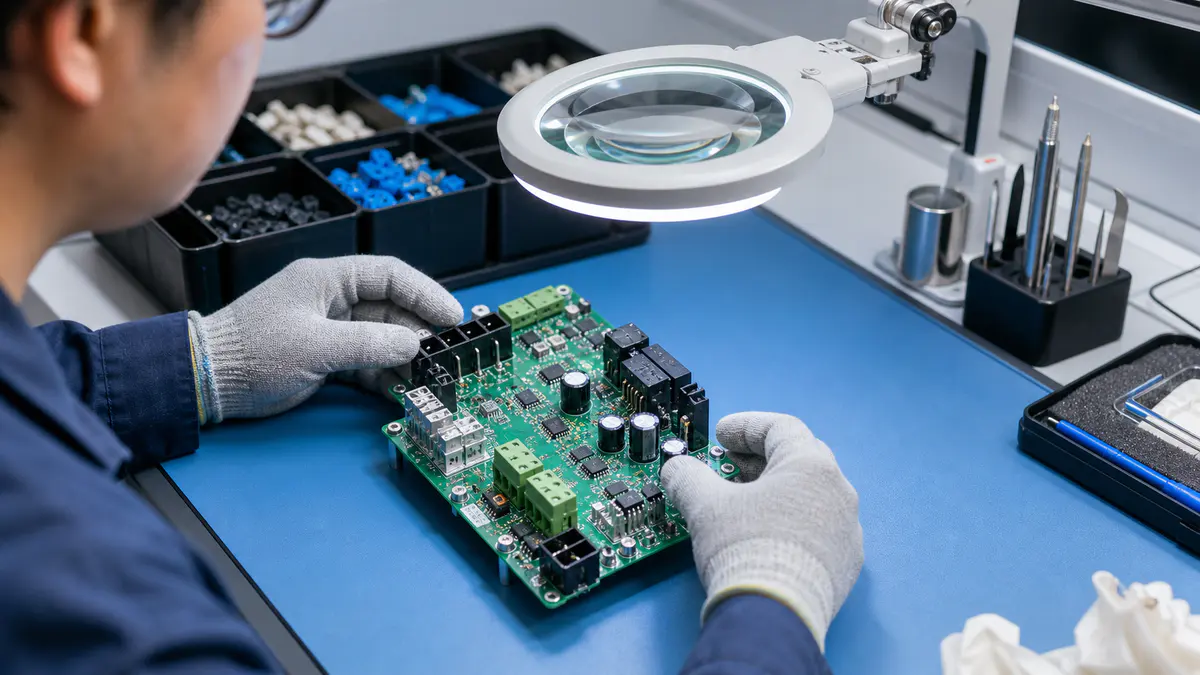
When your production line is waiting on control boards for electric scooters, cargo trikes, or delivery bikes, a vague quotation can stop your whole schedule. We’re Informic, and we coordinate turnkey PCBA for two- and three-wheel EV factories across the Middle East. Our job is to turn a complex industrial control PCB assembly request into a clear, itemized quotation that your finance team can approve without a dozen follow-up emails. Here is how we make purchasing clearer, step by step.
Start with the right industrial control PCB assembly quotation request
The difference between a quick quote and a two-week email loop often comes down to the initial RFQ. For an industrial control board. think motor controllers, battery management interfaces, or dashboard logic. we need to understand the operating environment first. A controller for a delivery trike in Dubai summer heat behaves differently than one for a warehouse scooter in a cooler climate.
Technical reference: For related engineering context, see IPC standards and industry resources.
Send us the basics, even if they feel obvious:
- Target annual volume and expected order frequency
- Board dimensions and layer count, if you have them
- Operating temperature range and any dust or humidity exposure
- Input voltage and current requirements
- Which components you’ve already selected, if any
If you don’t have a full schematic, that’s fine. We regularly start with a simple block diagram or even a photo of a working board. The point is to avoid guessing. For a factory that assembles 500 units per week, a missing thermal specification can lead to the wrong solder mask or a capacitor that fails early. We’d rather ask three questions upfront than rework a batch later.
When you send your RFQ, be specific about the pcbManufacturing requirements. A standard FR-4 board might work for a basic throttle controller, but a high-current motor driver may need thicker copper or a different surface finish. We’ve seen factories assume all boards are the same. They are not. Your quotation should reflect the actual board construction, not a generic “PCB” line item.
How we structure a turnkey PCBA quotation for EV factories
We don’t send a single lump-sum number and hope it sticks. Our quotation breaks down into four visible sections: board fabrication, component sourcing, assembly labor, and testing. This way, you can see where the cost sits and adjust if needed.
| Quotation section | What we include | Why it matters to your purchasing team |
|---|---|---|
| Board fabrication | Material, layer count, copper weight, surface finish | Determines durability in heat and vibration |
| Component sourcing | Part numbers, manufacturers, lead times | Shows which parts are common vs. long-lead |
| Assembly labor | SMT, through-hole, selective soldering, conformal coating | Explains manual vs. automated work |
| Testing | ICT, functional test, burn-in | Reduces field failures and warranty claims |
That table is not only decoration. When we send this breakdown, your team can compare our pcba proposal against another supplier’s quote line by line. If a competitor quotes a lower total but omits testing, you’ll see it immediately. We want you to buy with confidence, not only on price.
DFM feedback: the part of the process that saves you money
Design for manufacturability (DFM) is not a buzzword. It’s a practical review we perform before we order any components or start assembly. For a two- or three-wheel EV control board, common DFM issues include:
- Vias placed too close to pads, causing solder wicking
- Component footprints that don’t match the actual part dimensions
- Missing test points for in-circuit testing
- Thermal reliefs that are too small for high-current traces
When we flag these issues, we give you a clear recommendation, not a lecture. For example, we might say, “Move these two vias 0.3mm away from the pad, or we’ll see intermittent shorts during wave soldering.” That’s a concrete adjustment your design engineer can make in an hour. We’ve seen factories ignore DFM feedback and then face a 12% failure rate in the field. That’s not acceptable for a fleet of delivery vehicles.
We’ll also ask about your board’s mechanical mounting. A controller that vibrates loose on a scooter frame is a safety issue. We can suggest adding mounting holes, standoffs, or even a conformal coating for humid coastal areas like Jeddah or Muscat. These small details go into the quotation as optional line items, so you decide what fits your budget.
BOM management: where procurement gets messy
Component sourcing is often the longest lead time in the entire PCBA process. For EV control boards, the critical parts are usually the microcontroller, power MOSFETs, gate drivers, and connectors. Some of these have lead times of 20 weeks or more. We don’t want you to discover that after you’ve signed the order.
When we receive your bill of materials (BOM), we check each part for:
- Lifecycle status (active, obsolete, or end-of-life)
- Current market availability and lead time
- Alternate pin-compatible parts from a second manufacturer
- Minimum order quantities that might inflate your cost
If a part is obsolete, we don’t just tell you. We offer a tested alternative and explain the difference in performance. For example, swapping a MOSFET with a slightly higher RDS(on) might be fine for a 250W motor but not for a 1kW cargo bike. We explain the trade-off in plain numbers, so your engineering team can make an informed decision.
We also consolidate your component purchases. Instead of ordering 100 microcontrollers from one distributor and 500 capacitors from another, we source everything through our supply chain. This reduces your freight cost and administrative burden. For a factory in Riyadh or Cairo, that means fewer customs clearance headaches and a single delivery schedule.
Testing: the step that protects your brand
No factory wants to ship a scooter that stops working after a week. That’s why we include functional testing in most quotations. For industrial control PCBA, we typically run:
- In-circuit testing (ICT) to verify every resistor, capacitor, and IC is placed correctly
- Functional testing with a simulated motor load to check PWM output and current sensing
- Visual inspection per IPC-A-610 standards for solder joint quality
We don’t claim that our testing catches every possible defect. That would be dishonest. But we do say that a proper test plan reduces your field failure rate significantly compared to a visual-only inspection. If your quotation doesn’t include testing, ask yourself why. We’d rather quote a slightly higher price with testing included than promise a low price and leave you with silent failures.
For high-volume production, we can also set up a custom test fixture that matches your specific board. This is a one-time engineering cost, but it pays off if you’re producing thousands of units. We’ll explain the fixture cost in the quotation so there are no surprises later.
What we need from you to move fast
We’ve worked with EV factories from Tehran to Casablanca, and the ones that move fastest share a common habit: they send complete information in the first email. Here’s a practical checklist for your next RFQ:
- Board dimensions and layer count, or a reference design
- Full BOM with part numbers and quantities per board
- Any design files (Gerber, ODB++, or PDF schematic)
- Operating environment details (temperature, humidity, vibration)
- Target production volume and ramp-up schedule
- Required certifications or compliance standards
If you don’t have all of these, send what you have. We’ll ask for the rest in a structured way. We never make you feel like you’re bothering us. That’s part of our job as a turnkey coordinator.
One more thing: be honest about your volume projections. If you say 10,000 units but only order 500, we’ll still treat you well, but the price per board will be different. Conversely, if you’re planning a big ramp-up, tell us. We can reserve component stock and negotiate better pricing on your behalf. That’s the benefit of working with a coordinator who knows the supply chain.
Making the final decision
When you receive our quotation, you should be able to understand every line item without calling us. If you can’t, that’s our failure, not yours. We use plain descriptions like “FR-4, 2-layer, 1oz copper” instead of vague terms like “standard board.” We list component manufacturers and part numbers. We show assembly labor hours and testing coverage.
Compare our quotation against others with this lens: does the supplier explain what they’re doing, or just give you a number? A detailed quotation is a sign of a supplier who has actually reviewed your design. A one-line quote is a guess. You don’t build a factory on guesses.
If you’re ready to move forward, send us your RFQ through our quote page. We’ll respond within two business days with a structured breakdown and a list of any missing information. If we can’t meet your target price, we’ll tell you upfront and suggest where you might adjust the design or volume to get there.
FAQ
What is the typical lead time for industrial control PCB assembly?
Lead time depends on component availability and board complexity. For a standard two-layer board with common components, we can often deliver prototype quantities in 3 to 4 weeks. Production quantities typically run 6 to 8 weeks, including testing. If you have long-lead components, we’ll flag them in the quotation so you can plan your production schedule accordingly.
Can you handle both low-volume prototyping and high-volume production?
Yes. We regularly support factories that start with 50 units for field trials and then scale to 2,000 units per month. The quotation will show different price tiers based on volume. For prototyping, we might use a faster but slightly more expensive assembly process. For production, we optimize the setup to reduce per-unit cost.
How do you handle component shortages or obsolescence?
We monitor component lifecycle status for every part in your BOM. If a part is at risk of obsolescence, we’ll recommend an alternative before it becomes a problem. During a shortage, we use our supplier network to find available stock or suggest a pin-compatible substitute. We always verify the substitute’s performance against your requirements before making a change.