
An air variable capacitor changes capacitance mechanically, usually by rotating a set of plates relative to a stationary set. It is used for tuning and impedance matching in RF circuits. Selecting one requires the capacitance range, electrical ratings and mechanical drawing for the exact part, rather than a generic rating for all air capacitors.
How an air variable capacitor works
In a common rotary design, rotor and stator plates interleave without touching. Rotating the shaft changes their overlapping area and therefore the capacitance. Air separates the conductive surfaces; insulating supports and the mechanical assembly also affect real-world performance.
Greater overlap generally increases capacitance. Plate shape determines the relationship between shaft angle and capacitance, so a linear tuning response should not be assumed for every model. Minimum capacitance, maximum capacitance and the required rotation range all matter when replacing an existing component.
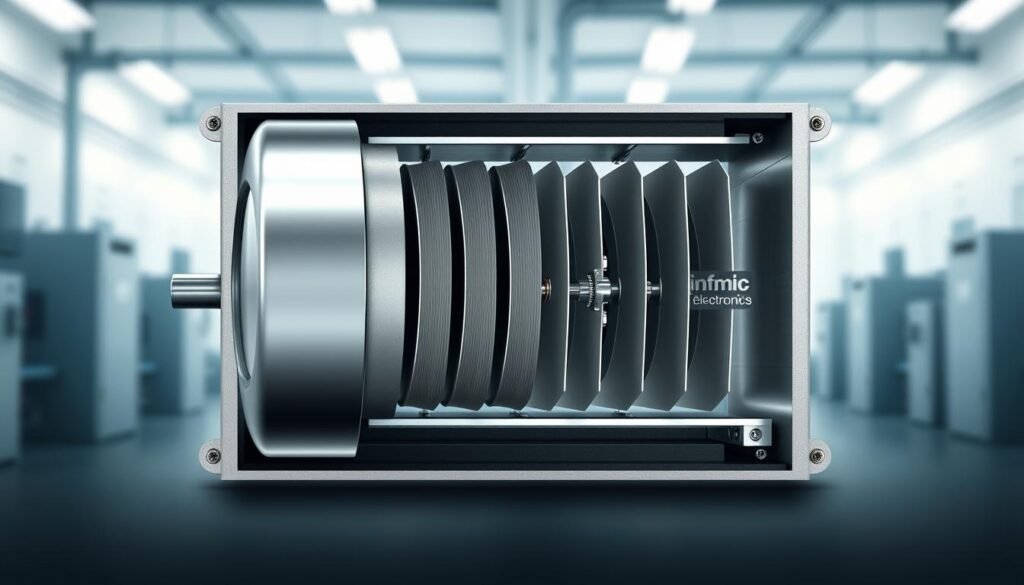
Illustration only; use the selected manufacturer's drawing for dimensions and construction details.
Specifications to check before selection
| Requirement | What to verify | Why it matters |
|---|---|---|
| Capacitance range | Minimum and maximum capacitance for each section, including relevant tolerances. | The entire tuning range must fit the circuit, including stray capacitance. |
| Voltage rating | Whether the published value is an operating, peak or withstand rating, and the stated test conditions. | Different rating definitions are not interchangeable. |
| RF operation | Frequency range and any published current, loss or Q specifications. | A voltage figure alone does not establish suitability for RF power service. |
| Mechanical fit | Body dimensions, mounting points, shaft diameter, shaft length and rotation limits. | A part with a similar capacitance range may not fit the existing assembly. |
| Adjustment | Drive ratio, torque, backlash, locking method and access for adjustment. | The mechanism must support the required tuning resolution and stability. |
| Environment | Temperature, humidity, contamination, vibration and enclosure requirements. | The installed environment can affect electrical clearance and mechanical operation. |
A manufacturer example: distinguish withstand voltage from operating voltage
Cardwell's Johnson Type L–167 series page lists a 0.030-inch air gap with a peak withstand voltage of 1,500 V, and mentions alternative gap options. This is a series-specific specification, not a rule that a particular spacing is safe at any chosen operating voltage. Check the exact ordering code and obtain the applicable operating limits before using it in an RF power circuit.
The manufacturer's Type L–167 series documentation also describes the mechanical construction and available configurations. Do not infer continuous working voltage from a withstand test, or substitute a fixed percentage margin for application-specific qualification.
Applications and circuit integration
Air variable capacitors can provide adjustable capacitance in LC tuning circuits and antenna matching networks. Select the component for the actual circuit voltages, currents and frequency range. Resonant circuit conditions may differ from the supply voltage, so the supply label alone is not an adequate selection basis.
Check the installed tuning range, mounting arrangement and adjustment access during prototype evaluation. If a reduction drive or motorized mechanism is required, confirm its compatibility with the capacitor shaft, torque and travel limits. A motorized assembly is a separate requirement; it is not a feature of every air variable capacitor.

Illustrative component image, not a photograph of a specified production model.
Inspection and sourcing checks
- Record the manufacturer and full part number, including section arrangement and mechanical options.
- Request the current specification and dimensioned drawing.
- For surplus or previously used parts, establish condition, provenance and available test evidence.
- Inspect for bent plates, contamination, damaged supports and rough shaft movement before qualification.
- Follow the manufacturer's cleaning and service instructions. Do not assume that bending plates back restores the original voltage rating.
For a sourcing review, send the part number, required quantity, electrical requirements and mechanical drawing through our contact page. Availability, condition and documentation should be confirmed in the written quotation.
Frequently asked questions
Can two parts with the same maximum capacitance be substituted?
Not on that value alone. Compare minimum capacitance, section configuration, voltage-rating definitions, RF requirements and mechanical dimensions, then qualify the replacement in the circuit.
Does an air dielectric eliminate all losses?
No. The complete component still includes conductors, contacts, supports and parasitic effects. Use manufacturer data or measurements for the required frequency and operating conditions.
Does wider plate spacing automatically establish a safe operating voltage?
No. Spacing is only one factor. Use the manufacturer's rating and conditions for the complete assembly, including any environmental limitations.
