
Component Lifecycle Intelligence | 29 August 2026
By Feifei Deng | Updated 29 August 2026
The short answer: TE Connectivity PCN-25-245246 makes 29 August 2026 the last-ship date for 776464-2. The notice recommends 2389806-1, but it also names a physical difference: latch versus screw mounting. Procurement can screen remaining traceable stock and request 2389806-1 quotations now, but engineering should not treat the new number as a blind drop-in. Release it only after the drawing, enclosure fit, cable routing, assembly method and controlled documents have been checked.
This is a small-looking accessory change with the usual potential to create an outsized line problem. The electrical connector may still mate, yet the backshell or wire-relief method can alter clearance, retention, operator steps, packing quantity or inspection criteria. The practical task is therefore a controlled cutover: contain the obsolete part, prove the proposed assembly, then move the approved BOM and work instructions together.
Facts: what PCN-25-245246 actually confirms
The TE product discontinuation notice PCN-25-245246 lists 776464-2 as discontinued. It gives a last order date of August 29, 2025 and a last ship date of August 29, 2026. It also names 2389806-1 as the substitute and describes the difference as “latch vs screw mounting.” Those are the controlling lifecycle facts for this article.
The distinction between order and ship dates matters. The order window closed a year before the final shipping boundary. August 29, 2026 is not another opportunity to submit a normal factory order for the obsolete part. It is the end of the period in which accepted final orders may ship. Residual distributor stock can still appear after that date, but it is separate from continuing factory production.
The TE page for 2389806-1 lists the part as Active. TE describes it as a black, 23-position AMPSEAL backshell with strain relief, PBT GF15 material, a 180-degree cable exit and an operating-temperature range from -40°C to 125°C. The page also provides a product drawing and explicitly says to use that drawing for design activity. It does not claim that every existing 776464-2 installation can change without a fit or process review.

Facts and limits: read distributor inventory as a dated snapshot
The August 29 intelligence snapshot found three useful signals. DigiKey marks 776464-2 Obsolete and shows 2389806-1 as the manufacturer-recommended substitute. Mouser Brazil showed 329 units of 776464-2 in the dated public snapshot. For 2389806-1, Mouser showed 17,438 units and DigiKey showed 1,420; both replacement pages displayed 13 weeks. Mouser's description also says that two pieces make one full assembly.
Those figures are decision inputs, not supply guarantees. Distributor quantities can change between page capture, quotation and order entry. Regional stocks must not be added into a fictional “global ATP” number, and a displayed lead time is not a promise for a particular order quantity or destination. The safe commercial statement is narrower: the replacement was visibly available through more than one authorized channel at the time of the snapshot, while the old part was obsolete with limited residual stock.
For the obsolete material, verify chain of custody, factory packaging, labels, date code, quantity, storage condition and return rights before counting it against demand. A marketplace or independent-channel listing should not be treated as equivalent to traceable authorized stock. If old material is needed for service continuity, connect each purchase to a defined consumption horizon instead of buying an undefined “safety” quantity.
Judgment: the mounting note makes this an engineering change
“Latch versus screw mounting” is short PCN language, but it changes the release question. The team is not merely replacing one approved vendor-list number with another. It must establish how the new backshell closes, how it is retained, whether two halves are required per connector, whether any screw or tool is used, and whether the completed assembly still clears the enclosure and adjacent harness features.
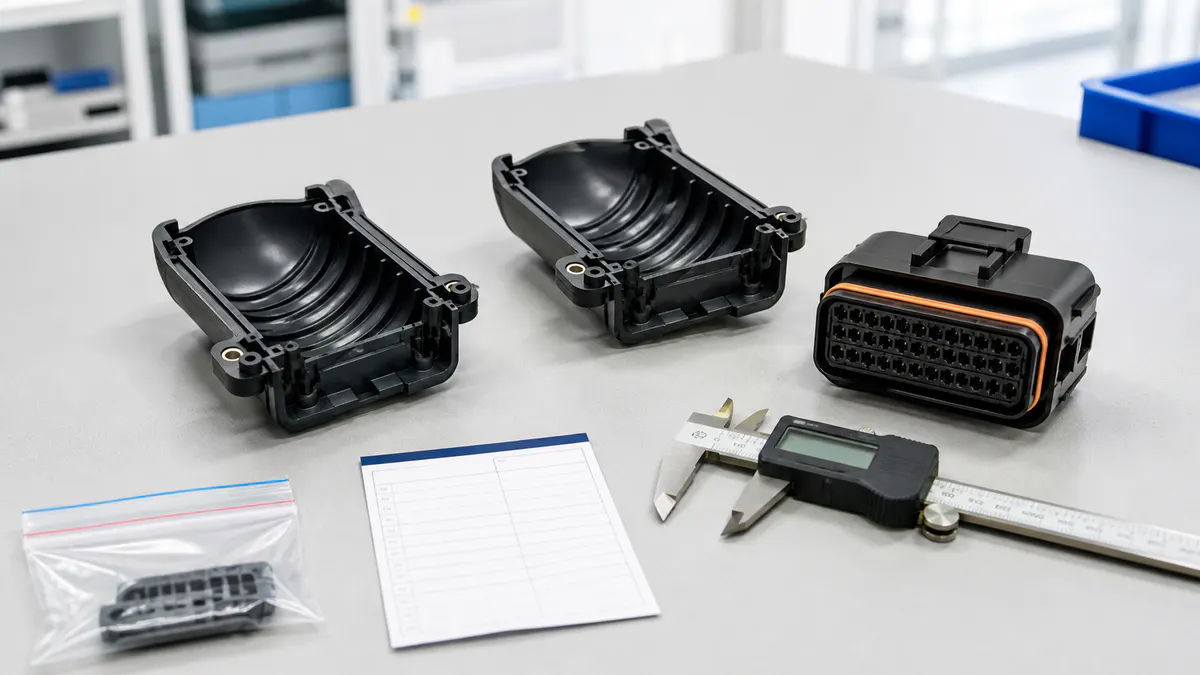
Begin with the official 2389806-1 product drawing, not a distributor thumbnail or the generic illustration on this page. Compare overall envelope, cable exit, mating housing interface, latch features, screw features, keep-outs and any dimensional tolerances relevant to the enclosure. If the old drawing is available in the controlled document system, create a marked comparison. Where a dimension is absent, do not infer it from a photograph; measure approved samples or ask TE for clarification.
The assembly process deserves equal attention. Mouser's listing says two pieces make one full assembly, which affects the purchase quantity and kitting logic. Confirm whether the current BOM quantity is “pieces per connector” or “complete backshell assemblies.” Then build a sample using production-intent cable, seals, terminals, housing and routing. Check that the strain relief closes correctly, the cable is not pinched, the connector can still mate and unmate, and the assembly fits the real enclosure path.
This does not mean the replacement is unsuitable. TE recommends it and lists it Active. It means the PCN itself identifies a reason to validate. Calling it a drop-in before that work would erase the most important warning in the source document.
Recommendation: release 2389806-1 through four named gates
A compact gate plan keeps sourcing urgency from bypassing engineering control. Give every gate an owner, evidence and due date.

- Geometry and fit: compare controlled drawings and confirm the new backshell envelope, interface, cable exit and enclosure clearance. Record every relevant difference instead of relying on “same family” language.
- Assembly method: confirm the number of pieces per completed connector, closure or mounting method, tools, cable routing, operator access and inspection points. Run a production-intent sample build and retain photographs or measurements that contain no customer-confidential markings.
- Revision control: update the BOM, AVL, assembly drawing, work instruction, inspection plan, packaging definition and service documentation as applicable. Define the effectivity rule: serial number, work order, lot, build date or exhaustion of approved old stock.
- Supply release: obtain a written quotation for the exact 2389806-1 MPN. Confirm quantity per assembly, MOQ, order multiple, factory pack, ATP, lead time, origin, traceability, date-code expectations and accepted delivery schedule.
If the program is customer-controlled, regulated or safety-relevant, add the required customer notification, PPAP or internal qualification path. The public sources reviewed here do not prove that any particular customer approval is unnecessary.
Recommendation: keep old-stock containment and new-part release separate
Use two linked records. The first controls remaining 776464-2 inventory. The second releases 2389806-1. This prevents an urgent purchase from silently changing production documentation.
For 776464-2, record the physical quantity, location, source, traceability, date code, open purchase orders and demand allocation. Decide whether the material is approved for new builds, service only or quarantine pending review. If independent-channel stock is considered, state the authenticity and incoming-inspection plan before the purchase order is issued.
For 2389806-1, create an engineering-change record that references PCN-25-245246 and the official drawing revision reviewed. Attach the fit-check evidence, updated assembly method and approval signatures. The BOM line should state the correct quantity basis, especially because a distributor description indicates two pieces per full assembly. The work instruction should show how the new closure or mounting feature is handled without copying unverified imagery from a public listing.
Finally, define the cut-in rule. Mixing old and new hardware on the same work order without a recorded effectivity point can complicate training, inspection, service spares and failure analysis. A controlled transition can allow both configurations, but the allowed combination and documentation must be explicit.
Recommendation: make the RFQ answer the real decision
A useful RFQ does more than ask for unit price. Send the exact MPN, required quantity, need date, ship-to country, approved-source requirement and traceability expectations. State whether the quantity is individual pieces or complete two-piece assemblies. Ask the supplier to confirm current ATP, factory lead time for the uncovered balance, MOQ, standard pack, price validity, origin, date code, certificate options and whether allocation applies.
If 776464-2 is still present in the BOM, include the lifecycle status and ask the supplier to separate any residual old-part offer from the 2389806-1 quotation. Do not allow a line-item substitution to act as engineering approval. Label 2389806-1 as manufacturer-recommended substitute / engineering validation required until the release gate closes.
For a PCBA or harness program, the engineering package may also need the mating connector, cable or wire specification, enclosure constraints and controlled assembly drawing. Gerber data is usually not required for a free-hanging backshell change unless board-level clearance, header alignment or adjacent mechanical features are affected. Share only the files needed for the review and remove customer-confidential material that is not necessary.
Need a controlled 776464-2 cutover?
Send the exact BOM line, current quantity per assembly, remaining approved stock, required build dates and the 2389806-1 quotation you want checked. For PCBA programs, include the relevant assembly drawing, enclosure or harness constraints and the minimum Gerber or mechanical data needed to review clearance. Informic can help structure the RFQ, separate lifecycle facts from supplier assumptions and prepare an engineering-review checklist for the change.
Request a BOM, RFQ or PCBA engineering review. Any proposed substitute remains subject to your drawing, sample, quality and customer-approval process.
Frequently Asked Questions
Is 2389806-1 a confirmed drop-in replacement for 776464-2?
No. TE lists 2389806-1 as the substitute, but PCN-25-245246 also states a latch-versus-screw-mounting difference. Treat it as a manufacturer-recommended substitute that requires drawing, fit and assembly validation before release.
Can we still place a normal factory order for 776464-2 on August 29, 2026?
The PCN gives August 29, 2025 as the last order date and August 29, 2026 as the last ship date. The later date is a shipping boundary for accepted final orders, not an extension of the stated order window.
Does visible distributor stock mean the EOL risk is solved?
No. Residual stock may cover a defined need, but quantity, traceability, date code and availability can change. Obtain a written quotation and order acceptance, and tie any old-part purchase to a documented demand horizon.
Why does “two pieces make one full assembly” matter?
It can change the BOM quantity, purchase quantity, packaging assumptions and kitting instructions. Confirm whether your controlled BOM counts individual halves or complete backshell assemblies before ordering or releasing work instructions.
Do we need to change Gerber files for this replacement?
Not automatically. A backshell is usually a mechanical or harness accessory. Review Gerbers only if board-level clearance, header position, enclosure geometry or adjacent features are affected. The assembly drawing, BOM, AVL and work instructions are more likely to require updates.
Sources
- TE Connectivity Product Change Notification PCN-25-245246, lifecycle dates, substitute and stated mounting difference; checked August 29, 2026.
- TE Connectivity 2389806-1 product page, Active status, product attributes, drawing and design-use note; checked August 29, 2026.
- DigiKey 776464-2 product page, Obsolete status and manufacturer-recommended substitute; checked August 29, 2026.
- DigiKey 2389806-1 product page, Active status and dated inventory/lead-time snapshot; checked August 29, 2026.
- Mouser 2389806-1 product page, dated inventory/lead-time snapshot and two-piece assembly description; checked August 29, 2026.
- Mouser Brazil 776464-2 product page, end-of-life status and dated residual-stock snapshot; checked August 29, 2026.
Choose the long-term lifecycle response
This notice is one part-specific event. Use the obsolete and EOL components decision framework to compare a calculated last-time buy, replacement qualification and redesign using the same demand, inventory, timing and approval evidence.
