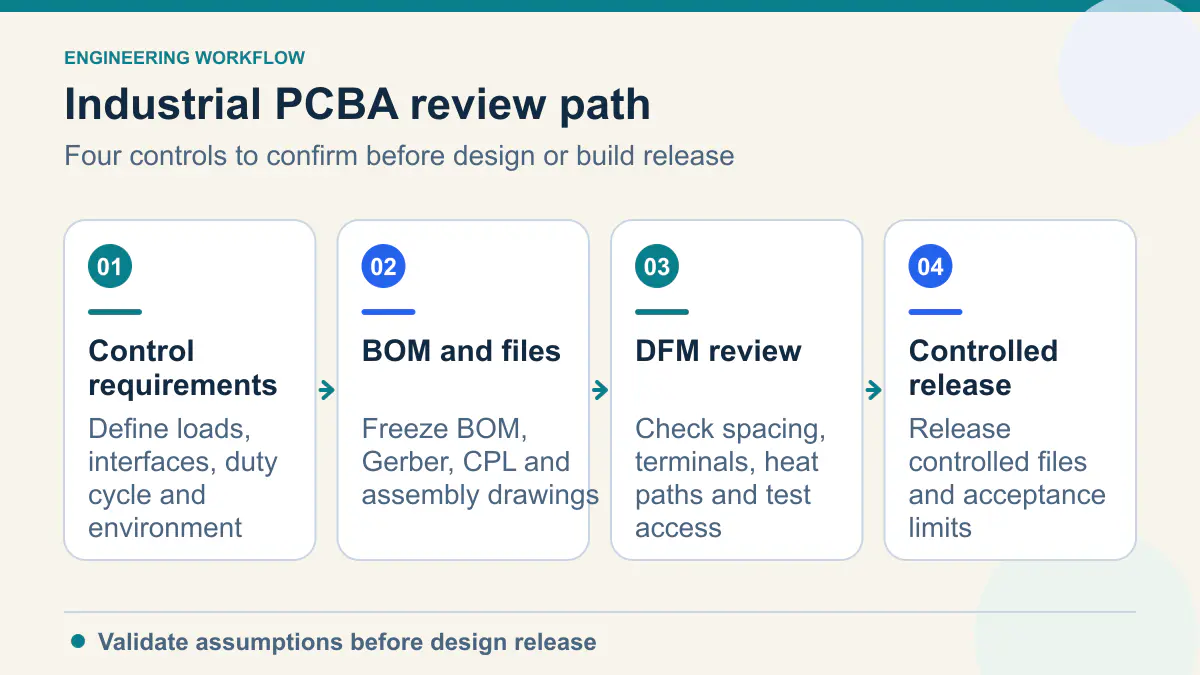
When you are specifying an industrial control PCB assembly for a smart electricity meter, the difference between a smooth production ramp and a field failure often comes down to decisions made before the first board is ordered. We write to you as a team that coordinates turnkey PCBA builds daily, and our answer is direct: the lowest-risk path is a disciplined engineering checklist applied to the design, the bill of materials (BOM), and the fabrication data before you send a single file to us.
This article is a practical, first-person guide from our work coordinating these builds. We will walk you through the specific questions we ask, the data we verify, and the coordination steps we take to reduce surprises. We are not presenting new test results or certifications; we are sharing the operational framework we use to keep your project moving.
Start with the Operating Environment, Not the Schematic
We begin every smart meter PCBA coordination project by asking about the physical environment. A meter on a utility pole in Minnesota faces different thermal cycling than one in a climate-controlled substation in Texas. We need to know the expected temperature range, humidity exposure, and whether the enclosure is sealed or vented. This is not a hypothetical exercise; it drives component derating, conformal coating choices, and solder mask selection.
Technical reference: For related engineering context, see IPC standards and industry resources.
Ask yourself: what is the maximum continuous current through the current-sense traces? What is the peak voltage transient the metering IC might see? These numbers should be written down before you choose a PCB stack-up. We have seen too many designs where the analog front-end is well-protected, but the power supply section has inadequate clearance for the expected surge. We will review your schematic for these gaps, but you should have the answers ready.
Our Engineering Checklist for Industrial Control PCB Assembly
Below is the core checklist we use when reviewing a smart meter design for manufacturability. It is not exhaustive, but it represents the highest-impact items we see in daily work. We encourage you to run your design against this list before you request a quote.
| Checklist Item | Why It Matters for Smart Meters | Action We Take |
|---|---|---|
| Trace width and spacing for high voltage | Mains-connected circuits require creepage distances per safety standards; we verify your layout meets the required clearances. | Run a design rule check (DRC) on the final Gerber files and flag any violations. |
| Thermal relief on ground planes | Poor thermal relief makes soldering difficult and can cause tombstoning on small passive components. | Verify all through-hole and SMD pads connected to planes have adequate thermal spokes. |
| BOM component lifecycle status | Using an end-of-life (EOL) part in a 10-year meter deployment is a recipe for a redesign. | Cross-check every part number against current availability and lifecycle data. |
| Fiducial placement for SMT | Misplaced or missing fiducials slow down the pick-and-place setup and reduce accuracy. | Confirm at least three global fiducials are present and clear of components. |
| Test point accessibility | In-circuit test (ICT) or flying probe requires physical access to nets; we need to see them on your layout. | Review the test point map and suggest additions where coverage is weak. |
This table is a starting point. For a more detailed review, we recommend you also look at our pcbManufacturing guide, which covers stack-up and material selection in depth.
The RFQ Process: What to Send Us
When you request a quote for an industrial control PCB assembly, the quality of the information you provide directly affects the accuracy of our response. We need a complete package, not only a schematic. Here is the minimum set of files we require:
- Gerber files (RS-274X) with a clear readme file explaining layer names.
- A drill file (Excellon) with plated and non-plated holes clearly marked.
- A full BOM in CSV or Excel format, including manufacturer part numbers, values, tolerances, and any alternate sources.
- A centroid file (XY coordinates) for all SMD components.
- A fabrication drawing with board thickness, copper weight, surface finish, and solder mask color.
- An assembly drawing or a marked-up PDF showing polarity, pin 1 orientation, and any special handling notes.
We also ask for a document that specifies your testing requirements. Do you need a basic continuity test, or do you require full functional test with a simulated load? For smart meters, we often see customers request a calibration step after assembly. We need to know this upfront because it affects the test fixture design and the overall lead time.
One common mistake is sending a BOM with distributor-specific part numbers instead of manufacturer part numbers. A part number like "Mouser 123-ABC" is not helpful if we need to source from a different distributor. Use the manufacturer's part number and the manufacturer's name. This is a simple step that saves a full day of back-and-forth.
DFM Review: Catching Problems Before They Cost Money
Our design for manufacturability (DFM) review is a separate step from the initial quote. We run a software analysis on your Gerber files and then a manual review by an engineer. The software catches issues like solder mask slivers, annular ring violations, and acid traps. The manual review is where we look for things the software cannot see, such as a component placed too close to a mounting hole or a connector that blocks access to a test pad.
We have a specific question we ask about every smart meter design: where is the isolation barrier? In a meter, you typically have a mains side and a low-voltage side. The creepage distance across the barrier is critical. If your layout has a slot cut in the PCB to increase the distance, we need to verify that the slot is routed correctly and that no copper traces cross it. We also check that the optocouplers or isolated DC-DC converters are placed with the correct orientation relative to the barrier.
Another frequent issue is the use of vias in pads. While this is acceptable for some designs, it can cause solder wicking issues during reflow. We will flag any via-in-pad that is not filled and capped. For a smart meter, where reliability over a decade is expected, we recommend filled vias in the current-sense circuit to avoid any potential for voiding or fatigue cracks.
We do not claim to catch every possible issue, but we do promise to give you a written report of our findings before we proceed to assembly. This report is your opportunity to make changes without incurring a second tooling charge.
BOM Coordination: The Hidden Risk in Every Build
The BOM is where we spend the most time during coordination. A smart meter PCBA can have 200 to 500 unique components, and each one has a supply chain story. When we receive your BOM, we immediately check for the following:
- Are all components active and not obsolete?
- Are the specified package sizes and footprints consistent with the layout?
- Are there any parts with long lead times (over 20 weeks)?
- Are there any single-source components that need a second source recommendation?
- Are the passive component tolerances appropriate for the metering accuracy requirements?
We often recommend alternative components, but we never make a substitution without your written approval. For example, a 1% resistor in the voltage divider network is usually fine, but a 0.1% resistor might be required for the reference circuit. We will not guess. We will ask you to confirm the accuracy class of the meter and then verify that the BOM matches that class.
We also coordinate with our trusted components suppliers to secure inventory early. This is especially important for the application-specific integrated circuit (ASIC) or the metering IC, which is often the longest lead-time item. We will advise you on when to place a non-cancellable order to protect your schedule.
If you are working with us on a turnkey basis, we take ownership of the procurement. This means we manage the purchase orders, the incoming inspection, and the kitting. You do not need to worry about a reel of capacitors arriving late or a batch of ICs being counterfeit. We handle that. But we still need your input on the approved manufacturer list (AML) and the approved vendor list (AVL).
Assembly Process Control for Smart Meters
Once the design and BOM are approved, the actual assembly process requires its own set of controls. We use a standard SMT line with solder paste printing, pick-and-place, and reflow. However, for smart meters, we pay special attention to a few steps:
First, the solder paste stencil design. We adjust the stencil aperture ratio for fine-pitch components and for components that need a higher solder volume, such as the current-sense resistor. We use a laser-cut stencil with electropolished apertures to ensure consistent paste release. This is a detail that affects the yield rate, especially for large arrays of boards.
Second, the reflow profile. We create a custom profile based on the solder paste specification and the thermal mass of the board. A smart meter board with a large copper pour for the current path will require a different profile than a simple logic board. We monitor the profile with a thermal profiler on the first board of every batch and then periodically during the run.
Third, the inspection process. We use automated optical inspection (AOI) on every board after reflow. We also use X-ray inspection for BGA components and for the isolated power supply modules if they are present. For final assembly, we perform a visual inspection per IPC-A-610 Class 2 standards, which is the typical requirement for industrial control products. We do not claim Class 3 unless you specifically request it and we agree on the additional cost and inspection time.
We also handle the programming of any microcontrollers or memory chips. This is often done before assembly, using a programming fixture, or after assembly, via a programming header. We need to know your preference early because it affects the test plan.
Functional Testing and Your Role
The final step before shipping is functional testing. We do not offer a generic "test" without understanding what you need. For a smart meter, the test might include:
- Power-up test with a specified input voltage.
- Current measurement accuracy check using a calibrated source.
- Communication interface test (e.g., RS-485, PLC, or RF module).
- Firmware upload and verification.
We can build a custom test fixture for your product, but we need your input on the test specification. We will ask you for the pass/fail criteria for each test point. We do not invent these criteria. We also recommend that you provide a reference unit or a golden sample that we can use to calibrate the test fixture.
One question we always ask is: who owns the test software? If you provide the test scripts, we will integrate them into our test station. If you expect us to write the test software, we need a detailed specification of the electrical measurements and the communication protocol. This is a significant part of the project scope, and it is often underestimated in the planning phase.
We also recommend that you review the test coverage with us. A basic test might only check for shorts and opens. A comprehensive test will verify the functionality of every major IC. For a smart meter, we strongly recommend a functional test that exercises the metering path, as this is the core function of the product.
If you need to make changes after the first test run, we will work with you to update the test plan. This is a normal part of the development cycle. We do not charge for every minor change, but we do track the time and communicate clearly if a change requires significant rework.
Working with Our Team
Our goal is to be a single point of contact for your pcba needs. We coordinate the PCB fabrication, the component procurement, the assembly, and the testing. This does not mean you lose control; it means you have fewer vendors to manage. We provide you with a project manager and a process engineer who are available to answer your questions.
We encourage you to ask for a design review call before you finalize your layout. We can often spot issues that will save you a revision cycle. For example, we might suggest moving a test point or changing a footprint to improve solderability. These are small changes that have a big impact on yield.
We also recommend that you visit our facility if you are in North America. Seeing the assembly line and the test area gives you confidence in the process. We can show you how we handle ESD control, how we store components, and how we track each board through the production process. This is not a sales pitch; it is a practical step to build trust.
When you are ready to move forward, the first step is to send us your files for a quote. You can use the quote request form on our website. We will respond within one business day with a preliminary review and a request for any missing information.
FAQ
What is the minimum order quantity for a turnkey PCBA?
We do not have a fixed minimum order quantity (MOQ) for all projects. For smart meter PCBA, we regularly handle prototype runs of 10 to 50 boards and production runs of 1,000 or more. The MOQ is often driven by the component procurement, especially for custom or long-lead items. We will give you a clear breakdown of any MOQ-related costs during the quote process.
How do you ensure the quality of the components you source?
We source components only from authorized distributors or directly from manufacturers. We do not buy from brokers or open-market sources unless you explicitly request it and accept the risk. Every component lot is verified against the manufacturer's markings and, for critical parts, we perform incoming inspection with a microscope and, if necessary, X-ray. We also maintain a traceability record for every reel and tube used in your build.
Can you help us with a design that is not yet finalized?
Yes, we can work with you during the design phase. We offer a DFM review on preliminary layouts and can provide feedback on component selection and board stack-up. This is a paid service if it requires significant engineering time, but we often include a basic review as part of a new project kickoff. The earlier you involve us, the more value we can add in terms of manufacturability and cost reduction.