
When your product is a specialized control module for a classic truck, a telematics unit for a niche fleet, or a driver-assistance retrofit for a legacy platform, your PCBA volume rarely looks like a smartphone. You are operating in high-mix, low-volume (HMLV) territory. For automotive aftermarket electronics, the engineering challenge is not about squeezing cost from a million-unit run; it is about controlling risk when every board revision matters and your supplier’s mistakes become your field failures.
We engineer a lower-risk path for HMLV PCBA by treating the bill of materials and the assembly process as a single system. We do not simply quote your Gerbers and hope for the best. We start with a direct question: What is the intended operating environment for this board, and what failure mode keeps you awake at night? The answer changes our DFM review, component selection, and test strategy.
Our HMLV Engineering Checklist: From RFQ to First Article
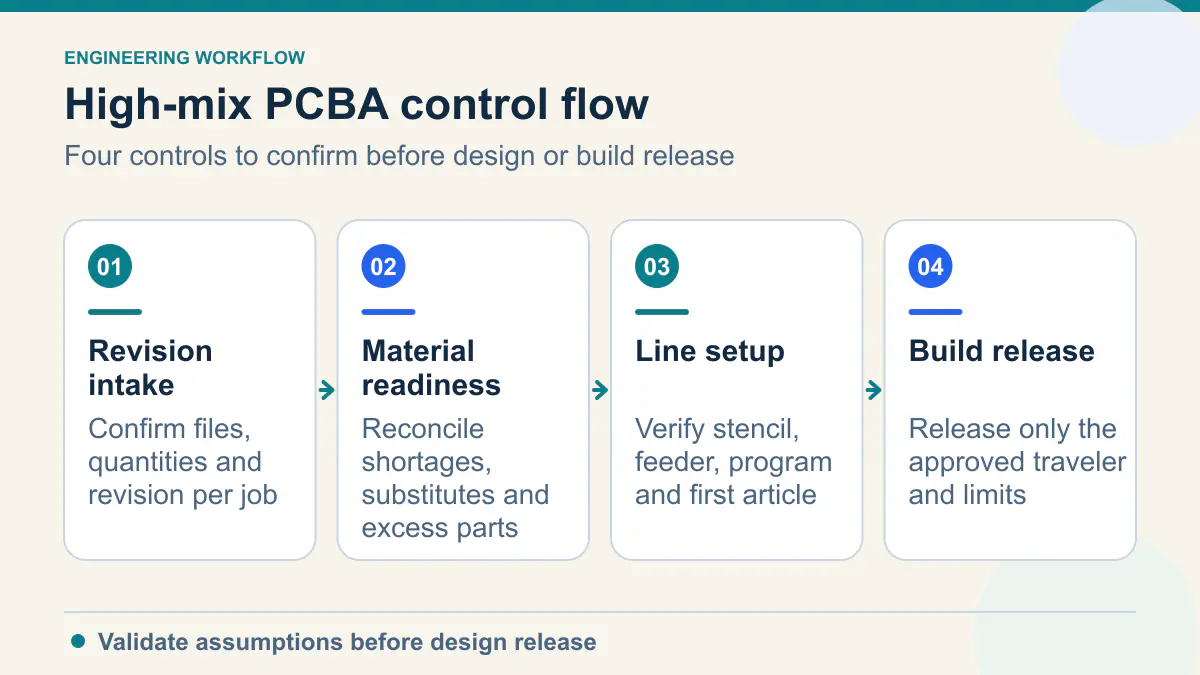
We approach every automotive aftermarket project with a specific sequence of engineering reviews. This is not a generic quality checklist; it is a focused set of actions designed to catch issues before they become expensive rework loops.
Technical reference: For related engineering context, see IPC standards and industry resources.
1. RFQ Review: Beyond the Netlist
When you send us a request for quote, we do not immediately calculate a price. We first perform a design for manufacturability (DFM) review focused on HMLV realities. For automotive aftermarket, we look for specific risks:
- Component obsolescence: Are any parts nearing end-of-life? We check against our components database for alternate sourcing.
- Thermal cycling: Is the board subject to under-hood temperatures or cabin temperature swings? This drives solder paste selection and pad design.
- Vibration resistance: Are heavy components like electrolytic capacitors properly supported? We may recommend adhesive or through-hole mounting for critical parts.
- Connector strain: Are the connectors rated for repeated mating cycles common in aftermarket installation?
We ask you for the worst-case electrical load and the expected field life. A board that works for a bench demo may fail after two winters of salt spray and vibration. We want to know that before we order stencils.
2. DFM: Designing for the Assembly Line, Not the Drawing Board
In HMLV, the assembly line changes every week. Your board must be robust to setup variation. We focus on three areas:
- Panelization: We design break-away arrays that allow for consistent solder paste printing. We avoid V-score lines that weaken the board near high-stress components.
- Fiducials: We require at least three fiducials for accurate placement. For boards with fine-pitch QFPs or BGAs, we add local fiducials near the critical component.
- Thermal relief: We check that ground planes connected to through-hole pins have proper thermal relief. Without it, you get cold solder joints on connectors. a classic field failure.

We also look at your component placement from the perspective of a pick-and-place machine. Can the nozzle reach every part? Are there tall components blocking the placement of smaller ones? A 30-second design tweak can save hours of manual assembly time in a low-volume run.
3. BOM Management: The HMLV Trap
The biggest risk in HMLV is not assembly; it is the bill of materials. A single obsolete component can halt production for weeks. We manage this actively.
| BOM Risk | Our Engineering Response | Why It Matters for Automotive Aftermarket |
|---|---|---|
| Obsolete part | We identify alternate sources or suggest a drop-in replacement with similar electrical specs. | Your product may be in service for 10+ years; you need a path to repair. |
| Long lead time | We flag parts with 20+ week lead times and suggest a second source. | Unexpected demand for a retrofit kit cannot wait for a custom IC. |
| Moisture-sensitive devices (MSD) | We verify the MSL level and ensure proper baking before assembly. | Aftermarket boards often sit in warehouses before installation; moisture damage is silent. |
| Counterfeit risk | We source only from authorized distributors or our trusted pcba supply chain. | Automotive environments punish fake components quickly. they fail under heat and vibration. |
We also ask you to provide a list of critical components that must not be substituted without your written approval. For everything else, we propose alternates during the quote phase, not after the board is in production.
Assembly Process Engineering for Low Volumes
High-volume lines use massive solder paste printers and high-speed placement machines. For HMLV, we use flexible cells that can switch over quickly. But flexibility does not mean lower quality. We maintain the same stencil inspection and solder paste quality checks as a high-volume line.
Solder Paste and Stencil Design
We use a laser-cut stencil with electro-polished apertures for consistent paste release. For boards with mixed component sizes. a large connector next to a 0402 resistor. we may recommend a step stencil. This is a critical DFM decision. If the stencil is too thick, you get solder balls on fine-pitch parts. If it is too thin, you get insufficient solder on through-hole components.
Selective Soldering for Through-Hole
Many automotive aftermarket boards use through-hole connectors for durability. We use selective soldering machines for these joints. This provides consistent results without subjecting the entire board to wave solder thermal shock. We set up the nozzle program based on your board layout and monitor the solder joint quality with automated optical inspection (AOI) after the process.
Testing: Where HMLV Actually Wins
In high-volume, you rely on statistical process control. In HMLV, you can afford to test every board. We recommend a two-stage test strategy:
- In-circuit test (ICT): For boards with test points, we use a fixture to check opens, shorts, and component values. This catches assembly defects quickly.
- Functional test: We build a custom test rig that simulates the automotive environment. voltage fluctuations, load changes, and signal integrity. We run your firmware or a basic loop-back test to verify the board operates as intended.
We ask you to provide a test specification or a known-good board for reference. If you do not have a formal test document, we can work with you to define a basic power-on and I/O check. This is not a replacement for your own validation, but it catches the majority of assembly errors.
Why We Do This Work Differently
We are not a high-volume contract manufacturer that accepts your files and disappears. We are an engineering partner that reviews your design with the same care you would apply to your own prototype. When you send us a pcbManufacturing inquiry, we respond with questions, not only a quote. We want to know about your connector choices, your enclosure constraints, and your field service plan.
This approach is slower at the front end. But it is faster at the back end. We have seen too many HMLV projects fail because the supplier treated a 100-board run like a 100,000-board run, using automated DFM tools that flagged every via as a problem and ignored the real issues like thermal stress on a power transistor. We use our engineering judgment, not only software flags.

FAQ
What is the minimum order quantity for HMLV PCBA?
We do not have a fixed MOQ. We have assembled single prototype boards for validation and runs of 500 units for a pilot production. The key is not the quantity but the engineering setup. We can work with you to minimize setup costs by grouping multiple board designs in a single panel or using common component libraries. For automotive aftermarket, we recommend starting with a pilot run of 25–50 boards to validate the assembly process before committing to a larger quantity.
How do you handle component obsolescence for long-life automotive products?
We monitor your BOM against our component database and industry notifications. When a part is flagged for end-of-life, we notify you immediately and propose alternatives. We also recommend designing with second sources in mind from the start. using standard package sizes and avoiding custom parts where possible. For critical components, we can arrange for a last-time buy and hold the inventory in our bonded warehouse.
Can you test boards with our proprietary firmware?
Yes, but we need a clear test protocol. You can provide a test script, a known-good board, or a simple pass/fail criteria. We can also work with your firmware engineer to develop a basic boundary scan or a loop-back test that verifies the board’s I/O without exposing your intellectual property. We do not need your source code; we need a defined electrical stimulus and expected response.
