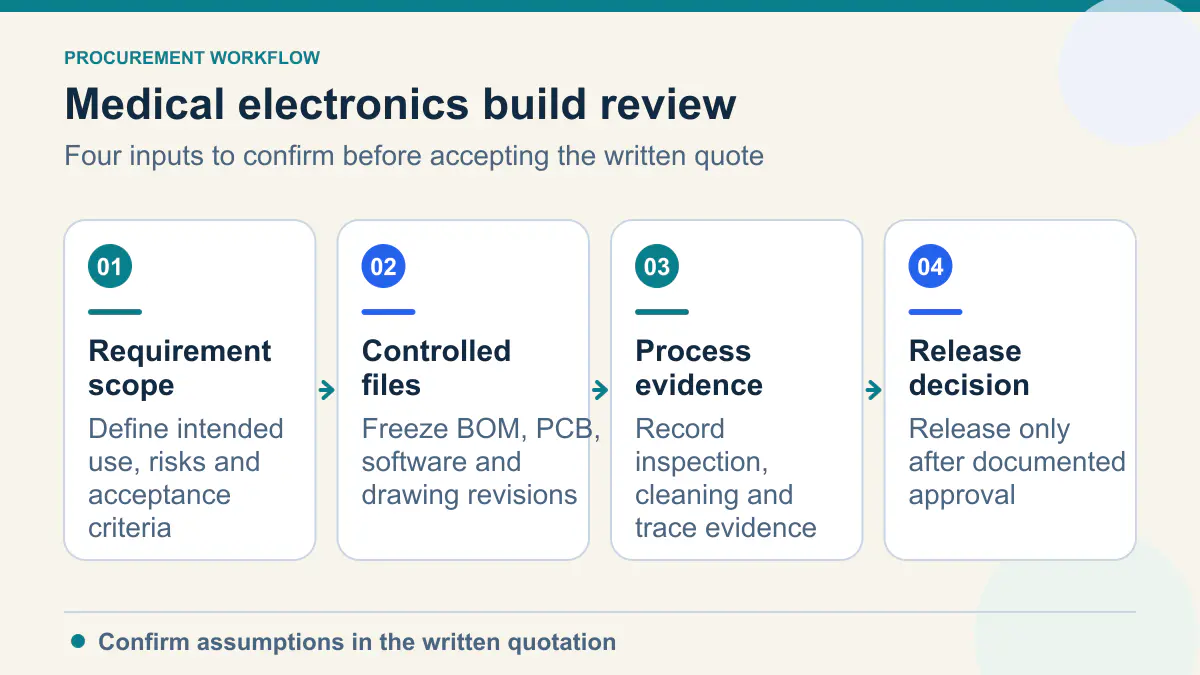
If you are sourcing electronics for smart electricity meters and have been told to look at medical device electronics manufacturing standards, you likely have one pressing question: how do we get a clear, accurate supplier quotation without weeks of back-and-forth? The direct answer is this: send us a complete RFQ package with your bill of materials (BOM), known component risks, and target test criteria. That is the fastest path to a reliable quote. In our daily work, we see that purchasing teams who prepare these three items get clearer pricing and faster feedback than those who send only a schematic.
We are Informic. We work with manufacturing teams across African markets, from Nairobi to Lagos, who build electricity meters under tight deadlines. Our role is to support your electronics solution from component selection through PCBA assembly. This article explains exactly what we need from you, why medical device grade thinking applies to metering, and how we turn a vague request into a concrete quotation.
Why Medical Device Electronics Manufacturing Standards Matter for Metering
Smart electricity meters are not medical devices, but they share critical demands. Both require long lifecycle reliability, precise measurement, and predictable behavior over years of operation. Medical device electronics manufacturing often uses stricter component traceability and testing protocols because a failure has direct human consequences. For electricity meters, a failure means inaccurate billing, safety risks, or grid instability. So, when we apply medical grade discipline to your meter project, we are not adding bureaucracy. We are reducing the chance that a batch of 10,000 units fails in the field.
Technical reference: For related engineering context, see IPC standards and industry resources.
What does this mean for you as a buyer? It means we ask harder questions upfront. We want to know your expected operating temperature range, your surge immunity requirements, and your accuracy class. We do not assume that a standard commercial grade component will work just because it is cheaper. We treat your meter as a critical instrument, not a commodity gadget.
Our Daily Approach to RFQ Review
When your RFQ arrives, we do not only read the first page. We check the BOM line by line. We look for obsolete parts, long lead time items, and components that have known counterfeit risks. Then we compare your requested components against our current stock and supplier network. This is where our components sourcing strength comes in. We can often suggest a drop-in alternative that is more available in your region, saving you months of waiting.
We also review your test requirements. Many meter buyers specify IEC standards, but they do not always tell us which tests they will run themselves versus which tests they expect us to perform. That distinction changes the quotation significantly. If you plan to do final calibration in-house, we can adjust our process. If you want us to handle full functional testing, we need to see your test fixture specifications. This is not a delay tactic. It is how we avoid quoting you for work you do not need or missing work you do need.
Three Concrete Steps to Get a Better Quotation
Here is a practical sequence we recommend to every procurement team we speak with. Follow these steps, and you will see a measurable difference in the clarity of our response.
Step 1: Prepare a Complete BOM with Manufacturer Part Numbers
Do not send a generic description like "capacitor 10uF." We need the exact manufacturer part number, the package size, and the voltage rating. If you have multiple approved sources, list them all. This allows us to check availability across our distributor network instantly. A complete BOM also lets us flag potential issues before we quote. For example, if your BOM includes a microcontroller that is already end-of-life, we can tell you now, not after you have signed a contract.
We also recommend you include your annual volume forecast and your expected order frequency. This is not only for pricing. It affects how we plan component stocking. If you tell us you need 5,000 units per quarter, we can hold critical parts for you. If you only need a one-time batch of 500, we will advise you on the most economical way to purchase components without overcommitting to inventory.
Step 2: Share Your Design Files and Test Criteria
Send us your Gerber files, schematic, and assembly drawings. If you have a design for manufacturability (DFM) checklist, include it. We will run our own DFM review, but your input helps us understand which constraints are fixed and which are flexible. For instance, if your PCB layout is already finalized for a specific enclosure, we need to know that. It changes our advice on component placement and thermal management.
For test criteria, be explicit. List the functional tests you require, the pass/fail thresholds, and the sampling plan. If you need a 100% burn-in test for every unit, say so. If you accept AQL sampling, specify the level. This clarity prevents disputes later. We have seen projects stall because the buyer assumed we would do full functional testing, but the quotation only included basic visual inspection. Do not let that happen to you.
Step 3: Ask About Component Risk and Substitution Options
Before you send the RFQ, think about which components are critical to your meter's accuracy. Usually, that is the metering IC, the voltage reference, and the current sensing elements. Ask us directly: "What is the lead time on these parts?" and "If this part becomes unavailable, what is your recommended alternative?" A good electronics manufacturing partner will have a plan, not only a price.
We maintain a list of approved alternates for many common metering components. When we see a risky part in your BOM, we will offer a substitution that meets your specs. This is not a sales tactic to push higher margin parts. It is a risk management conversation. We would rather you know the risk upfront than discover it six months into production.
For a deeper look at how we handle PCB fabrication, you can review our pcbManufacturing process. For assembly and testing specifics, see our pcba page. Both pages describe the capabilities we bring to your project.
What We Include in Every Quotation
When we send you a quotation, it is not only a price per unit. It is a document that breaks down the cost into three clear sections: component cost, assembly cost, and test cost. This transparency helps you compare our quote against others and understand where your money goes.
| Cost Section | What It Covers | What We Need From You |
|---|---|---|
| Component Cost | All active and passive components, plus any sourcing fees for hard-to-find parts | Complete BOM with part numbers and quantities |
| Assembly Cost | PCB fabrication, solder paste, placement, reflow, and manual assembly if needed | Gerber files and assembly drawings |
| Test Cost | In-circuit test, functional test, calibration, and burn-in as required | Test specifications and pass/fail criteria |
We also include a lead time estimate for each phase. This is not a fixed promise because component availability changes weekly. But it gives you a realistic planning window. If we see a component with a 20-week lead time, we tell you immediately and suggest a faster alternative if one exists.
Common Misunderstandings About Medical Device Grade Manufacturing
We often hear buyers say, "We are not a medical device company, so why are you talking about medical standards?" The answer is simple. The processes that medical device manufacturers use, like full traceability of components, documented test results, and change control, are the same processes that protect you from field failures. We are not asking you to become a medical device company. We are asking you to adopt the good habits that keep your meters reliable.
Another misunderstanding is that medical grade manufacturing is always slower and more expensive. That is not necessarily true. The extra cost comes from documentation and testing. If you do not need full traceability, we can skip that and reduce cost. But we will ask you to sign a waiver acknowledging that you accept the risk. Our job is to make the tradeoff visible, not to decide for you.
How We Support African Manufacturing Teams Specifically
We understand that logistics in African markets can be challenging. Customs clearance, local regulations, and power reliability all affect your production schedule. We work with you to plan around these issues. For example, we can recommend components that are easier to source through regional distributors, reducing your dependence on international air freight. We also design for manual assembly where automation is not available, without compromising quality.
We also know that payment terms and currency fluctuations matter. We quote in your preferred currency when possible and offer flexible payment milestones. This is not something you will find in a standard brochure. It comes from years of working with teams like yours. If you want to discuss your specific situation, use our quote form and mention your location and volume. We will respond with practical advice, not a generic sales pitch.
Practical Recommendations vs. Verified Facts
We want to be clear about what we know versus what we recommend. The fact is that smart electricity meters require accurate measurement and long-term stability. That is a verified technical requirement. What we recommend is that you apply medical device manufacturing discipline to your supply chain. That is our professional opinion based on years of seeing projects succeed or fail. We do not claim that every meter must be built to medical standards. We do claim that the habits of traceability and upfront testing will save you money in the long run.
We also recommend that you test early and test often. Build a few prototypes, run them through your own environmental tests, and then send us the results. This is cheaper than discovering a design flaw after you have ordered 10,000 PCBs. We can help you with the prototype build and the initial test plan.
FAQ
Do I need to have a complete BOM before I request a quote?
Yes, a complete BOM is the single most important document you can send us. Without it, we can only give you a rough estimate, which is often wrong. If you have a partial BOM, send it anyway. We can help you identify missing components and suggest parts for critical functions. But the faster you complete the BOM, the faster we can give you an accurate quotation.
What is the typical lead time for a smart meter PCBA order?
Lead time depends on component availability and your test requirements. For a standard design with readily available components, we can often deliver prototypes in three to four weeks. Production quantities of 1,000 units or more typically take six to eight weeks, including testing. If your design uses rare components or requires extensive calibration, the lead time will be longer. We will always give you a specific lead time in your quotation, not a vague range.
Can you help us if our design is still in development?
Yes, we support design-in work. We can review your schematic for manufacturability, suggest component alternatives that are easier to source, and build early prototypes for testing. This is often the most valuable time we spend with a customer. Catching a design issue before you commit to tooling or full production saves significant time and money. Send us your current design files, even if they are not final, and we will give you feedback.