
When you ask us for a PCB stackup design supplier quotation, the first thing we do is ask you three questions. How many layers? What copper weight? What thickness? If you can answer those, we can give you a realistic price range in hours, not days. If you cannot, we will help you answer them before we talk money. That is the core of our daily work at Informic. We are not here to sell you a mystery box. We are here to make the BOM sourcing and consolidation process for two- and three-wheel electric vehicle factories as boring and predictable as possible.
Let us be direct. A PCB stackup is the layered structure of your circuit board. It defines how copper, insulation, and signal layers are arranged. For electric scooters, motorcycles, and three-wheelers, the stackup directly affects your motor controller, battery management system (BMS), and dashboard display. If the stackup is wrong, your factory stops. If it is right, you assemble faster and troubleshoot less. That is why we start with the physical board, not the component list.

Why the stackup matters more than you think for EV production
In our experience working with assembly teams across African manufacturing markets, we see the same pattern. A procurement buyer receives a design file from an engineer. The engineer specifies a four-layer board. The buyer sends that file to three PCB suppliers. The suppliers return wildly different quotes. Why? Because the stackup was not fully defined. One supplier assumes 1.6mm total thickness. Another assumes 1.0mm. One quotes 1oz copper on all layers. Another quotes 0.5oz on inner layers. The price difference can be 30 percent or more. But the physical board also behaves differently.
Technical reference: For related engineering context, see IPC standards and industry resources.
For a two-wheeler controller handling 30 to 60 amps, copper thickness is not a detail. It is a thermal and current-carrying decision. For a BMS monitoring 20 series cells, the spacing between layers affects noise and safety. We are not making a scientific claim here. We are describing what we check every day when we review stackup files from our customers. The practical point is this: a vague stackup is a vague quote. A specific stackup is a firm quote.
The four numbers we need from you
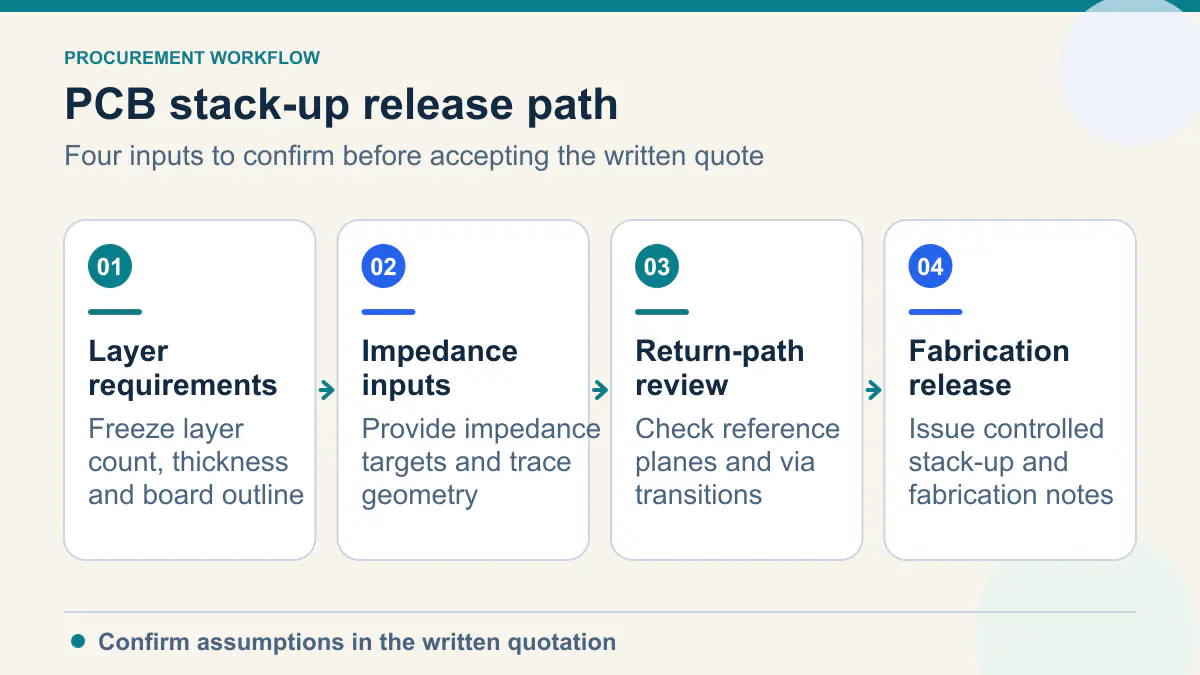
When you send us a request for quotation (RFQ), please include these four numbers if you have them. If you do not have them, we will ask your engineering team or help you derive them from the design.
- Layer count: Usually 2, 4, or 6 for EV applications.
- Total board thickness: Common values are 1.0mm, 1.2mm, 1.6mm, or 2.0mm.
- Copper weight per layer: Outer layers often 1oz or 2oz. Inner layers often 0.5oz or 1oz.
- Surface finish: HASL, lead-free HASL, ENIG, or OSP. This affects solderability and cost.
If you give us those four, we can give you a stackup that is manufacturable and cost-effective. We do not invent exotic materials unless your design requires them. For most two- and three-wheel EV boards, standard FR-4 is the right choice. It is proven, available, and affordable. We will not push you to a high-frequency material for a motor controller. That would be over-engineering and over-budget.
How we turn a stackup into a clearer BOM
Here is where our role changes. We are not only a PCB supplier. We are a BOM sourcing and consolidation partner. Once the stackup is fixed, we know the board's physical constraints. That tells us which components can fit and which cannot. For example, a 1.0mm board with 0.5oz inner layers is not ideal for a high-current MOSFET in a TO-220 package unless you use proper thermal vias. We flag that before you buy 10,000 pieces.
This is the practical value of combining stackup design with component sourcing. When you ask for a quote, we look at the whole picture. We check your schematic against the stackup. We ask about operating temperature. We ask about vibration because a three-wheeler on a Nairobi road is different from a test bench. We ask about your expected production volume because that affects whether we recommend a panel layout with multiple boards per panel or a single board per panel.
A simple table to compare stackup options
To make this concrete, here is a comparison we often use in early discussions with EV factory teams. This is not a price list. It is a decision aid.
| Stackup option | Typical use | What we check | Cost direction |
|---|---|---|---|
| 2-layer, 1.6mm, 1oz outer | Simple BMS, display board | Trace width for current, spacing for voltage | Lowest |
| 4-layer, 1.6mm, 1oz outer, 0.5oz inner | Motor controller, main logic board | Impedance control for signals, thermal relief | Moderate |
| 4-layer, 2.0mm, 2oz outer, 1oz inner | High-current controller, 48V and above | Copper thickness for heat, via size, solder mask | Higher |
| 6-layer, 1.6mm, 1oz all layers | Complex BMS with CAN bus and sensing | Layer spacing for noise, ground planes | Highest |
This table is not a rule. It is a starting point. Your specific design may need a different combination. That is fine. The point is to have a conversation, not a monologue. When we receive a stackup that is incomplete, we do not guess. We send you a short list of questions. That is faster for everyone than quoting on a wrong assumption.
DFM steps we run before you commit
Design for manufacturability (DFM) is not a buzzword for us. It is a checklist we run on every stackup we receive. Here are the steps we take, and you can ask your current supplier if they do the same.
First, we check the minimum trace width and spacing against the copper weight. A 2oz copper layer requires wider minimum traces than a 0.5oz layer. If your design has 5 mil traces on 2oz copper, that is a problem. Second, we check the hole size to board thickness ratio. A 0.2mm hole on a 2.0mm board is difficult to plate reliably. We will ask you to enlarge the hole or reduce the thickness. Third, we check the solder mask clearance around pads. If the clearance is too small, solder bridges appear during assembly. That is a field failure waiting to happen.
We do not charge you for this review. It is part of our service. But we are transparent about what we find. If we see a risk, we tell you. If we see a way to reduce cost by changing the stackup, we tell you. For example, if you have a four-layer board but only two layers carry signals, we might suggest a two-layer board with thicker copper. That could cut your board cost by 20 percent. We will not make that change without your approval. But we will offer it.
The RFQ process we recommend
To get a clear quotation from us, follow this sequence. It saves time for both sides.
First, send us your schematic and layout files in a common format like Gerber or ODB++. If you do not have them, send us a block diagram and a list of key components. Second, include the four stackup numbers we mentioned earlier. If you are missing any, tell us. We will ask targeted questions. Third, tell us your target production volume and expected timeline. A prototype run of 10 boards is different from a production run of 5000 boards. Prices and lead times differ. Fourth, tell us your assembly location. If you assemble in Lagos, Accra, Nairobi, or Johannesburg, we can plan logistics for pcbManufacturing and delivery accordingly.
We also recommend you ask us for a dual quote. One quote for the bare PCB and one quote for the PCB plus pcba (printed circuit board assembly). That way you see the board cost and the assembly cost separately. Some suppliers bundle them and hide the margin. We do not. We want you to know what you are paying for. When you consolidate your BOM with us, we source components from our network and combine them with your boards. This reduces your supplier count and your inbound freight cost.

Common mistakes we see in EV stackup requests
We have seen many RFQs from two- and three-wheeler factories. Here are the most common mistakes we encounter. First, ignoring the thermal path. A motor controller without proper thermal vias will overheat. The stackup must include a thermal relief pattern under high-power components. Second, using the same stackup for a prototype and a production run. Prototypes can tolerate a slightly exotic stackup. Production needs a standard one. We will advise you to standardize early. Third, forgetting the mechanical fit. A board that is 1.6mm thick may not fit in a sealed controller housing designed for 1.2mm. We ask about your enclosure before we finalize a stackup.
Another mistake is specifying a surface finish that does not match your assembly process. If you use lead-free solder, HASL lead-free is fine. If you need fine-pitch components like QFPs, ENIG is better. If you are cost-sensitive and use through-hole components, OSP is an option. We will match the finish to your assembly method, not to a preference sheet.
What we will tell you before you sign
We are clear about what we know and what we do not know. We do not claim that a specific stackup will improve your efficiency by a percentage. We cannot prove that. What we can tell you is whether a stackup is manufacturable, what it will cost, and what risks we see. That is based on our daily work with PCB suppliers and assembly partners. We will also tell you if we think a different stackup could save money without changing performance. That is a recommendation, not a guarantee.
We also tell you about lead times. A standard 4-layer board with 1oz copper is often faster to source than a 6-layer board with 2oz copper. If you are in a hurry, we will tell you to simplify. If you have time, we will tell you when a more complex stackup is worth it. We do not push you to the cheapest option if it will fail in the field. We also do not push you to the most expensive option if the standard one works.
How to get a quote from us
The fastest way to start is to send us your stackup file and your BOM list. If you have a schematic but no stackup, send the schematic. We will work with you to define the stackup. If you have a completed design, send the Gerbers. We will review them and come back with questions. You can reach us through our quote page. We respond within one business day. That is our standard.
We work with factories across African manufacturing markets. We understand that logistics can be challenging. We also understand that a stopped line costs more than a slightly higher component price. That is why we focus on clarity first. A clear stackup and a clear BOM lead to a clear quote. That is the whole point.
FAQ
What is the minimum information I need for a PCB stackup quotation?
You need the layer count, total board thickness, copper weight per layer, and surface finish. If you have a Gerber file, that helps us verify the design. If you do not have these numbers, send us your schematic or a block diagram. We will help you define them before quoting.
How does the stackup affect my BOM cost?
The stackup determines which components can be placed and how they are connected. A thicker copper layer allows higher current but may require wider traces, which affects board size. A thicker board may require larger holes, which affects drilling cost. We consolidate your BOM to match the stackup, so you do not buy components that will not fit or perform poorly.
Can you help me change my stackup to reduce cost?
Yes, but only after we review your design. If your current stackup has more layers than needed or thicker copper than required, we will suggest alternatives. We do not make changes without your approval. We explain the trade-offs in plain language, so you can decide based on your production needs and budget.
