Electronics Contract Manufacturing Quotes: How We Make Purchasing Clearer for AI and Data-Center Server Teams
When you ask for an electronics contract manufacturing quote, you usually want one thing: a clear, comparable price for a server board or system that meets your specification. We understand that. As a contract manufacturer focused on AI and data-center infrastructure, we work with procurement teams every week who are tired of vague proposals. Our job is to turn your BOM and drawings into a quotation you can actually use for budgeting and supplier comparison.
Technical reference: For related engineering context, see IPC standards and industry resources.
Here is how we approach quoting, what we include, and what you should expect from any serious partner in Europe.
Start With a Direct Answer to Your RFQ
We do not send a one-line price. A useful electronics contract manufacturing quote must break down the cost structure so you can see where the money goes. For AI server boards, the main cost drivers are usually the PCB layer count, the component density, and the assembly complexity. High-speed materials for 112G SerDes links cost more than standard FR4. Fine-pitch BGAs add X-ray inspection steps. These are not surprises; they are engineering facts we need to discuss early.
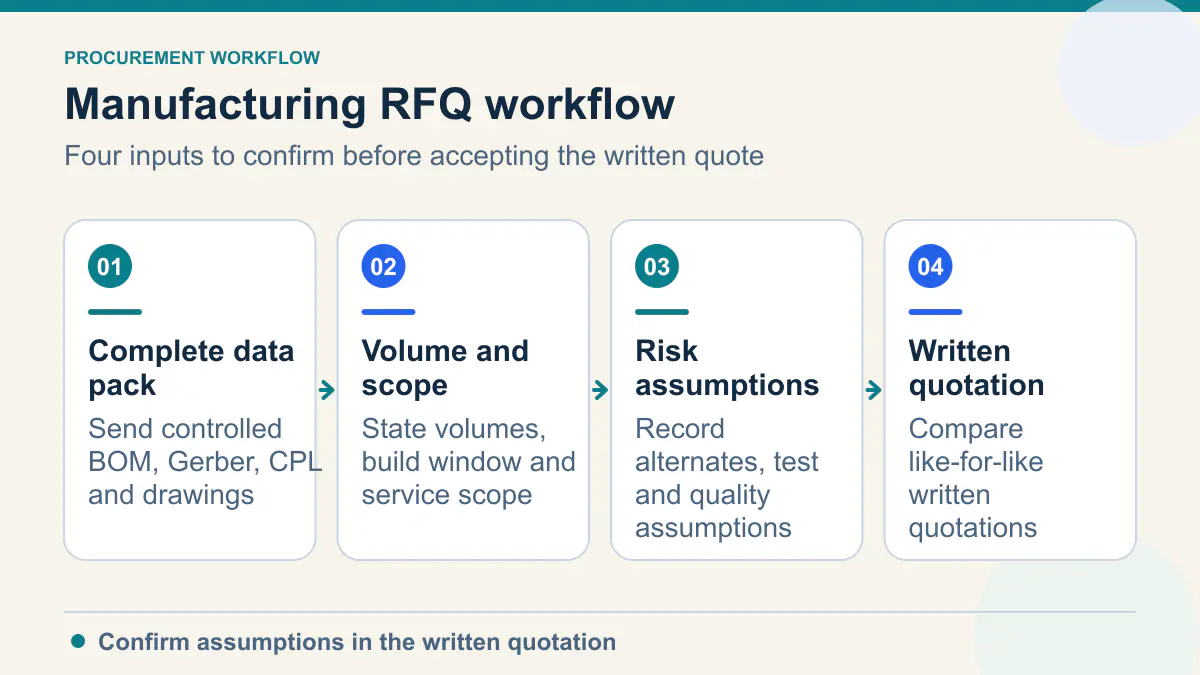
When we receive your RFQ, we respond with a structured document that includes:
- Unit price at your target annual volume (e.g., 500, 1,000, or 5,000 units).
- Tooling and NRE (non-recurring engineering) costs, including any test fixture design.
- Lead time for prototypes and for production ramp.
- Payment terms and Incoterms (we usually quote DDP within Europe).
- Assumptions about component availability and obsolescence risk.
That last point matters. In 2025, we still see allocation on certain power management ICs and high-end FPGAs. A quote without a component risk assessment is incomplete. We will tell you if a part has a long lead time or if we see a potential alternate source.
What We Need From You to Quote Accurately
To avoid a week of back-and-forth emails, please send us a complete package. The minimum is a BOM with manufacturer part numbers, a Gerber file set, and an assembly drawing. If you have a test specification, include it. If you do not have test coverage defined, we can help you write one, but that adds NRE time.
Here is a practical checklist for your RFQ:
- BOM in Excel or CSV format, with quantities per board.
- Approved vendor list (AVL) or a note that we can suggest alternates.
- PCB stack-up details, especially for high-speed layers.
- Any mechanical constraints, like heatsink mounting holes or panel thickness.
- Target price per board, if you have one. This helps us propose cost reductions.
We do not need a perfect design. We have seen many revisions. But the more complete the data, the faster we can return a realistic number.
How We Handle DFM and Component Sourcing
Before we quote, we run a quick design for manufacturability (DFM) review. This is not a paid service; it is part of our quoting process. For AI server boards, we check for things like via-in-pad on BGA areas, solder mask dams, and impedance control notes. We also look at the BOM for parts that are hard to source or that have a high counterfeit risk.
If we see a problem, we tell you before we send the quote. For example, if your design uses a 28-layer PCB with blind and buried vias, we will confirm that our partner fab can handle it and at what cost. If we think a 24-layer stack-up would work, we will say so and explain the savings.
Component sourcing is where we add real value. We maintain a broad network of franchised distributors and independent brokers across Europe and Asia. For your quote, we use current market prices from our suppliers, not a generic catalogue price. This means our quotation reflects today’s spot market, not a theoretical list price.
We also flag long-lead items early. If a specific power module has a 20-week lead time, you need to know that now, not after you have placed the order. We can propose a second source or a pin-compatible part if you approve the change.
Example Cost Breakdown for a Typical AI Accelerator Board
The table below shows a simplified cost structure for a mid-complexity AI server board (16 layers, 300 components, 1 BGA with 2,500 balls). This is illustrative, not a quote for your specific design.
| Cost Category | Percentage of Unit Price | Notes |
|---|---|---|
| PCB fabrication | 18-22% | Higher layer count and HDI increase this. |
| Component cost | 45-55% | FPGAs, memory, and power ICs dominate. |
| Assembly labour | 8-12% | Depends on SMT complexity and through-hole parts. |
| Test and inspection | 5-8% | X-ray, flying probe, and functional test. |
| Logistics and overhead | 8-12% | Includes packaging, handling, and margin. |
Notice that component cost is the largest slice. This is why we spend so much time on sourcing. A 5% reduction in component cost can have a bigger impact than a 20% reduction in assembly labour.
Practical Steps for a Better Quotation Experience
We have been doing this for a long time. Here are the questions we ask ourselves before we send you a quote, and you should ask the same of any supplier:
- Is the quoted lead time realistic for the current component market?
- Does the price include any buffer for yield loss during the first production run?
- What happens if a component goes end-of-life during the project?
- Is the test coverage defined, or will we add extra charges later?
If a supplier cannot answer these questions clearly, consider that a red flag. We include a written assumptions section in every quote. That way, if the market shifts, we both know what the original basis was.
Why We Prefer to Talk Before You Send a Formal RFQ
A 15-minute call can save days. We can tell you if your target price is feasible, if your PCB design is over-specified, or if there is a cheaper component alternative. We are not trying to upsell you. We want to win the business with a fair price, and then deliver on time.
For AI and data-center server teams, time-to-market is critical. A new GPU or accelerator card has a short lifecycle. You cannot afford a four-week delay because the quote was ambiguous. Our quoting process is designed to remove that risk.
We also work closely with our pcbManufacturing partners to ensure the board fab is aligned with your delivery schedule. If you need prototypes in two weeks, we will say if that is possible before we quote.
What About Long-Term Supply and Obsolescence?
AI servers have a longer production life than consumer electronics. You may build the same board for three years. We build that reality into our quote. We can suggest a 12-month or 24-month forecast for critical components. We can also hold buffer stock at our facility for a fee. This is not a hidden cost; we quote it clearly.
For pcba projects, we recommend a quarterly review of the BOM. Components change, and new alternates become available. We will proactively suggest changes that lower cost or reduce risk. This is part of our service, not an extra charge.
If you are designing a new server board, you might also need help with components selection. We can review your BOM against our current stock and distributor availability. This is especially useful for parts with long lead times, like high-end FPGAs or custom power ASICs.
How to Get a Quote From Us
The fastest way is to use our quote form. Attach your BOM and Gerbers. We will respond within two business days with a preliminary number and a list of questions. If you prefer, we can schedule a video call to walk through the details. We are based in Europe, so we work in CET time zones and can support English, German, or French.
We do not charge for quoting. We do not ask for a PO before we start the DFM review. We want to earn your business by being transparent and useful.
FAQ
What is the typical lead time for a prototype quote?
For a standard server board with a complete BOM and Gerbers, we can send a preliminary quote within two business days. A detailed quote with full DFM feedback may take up to five business days. If your design is urgent, tell us, and we will prioritise it.
Do you quote for low-volume production, like 100 boards per year?
Yes, we do. Low-volume quoting is different from high-volume because NRE and tooling costs are spread over fewer units. We will give you a transparent breakdown of fixed costs versus per-unit costs. We can also suggest a panelisation strategy to reduce PCB cost for small batches.
Can you help with component shortages before we send a formal RFQ?
Yes. If you send us a preliminary BOM, we can check availability for the top 20 critical parts within one business day. We will flag any that have a lead time over 12 weeks and suggest alternates. This is a free service, and it often saves weeks later.