
Have you ever wondered why your smartphone works flawlessly day after day? Or how medical equipment maintains precision in life-or-death situations? The answer lies in an unsung hero of modern technology – the intricate networks that connect and power our world.
These silent workhorses form the foundation of every electronic system. By 2030, this critical industry will grow to $107.6 billion as demand surges for smarter devices and industrial automation. Quality here isn’t optional – it determines whether your products outperform competitors or face costly recalls.
We specialize in creating these essential components through precision-driven processes. Our methods ensure optimal signal routing between components, from basic home appliances to advanced robotics. This expertise helps manufacturers achieve consistent performance while scaling production.
Key Takeaways
- Global demand for electronic foundations drives $107.6B market growth by 2030
- Component quality directly impacts product reliability and safety standards
- Advanced production techniques enable complex device functionality
- Strategic partnerships ensure supply chain stability for manufacturers
- Continuous innovation addresses evolving industry requirements
Introduction to Printed Circuit Board Manufacturing
Behind every gadget's success lies a critical component most users never see. These flat panels with copper pathways serve as the nervous system of modern electronics, directing signals between components with surgical precision.
Purpose and Importance
These engineered platforms solve a fundamental challenge: connecting electronic parts reliably while preventing short circuits. A typical unit contains insulating layers with precisely patterned conductive tracks. Mounted elements - from microchips to resistors - become functional systems through these pathways.
- Physical foundation for mounting delicate parts
- Electrical highway for signal transmission
- Thermal management through material selection
| Aspect | Traditional Methods | Modern Techniques |
|---|---|---|
| Material Use | Single-layer designs | Multilayer stacking |
| Connection Density | 50-100/cm² | 500-1000/cm² |
| Production Speed | 5-7 days | 48-hour turnaround |
Overview of the Manufacturing Guide
Our roadmap covers essential knowledge for sourcing professionals. You'll learn how raw materials transform into functional units through 12 key stages. We break down complex processes like photolithography and automated testing.
The guide addresses critical questions: How do design choices impact production costs? What quality checks prevent field failures? We provide actionable insights for evaluating suppliers and specifications.
Understanding the PCB Manufacturing Process
https://www.youtube.com/watch?v=hrFXbUkXdWc
What transforms raw materials into the backbone of modern electronics? The answer lies in a meticulously orchestrated sequence that combines precision engineering with rigorous validation. Every functional unit begins as a blank substrate, evolving through coordinated stages to become a reliable component.
Overview of Process Stages
Production starts with design validation, where engineers verify component placement and signal paths. From there, the workflow progresses through:
- Material preparation (substrate cleaning and coating)
- Pattern transfer using photolithography
- Copper etching and layer stacking
| Complexity Level | Key Stages | Quality Checkpoints |
|---|---|---|
| Basic Units | 8-12 steps | 5 inspections |
| Advanced Units | 18-22 steps | 12+ inspections |
Importance of Quality Control
We integrate verification at every phase because one micron deviation can cause system failure. Automated optical scanners compare designs to physical units during pattern creation. Post-etching, conductivity tests ensure proper isolation between pathways.
Critical control measures include:
- Layer alignment accuracy checks
- Dielectric thickness verification
- Final electrical performance testing
This multilayered approach prevents costly reworks and ensures consistent performance across production batches. Proper process management reduces error rates by up to 76% compared to end-line-only inspections.
Exploring Various PCB Design Types
Selecting the right foundation for electronic systems determines both performance and production efficiency. We help engineers match project needs with optimal configurations through these critical options.
Single-Sided vs. Multilayer Designs
Basic units use one conductive layer for simple devices like calculators. These cost-effective solutions minimize material use but limit component density. Double-sided versions double connection capacity through plated holes linking both surfaces.
Complex systems demand stacked designs with insulated layers. High-density layouts in multilayer units enable advanced computing and medical devices. Each added layer increases functionality but requires precise alignment during fabrication.
Flexible and Rigid Options
Traditional builds use rigid substrates for stability in industrial equipment. These withstand vibration and heat while maintaining signal integrity. Flexible alternatives bend without breaking – ideal for wearables and aerospace controls.
| Type | Layers | Cost Factor | Common Uses |
|---|---|---|---|
| Single-Sided | 1 | Lowest | Basic electronics |
| Double-Sided | 2 | Moderate | Automotive systems |
| Multilayer | 4-12+ | High | Network servers |
| Flexible | 1-4 | Variable | Medical sensors |
We guide clients through these options using real-world application data. Your project's size, environment, and budget dictate which design delivers maximum reliability at scale.
Key Components and Their Functions in PCB Production
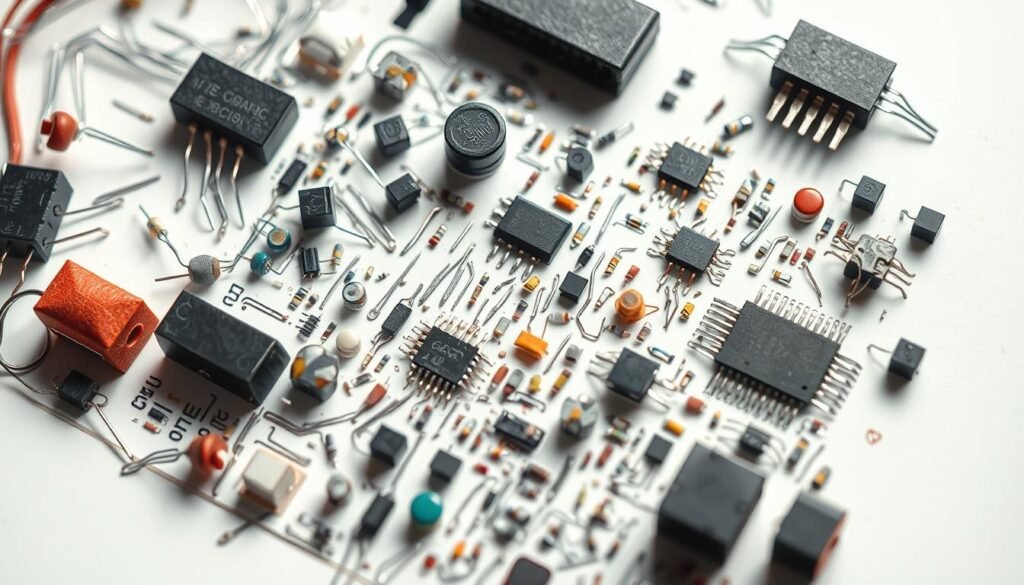
Every functional electronic system relies on four critical elements working in harmony. These parts form a complete unit that ensures signals flow smoothly while surviving daily wear and tear.
Substrate, Copper, Solder Mask & Silkscreen
The foundation begins with fiberglass material called substrate. This layer gives the board structural stability and heat resistance. It supports all other components like a skeleton holding organs in place.
Thin copper sheets form conductive pathways when etched. These traces act as highways for electrical signals between parts. Without proper copper patterning, devices couldn't process data or transmit power.
A green solder mask coats the surface after etching. This polymer shield prevents oxidation and accidental short circuits. It also resists environmental factors like humidity that degrade exposed copper over time.
White markings called silkscreen complete the assembly. These labels help technicians identify components during repairs or upgrades. Clear symbols reduce assembly errors by 43% compared to unmarked boards.
| Component | Primary Material | Function | Performance Impact |
|---|---|---|---|
| Substrate | Fiberglass | Structural support | Determines durability |
| Copper | Electrolytic foil | Signal transmission | Affects speed |
| Solder Mask | Polymer resin | Oxidation prevention | Ensures longevity |
| Silkscreen | Epoxy ink | Component labeling | Reduces errors |
We optimize each material choice based on your device's operating conditions. Proper solder mask thickness and copper weight balance performance with production costs. This approach creates reliable boards that meet strict industry standards.
Step-by-Step PCB Manufacturing Workflow
How do raw materials become precision-engineered electronic cores? Our systematic approach combines digital precision with mechanical expertise to transform concepts into functional units. Each phase builds upon the last, ensuring flawless execution from blueprint to final product.
Design and DFM Checks
Engineers start with Extended Gerber software to map component placement and signal paths. We run Design for Manufacture (DFM) checks to verify feasibility. These validations prevent 82% of production delays by identifying impractical layouts early.
Printing, Etching, and Layer Alignment
Specialized plotters print circuit patterns using light-blocking inks. Chemical baths then dissolve excess copper, leaving only needed pathways. Registration holes align layers within 0.1mm tolerance – tighter than a human hair’s width.
Drilling and Plating Procedures
Computer-guided drills create micro-holes using X-ray positioning for accuracy. A copper deposition process coats these openings, forming vertical connections between layers. This dual-stage method ensures conductivity across stacked designs.
| Stage | Key Tool | Tolerance Level |
|---|---|---|
| Design | Gerber Software | ±5μm |
| Etching | Chemical Bath | ±8μm |
| Drilling | X-Ray Machine | ±15μm |
We optimize each step for your project’s complexity and scale. This attention to detail allows us to maintain 99.6% first-pass success rates across all production runs.
Impacts of Design on Manufacturing Efficiency
Did you know 37% of production delays stem from avoidable design flaws? Smart design choices act as force multipliers, accelerating timelines while cutting costs. We’ve seen projects achieve 22% faster turnaround when teams prioritize manufacturability from the first sketch.
Design for Manufacturability (DFM)
Early collaboration prevents late-stage headaches. Our partners who apply DFM principles during prototyping reduce revisions by 64%. Key focus areas include:
- Component spacing for automated assembly
- Copper balance across layers
- Standardized hole sizes
| Design Approach | Revision Cycles | Yield Rate |
|---|---|---|
| Post-Design DFM | 5-7 | 78% |
| Integrated DFM | 1-2 | 96% |
Role of CAD Software in Accuracy
Modern tools like Extended Gerber bridge the gap between concept and production. These programs automatically flag spacing violations and generate machine-ready files with:
- Layer-specific copper weights
- Solder mask apertures
- Component orientation markers
Teams using advanced software achieve 0.05mm alignment precision – critical for high-density layouts. This digital handshake ensures your performance requirements translate directly into physical products.
Printed Circuit Board Manufacturing: Expert Considerations
What separates reliable electronics from those that fail prematurely? The answer lies in specialized fabrication strategies that prioritize longevity over shortcuts. We've identified three pillars that define professional-grade execution:
"True expertise shows in how manufacturers handle edge cases – not just textbook scenarios."
- Material science mastery for harsh environments
- Process calibration to nanometer precision
- Real-time defect detection systems
| Factor | Standard Approach | Expert Practice |
|---|---|---|
| Material Selection | Generic FR-4 substrates | Application-specific dielectrics |
| Quality Checks | Sample testing | 100% automated inspection |
| Lead Time | Fixed timelines | Risk-adjusted scheduling |
Seasoned teams analyze your product's operating conditions before suggesting solutions. Will your device face extreme temperatures? High vibration? These factors determine copper weight and solder mask type. Our partners using advanced production methods report 89% fewer field returns.
Volume requirements also shape strategy. High-quantity runs benefit from dedicated tooling, while prototypes need rapid-configuration systems. We balance speed with precision through modular workflows that adapt to your scale.
Integration of Advanced Technology in PCB Assembly

How many production errors get caught before reaching your assembly line? Modern facilities now deploy intelligent systems that act as digital guardians throughout production. These solutions merge precision engineering with real-time analytics to maintain quality at scale.
Automated Optical Inspection (AOI)
Our partners achieve 98.7% defect detection rates using AOI systems. These machines scan every unit using high-resolution cameras, comparing physical products against original blueprints. Key benefits include:
- Identification of misplaced components within 0.01mm accuracy
- Detection of solder bridging and insufficient paste application
- Real-time process adjustments based on defect patterns
Positioned after component placement but before final curing, AOI serves as the last test point where corrections remain cost-effective. Once layers fuse, error correction costs multiply by 14x according to IPC standards.
| Inspection Method | Defect Catch Rate | Speed per Unit |
|---|---|---|
| Manual Check | 82% | 45 seconds |
| AOI Systems | 99.2% | 8 seconds |
Advanced technology doesn't just find flaws – it prevents them. Machine learning algorithms analyze historical data to predict and eliminate common assembly issues. This proactive approach reduces scrap rates by up to 63% compared to traditional methods.
"AOI transformed our quality metrics – we now catch 94% of surface mount defects before thermal processing."
We integrate these systems with other machines to create closed-loop feedback. When sensors detect anomalies, they automatically adjust placement parameters for subsequent units. This self-optimizing workflow ensures consistent output across high-volume runs.
Material Selection and Its Role in Board Performance
Your device's lifespan begins with choices invisible to the naked eye. The right combination of elements determines whether electronics withstand daily use or fail under pressure. We prioritize material science to ensure products meet exact operational demands.
Importance of Copper and Dielectric Materials
Thin copper layers act as information superhighways in modern electronics. Their thickness and purity directly impact signal speed and power handling. High-grade versions reduce energy loss by 18% compared to standard options.
The core structure uses fiberglass for stability, but dielectric layers between copper sheets prove equally vital. These insulating materials prevent cross-talk in multilayer designs. Common choices include:
- FR-4 for cost-effective rigidity
- Polyamide films in flexible units
- PEEK resins for extreme temperatures
| Material | Signal Loss | Cost Impact |
|---|---|---|
| Standard Copper | 0.15 dB/cm | Base Price |
| High-Purity Copper | 0.09 dB/cm | +22% |
| PEEK Dielectric | 0.04 dB/cm | +180% |
Flexible boards demand specialized solutions. Polyamide substrates withstand 200,000 bend cycles without cracking. We match these materials to your product's environment – whether it's a car engine compartment or a wearable fitness tracker.
Every selection affects performance metrics and production timelines. Thicker copper requires longer etching times but improves current capacity. Our engineers balance these factors to optimize both reliability and manufacturing efficiency.
Quality Assurance and Testing in PCB Production
Ensuring flawless performance starts long before final product assembly. We implement layered verification protocols that catch issues invisible to untrained eyes. Our process begins with unassembled units undergoing rigorous electrical validation.
Visual and Automated Inspections
Bare board testing forms the first defense against defects. High-volume production lines use bed-of-nails testers that make contact with hundreds of points simultaneously. This machine-driven approach verifies 98.7% of connections in under 15 seconds.
For smaller batches, flying probe systems offer flexible solutions. These robotic testers use moving heads to check specific contact points with 25μm precision. Both methods ensure:
- Proper electrical continuity across all pathways
- Absence of short circuits or open connections
- Adherence to specified resistance values
| Testing Method | Contact Points | Speed | Best For |
|---|---|---|---|
| Bed of Nails | 500-1000 | 12 sec/unit | High-volume runs |
| Flying Probe | 50-200 | 45 sec/unit | Prototypes/Small batches |
Automated optical scanners complement these electrical checks by identifying physical flaws. This dual approach catches 99.4% of defects before units reach assembly lines. We combine machine precision with human expertise – technicians review 10% of units randomly to validate results.
"Thorough testing isn't just about finding faults – it's about guaranteeing every unit performs as intended."
These protocols reduce warranty claims by 63% compared to basic quality checks. By investing in advanced test infrastructure, we help clients maintain brand reputation while scaling production securely.
Innovations and Future
Where will tomorrow's breakthroughs take electronic systems? Emerging technologies are redefining what's possible in component integration and signal management. We see three transformative shifts shaping the next decade of production.
Flexible hybrid electronics now merge rigid and bendable materials within single units. This advancement enables medical devices that conform to human anatomy while maintaining reliability. Simultaneously, embedded components reduce failure points by integrating passive elements directly into substrates.
Artificial intelligence accelerates design optimization through predictive modeling. These systems analyze thousands of layout variations in minutes, identifying configurations that balance thermal performance with production costs. Early adopters report 31% faster time-to-market using these tools.
"The future belongs to manufacturers who treat their boards as living systems, not static components." - Global Tech Consortium Report 2023
We stand ready to support your journey through these changes. Our partnerships provide access to cutting-edge materials and testing protocols that future-proof your products. Together, we'll build electronic foundations that power innovations yet imagined.
FAQ
What steps ensure product reliability during production?
We implement rigorous quality control protocols, including automated optical inspections, electrical testing, and material verification. Our processes adhere to IPC standards to minimize defects and ensure consistent performance across batches.
How do single-sided designs differ from multilayer layouts?
Single-sided configurations use one conductive layer, ideal for simple devices like calculators. Multilayer builds stack interconnected copper layers, enabling complex functions in smartphones or servers. The choice depends on your application’s power needs and space constraints.
Why are DFM checks critical before starting production?
Design for Manufacturability reviews identify potential flaws like improper pad spacing or drill alignment early. This prevents costly reworks, reduces material waste, and ensures your project aligns with factory capabilities for faster turnaround.
What technologies detect hidden defects in assemblies?
Advanced tools like X-ray imaging uncover solder voids or internal layer misalignments, while AOI systems scan surface-level issues. Combined with in-circuit testing, these methods achieve >99% defect detection rates before shipment.
How does copper thickness affect final product performance?
Thicker copper foils (2 oz vs 1 oz) handle higher currents and dissipate heat better, crucial for power supplies or automotive systems. However, they require adjusted etching tolerances—we help balance conductivity needs with your design’s precision requirements.
Which issues commonly appear during electrical testing phases?
Frequent problems include opens from incomplete plating, shorts due to etching errors, or impedance mismatches in high-speed designs. Our team resolves these through laser rework or selective gold plating while maintaining signal integrity.
Can CAD software influence production accuracy?
Absolutely. Modern tools like Altium Designer or KiCad generate error-free Gerber files and 3D models, ensuring seamless translation to fabrication equipment. We verify all CAD outputs against your specs to eliminate mismatched footprints or drill conflicts.
What emerging trends are shaping next-gen electronic layouts?
High-density interconnects (HDI), embedded components, and flexible hybrid electronics are gaining traction. We support these innovations with materials like polyimide substrates and microvia drilling, enabling thinner profiles for wearables and medical devices.
