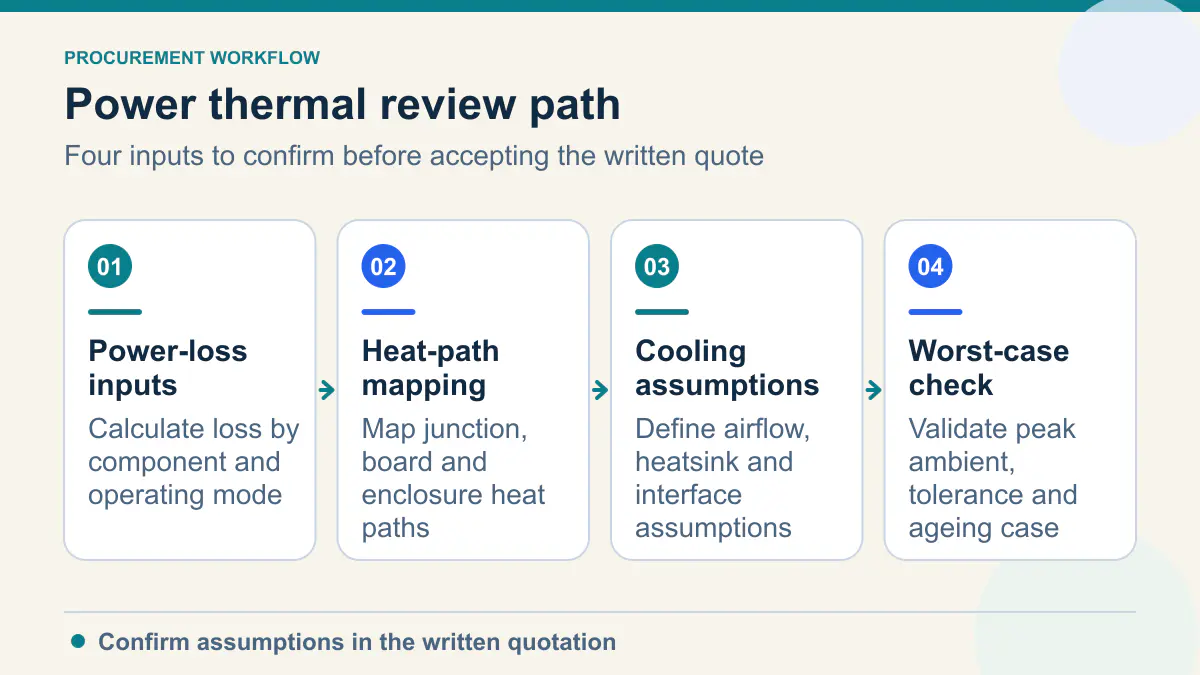
When you send us a BOM for an automotive power electronics module, the first question we ask is not about price. It is about heat. We ask where the heat goes, how it is removed, and which components sit closest to the thermal path. That is because your quotation depends on it. For automotive OE electronics, thermal management drives component selection, board layout, and ultimately the cost and lead time of your assembly. We want to make that process clearer for you, so here is how we approach it from a purchasing perspective.
We are Informic, a BOM sourcing and consolidation partner for European automotive electronics teams. We do not design your power stage, but we do buy the parts that make it work. We see hundreds of thermal management BOMs each year, and we know where the sourcing bottlenecks hide. This article explains what we look for, what we ask you before quoting, and how you can structure your RFQ to get faster, more accurate pricing.
Why thermal management changes your BOM sourcing strategy
Power electronics for automotive applications. traction inverters, DC-DC converters, onboard chargers. generate heat that must be moved away from silicon. That heat affects every component in the system. The IGBTs or SiC MOSFETs need specific thermal interface materials. The PCB needs thicker copper or a metal-core substrate. The housing needs mounting hardware that can handle thermal cycling. Each of these parts has a different supply chain, and each has a different lead time.
Technical reference: For related engineering context, see IPC standards and industry resources.
When we quote a BOM, we do not only price the active components. We price the entire thermal ecosystem: thermal pads, phase change materials, heatsinks, fans, potting compounds, and the fasteners that hold it together. We also look at the board itself. A standard FR4 board with 1 oz copper is a different product from a 2 oz copper board or an insulated metal substrate (IMS). Your pcbManufacturing partner needs to know the thermal requirements before they can give you a realistic lead time.
Here is the practical point: if you send us a BOM without thermal context, we will quote it, but we will likely ask for a revision. That revision costs you a week. If you send us the thermal design information upfront, we can source everything in parallel and often consolidate your orders into fewer shipments.
What we need in your RFQ for power electronics
We are not asking for your full thermal simulation files. We need enough information to make sourcing decisions. Here is the minimum we request for every automotive power electronics RFQ:
- Operating ambient temperature range and maximum junction temperature for the power devices.
- Cooling method: liquid, forced air, natural convection, or passive via housing.
- Board construction details: layer count, copper weight, substrate material, and whether you expect an IMS or ceramic base.
- Thermal interface material type and thickness, if already specified.
- Target production volume per year and expected ramp schedule.
- Any preferred suppliers or alternates you already qualify.
We understand that some of this is confidential. You can share it under NDA. But without this context, we cannot tell you whether a cheaper thermal pad will work, or whether you need a higher-spec heatsink. We also cannot advise on consolidation. For example, if you are using a custom heatsink, we may be able to source it from a single supplier who also provides your mounting brackets. That reduces your supplier count and your administrative overhead.
A practical table for thermal BOM line items
To make our conversations more efficient, we use a simple classification for thermal components. This helps us identify which parts are standard, which are custom, and which have long lead times.
| Component type | Typical lead time | Sourcing risk | Consolidation opportunity |
|---|---|---|---|
| Thermal interface pads (standard) | 2-4 weeks | Low | High – bundle with all passive components |
| Thermal interface materials (custom thickness) | 6-10 weeks | Medium – tooling or minimum order quantity | Medium – combine with gaskets or seals |
| Heatsinks (extruded, standard profiles) | 4-6 weeks | Low | High – source from metal fabricator |
| Heatsinks (custom machined or die-cast) | 10-16 weeks | High – requires tooling approval | Low – single supplier, long lead |
| Power modules (IGBT, SiC) | 20-40 weeks | Very high – allocation possible | Low – buy early, secure capacity |
| PCB with thermal vias or IMS | 4-8 weeks | Medium – depends on stack-up | High – coordinate with pcba partner |
This table is a starting point. Your actual lead times will vary by supplier and region. But it gives you a sense of where the bottlenecks are. If you are designing a new inverter, the power module is likely your critical path. We recommend you start sourcing that component first, even before the PCB is finalized.
How we handle DFM feedback for thermal designs
Design for manufacturability (DFM) is not only about the PCB. It is about the thermal assembly. When we receive a BOM, we often provide DFM feedback that affects your purchasing. Here are three common examples from our daily work.
First, we see BOMs where the thermal pad is specified as a custom die-cut shape but the drawing does not include a tolerance for the hole pattern. That is a problem. The pad may not align with the mounting holes, causing a gap in the thermal path. We ask for a revised drawing, which delays the quote. If you include tolerances in the initial RFQ, we can source the pad immediately.
Second, we see power modules specified with a screw torque requirement that does not match the recommended mounting hardware. The supplier of the module may require a specific washer or spring clip. If you do not specify that hardware, we have to source it separately, adding a line item and a potential mismatch. We can avoid this by asking you to share the module supplier's application note.
Third, we see PCBs with thermal vias that are not clearly defined. The via diameter, plating thickness, and fill material matter for thermal performance. If your pcbManufacturing partner does not know these details, they may produce a board that does not meet your thermal targets. We can help by coordinating between your design team and the board fabricator, but we need the specifications in writing.
BOM consolidation for thermal management: what we actually do
We are not a distributor with a catalogue. We are a sourcing and consolidation partner. That means we buy from multiple suppliers and deliver a single, coordinated shipment to your assembly partner. For thermal management, this is particularly valuable because the components come from different industries.
Your power module may come from a semiconductor manufacturer in Germany. Your thermal pad may come from a specialty materials company in Japan. Your heatsink may come from a metal fabricator in Italy. Your PCB may come from a fabricator in Eastern Europe. Each supplier has different payment terms, different minimum order quantities, and different shipping methods. Managing that yourself is a full-time job.
We consolidate those orders into a single purchase order for you. We handle the currency exchange, the logistics, and the quality documentation. For automotive OE electronics, this is critical because you need full traceability. We provide that traceability for every component in the thermal path.
When you send us a BOM, we do not only quote the line items. We look at the entire supply chain. We ask questions like: Can the thermal pad supplier deliver in the same week as the power module? Can we combine the heatsink and the mounting hardware into one shipment from the same metal supplier? Can we arrange for the PCB to be delivered directly to the pcba house to save a shipping step?
These are practical questions that reduce your total cost of ownership. They are not about the unit price of a single component. They are about the cost of managing the entire thermal system.
What we do not know, and what you should verify
We want to be clear about the limits of our advice. We are not a thermal engineering consultancy. We do not perform simulations, and we do not certify your design. We can tell you what components are available and what they cost, but we cannot tell you whether a specific thermal pad will meet your junction temperature target. That is your design team's responsibility.
We also do not have access to your proprietary thermal simulation data. If you share that data with us, we can use it to inform our sourcing decisions, but we cannot validate it. We recommend you work with a qualified thermal engineer for the design phase, and then bring us in for the procurement phase. That is the most efficient division of labour.
Finally, we do not guarantee stock levels or lead times from our suppliers. The electronics industry is volatile, and power modules in particular can have long allocation periods. We will give you our best estimate based on current information, but you should always verify critical lead times before you commit to a production schedule. We recommend you request a formal quotation from us, which will include our suppliers' confirmed lead times.
How to get a clearer quotation from us
If you are ready to get a quotation for your thermal management BOM, here is what we need from you. Send us your BOM in Excel or CSV format, including manufacturer part numbers and quantities. Include the thermal design information we listed earlier. If you have a target cost, tell us. If you have a target launch date, tell us. We will respond within two business days with a consolidated quotation and a sourcing plan.
We will also provide a risk assessment for each critical component. That assessment will show you which parts have long lead times, which have potential allocation issues, and which have alternates available. You can then decide whether to approve the plan or ask for changes.
We do not charge for quotations. We make our margin on the components we source. That means our incentive is to get you the best total cost, not the lowest unit price on a single part. We want you to come back for the next project, and that means we need to be transparent about what we can and cannot do.
FAQ
How early should we involve you in the thermal design process?
As early as possible. Ideally, you involve us when you have a preliminary BOM, even if it is not final. We can give you indicative pricing and lead times that will influence your design decisions. For example, if you know that a custom heatsink has a 16-week lead time, you may decide to use a standard profile instead. That decision is much easier to make in the design phase than after the design is frozen.
Can you source thermal interface materials from multiple suppliers?
Yes, we can. We work with several qualified suppliers of thermal pads, phase change materials, and thermal greases. We can provide you with a comparison of their products, pricing, and lead times. We can also help you qualify an alternate supplier if your primary source has a long lead time or a minimum order quantity that is too high for your project.
Do you provide any support for thermal simulation or testing?
We do not provide thermal simulation or testing services. We are a sourcing and consolidation partner, not a test laboratory. However, we can coordinate with your existing test partners and ensure that the components we source are delivered with the necessary documentation for your validation process. We can also arrange for sample quantities of thermal materials so your team can test them before committing to production volumes.