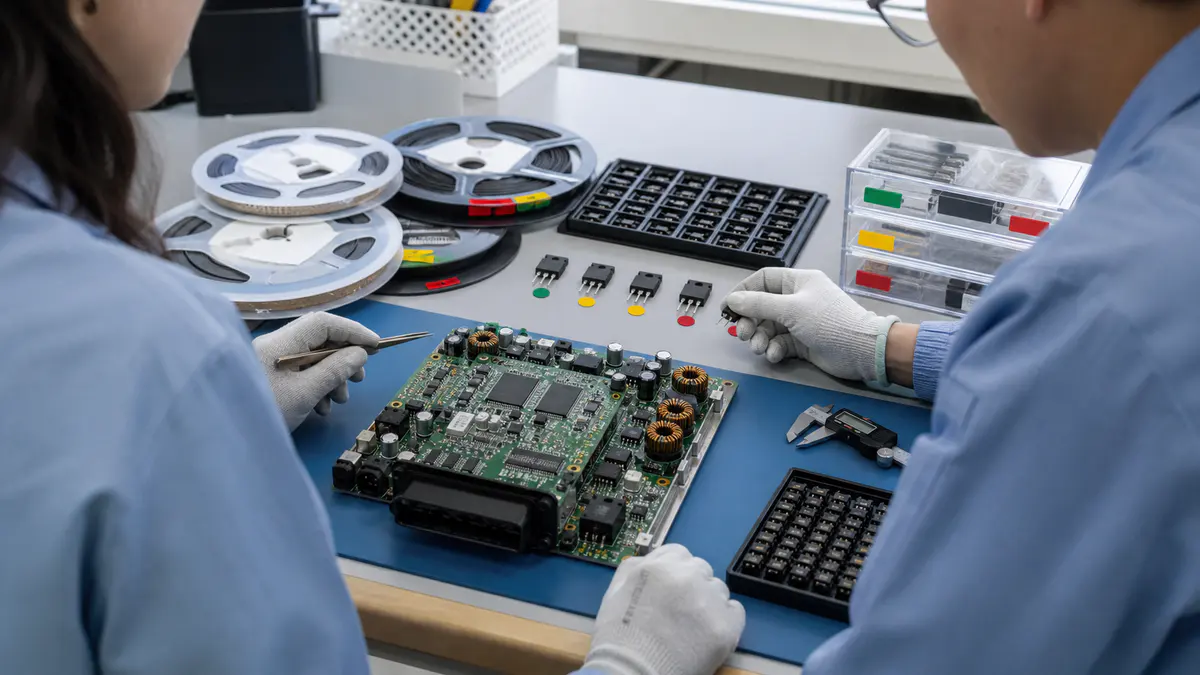
When a new-energy equipment buyer sends us a bill of materials, the first thing we do is not calculate a price. We read it like a production schedule. We look for the parts that will disappear from the market before your line starts. Then we tell you exactly what we see. That is the core of BOM shortage mitigation: not reacting to a shortage after it hits, but spotting the risk while the BOM is still a draft.
We work with manufacturing teams across African markets, from solar inverter assemblers in Lagos to battery-pack integrators in Johannesburg. Your purchasing reality is different from what you see in global trade magazines. You deal with longer freight times, currency swings, and a smaller pool of local distributors. So we write this from our daily work as a turnkey PCBA coordinator, not as a theory.
What a BOM shortage actually costs your project
Let us be direct. A missing component does not only delay a shipment. It triggers a chain of costs that most quotations never show:
Technical reference: For related engineering context, see IPC standards and industry resources.
- Your line stops, but your labor cost does not.
- You pay expedited freight for the rest of the BOM to arrive together.
- Your engineering team re-designs a board, then re-tests it, adding weeks.
- You lose customer trust for the next tender.
We cannot prevent every shortage. But we can make the risk visible before you commit to a production date. That clarity is what we sell, and it starts with how we read your BOM.
Our first step: a shortage-risk read, not a quote
When you send us a BOM for a new-energy project, we do three things in the first 48 hours. We check component lifecycle status. We check lead times against your target ship date. And we check for alternative part numbers that are drop-in compatible. We do not wait for you to ask.
Here is a practical example of what we look for, using a typical inverter control board:
| Component type | What we check | Why it matters for your schedule |
|---|---|---|
| Power MOSFET or IGBT | Manufacturer end-of-life notices, allocation status | These have the longest lead times in new-energy builds |
| Electrolytic capacitors | Date code freshness, moisture sensitivity level | Old stock can fail in high-heat environments |
| Microcontroller (MCU) | Firmware compatibility with alternative package | Switching MCU may require a firmware change |
| Passives (resistors, MLCCs) | Case size and voltage rating alternatives | Smaller case sizes are often on allocation |
| Connectors | Mating part availability, second-source options | Connector shortages are common and hard to substitute |
We share this table with you as a working document. You can see which lines are safe, which are at risk, and which need a decision from your engineer. That is the clarity we mean.
How we turn a shortage risk into a clear quotation
Most buyers ask for a quotation before we have discussed the BOM. We understand why. You need a number to put in your budget. But a quotation that ignores shortage risk is a false promise. So we do our risk read first, then we quote with conditions.
Here is how our quotation process works, step by step:
- You send the BOM with target quantities and a target ship date. We also need to know if the design is final or if changes are possible.
- We run the shortage-risk read. This takes 24 to 48 hours. We check our supplier network and open market data.
- We send you a two-part quotation. Part one is the price for the BOM as written. Part two is an alternative BOM with substitute parts that are available now, with the price difference shown.
- You decide, or we decide together. If you choose the alternative parts, we verify the change with your engineer before we order.
- We place the order with confirmed lead times. No vague promises. If a part slips, we tell you the same day we know.
This process is not complicated. It is just honest. But it requires a supplier who is willing to say "this part will be a problem" before you sign a purchase order.
DFM checks that prevent shortage-driven redesigns
Many BOM shortages are made worse by the design itself. We see boards where an engineer specified a unique capacitor that only one factory makes, or a connector that has no second source. That is not a design error. It is a supply chain risk that was not considered.
When we review a BOM for a pcbManufacturing project, we apply a few DFM rules that reduce shortage exposure:
- Use standard case sizes. 0402 and 0603 passives are easier to source than 0201 or odd sizes.
- Specify a primary and a secondary manufacturer. If the design can accept both, we can switch without a redesign.
- Avoid single-source connectors. If a connector is critical, we ask you to approve an alternative brand early.
- Check voltage derating. A capacitor rated at 50V is often easier to find than a 25V part with the same capacitance.
- Keep MCU firmware portable. If the MCU is unavailable, a firmware port is faster than a full board redesign.
We do not force these rules on you. We present them as options with cost and time implications. Your engineer makes the final call. Our job is to make sure the decision is based on real availability data, not on a datasheet that is already outdated.
What we can and cannot promise about shortages
We want to be clear about the limits of our service. We cannot predict the future. We cannot guarantee that a part will be available in six months. We cannot promise that a substitute part will perform identically in your final product without your testing.
What we can promise is this: we will check availability before we quote, we will tell you about risks we see, and we will not hide behind a low price that ignores the real market. That is the difference between a transactional quote and a coordination service.
When you work with us on a pcba project, we act as your eyes on the component market. We see allocation notices, end-of-life announcements, and price spikes before they hit the public news. We use that information to protect your schedule, not to inflate our margin.
How to get a useful quotation from us
If you are ready to test our process, send us a BOM with the following information. The more specific you are, the faster we can respond with a useful quotation.
- Target annual volume and batch size
- Target ship date for the first batch
- Design status: final, in testing, or still in layout
- Any customer-specific requirements for the final product
- Your preferred communication channel for updates
We do not need a full design file to start. A BOM in Excel or CSV is enough for the first risk read. We will ask for Gerber files only after we agree on the approach.
For a quick start, use our quote page to send the BOM. We respond within one business day, usually faster.
Our role in your supply chain
We are not a distributor. We do not stock millions of parts in a warehouse. We are a coordinator. We bring together components from multiple sources, manage the PCBA process, and handle the logistics. Our value is in the coordination, not in the inventory.
For new-energy equipment teams in Africa, this model makes sense. You do not need to hold large inventory when freight times are long and capital is tight. You need a partner who can see the whole picture and tell you where the risks are.
That is why we write this article. We want you to know what to expect when you work with us, and we want you to ask the right questions of any supplier you consider.
FAQ
How far in advance should we send a BOM for a new-energy project?
Send it as soon as the design is stable enough to know the major components. For a typical inverter or battery management system, that is at least 12 to 16 weeks before your target production date. If you send it earlier, we can flag long-lead items before they become critical. If you send it later, we will still help, but your substitution options will be fewer.
Can you quote on a BOM that has parts we have not used before?
Yes. We will check availability and lead times for those parts as part of the standard risk read. If a part is new to the market or has limited sources, we will note that in the quotation. We will also suggest alternatives if we see a risk, but we will not substitute without your approval.
What is the typical turnaround time for a quotation with a shortage-risk read?
For a BOM with 50 to 200 line items, we usually send a complete quotation with the risk assessment within two to three business days. If the BOM is larger or has very unusual parts, we may need an extra day to check the open market. We will always tell you if we need more time, rather than sending an incomplete quote.