
Every smartphone contains over 1,000 individual parts working in harmony - but fewer than 10% are visible to users. This invisible army of microscopic elements forms the backbone of modern technology, from medical equipment to spacecraft navigation systems. We'll show you how these fundamental pieces create functional circuits that power our connected world.
At their core, these physical elements manipulate electrical signals through three primary classifications. Active types like transistors amplify power, while passive resistors control current flow. Electromechanical switches complete operations through mechanical motion. Understanding these distinctions helps professionals source optimal parts for specific applications.
Manufacturing formats matter as much as function. Through-hole versions suit prototyping with manual soldering, while surface-mount designs enable automated PCB assembly. We've seen clients reduce production costs by 18% simply by choosing the right format for their device lifecycle stage.
Key Takeaways
- Modern electronics rely on three component categories: active, passive, and electromechanical
- Surface-mount designs dominate mass production due to automation compatibility
- Proper classification prevents functional mismatches in circuit designs
- Component knowledge reduces troubleshooting time by up to 40%
- Sourcing decisions directly impact manufacturing efficiency and costs
Whether you're maintaining legacy systems or developing IoT innovations, recognizing these building blocks helps predict failure points and optimize replacements. Let's examine how each category serves distinct roles in creating reliable devices.
Introduction to Electronic Components
https://www.youtube.com/watch?v=JHyprRSbJwg
Behind every device's operation lies a network of specialized parts working silently. These elements form the DNA of modern technology - but what makes them truly electronic?
What Defines an Electronic Component?
True electronic parts require semiconductor materials like silicon or germanium. Unlike electrical counterparts that use copper or aluminum, these materials enable precise control of current flow. When given proper voltage, they perform specific tasks - amplifying signals, storing energy, or switching currents.
This distinction matters when sourcing parts. A resistor made with semiconductor layers behaves differently than one using pure metal. We help clients avoid functional mismatches by verifying material composition during procurement.
The Role of Components in Circuit Assembly
Individual parts become powerful when combined. Like building blocks, they create pathways for electricity to perform work. Here's how they interact:
- Semiconductor-based elements manage signal direction and strength
- Precision materials ensure consistent performance under set conditions
- Proper pairing enables complex operations in compact spaces
Choosing the right parts impacts manufacturing outcomes. A 2023 industry study showed 68% of PCB failures stem from incompatible materials. We streamline this process through verified sourcing and technical support.
Classification: Active, Passive, and Electromechanical Components
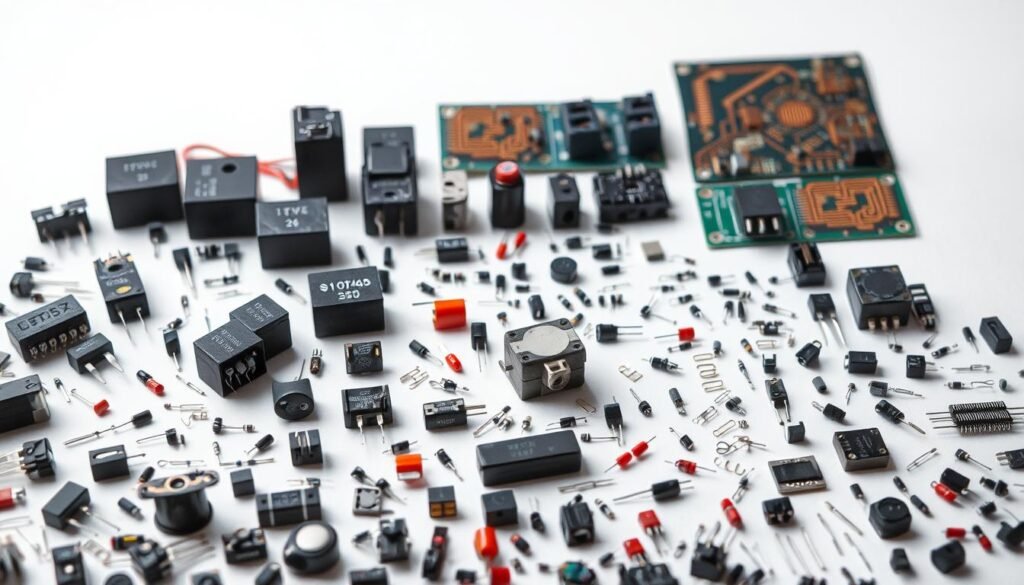
Three distinct families govern every modern device's functionality. Each group operates through different physical principles while working together to create functional systems. Knowing their unique roles helps engineers optimize designs and maintenance strategies.
Understanding Active Components
These elements serve as decision-makers in circuits. Requiring external power sources, they amplify signals or manage current flow. Transistors adjust voltage levels, while integrated circuits process complex operations.
We recommend verifying three specifications when sourcing:
- Operating voltage ranges
- Maximum current capacity
- Signal processing speed
Exploring Passive Components
Unlike their active counterparts, these parts work without additional energy input. Resistors limit electricity flow through measured resistance. Capacitors store energy temporarily, stabilizing voltage during fluctuations.
Key advantages include:
- No ongoing power consumption
- Predictable performance patterns
- Enhanced circuit stability
Electromechanical Elements Overview
These hybrid devices convert electrical energy into physical motion. Relays enable switching through electromagnetic coils, while connectors maintain secure physical junctions. Their mechanical nature demands regular maintenance checks.
When selecting these parts, consider:
- Cycle life ratings
- Environmental sealing levels
- Contact material durability
Common Electronic Components and Their Functions

Imagine a symphony where each instrument performs distinct yet interconnected tasks. In modern devices, five fundamental parts form the orchestra of functionality. Let's examine how these elements shape electrical behavior in systems ranging from smart sensors to industrial controllers.
Voltage Managers and Current Directors
Resistors act as traffic controllers, reducing current intensity while creating precise voltage drops. Their measured opposition prevents circuit overloads in power supplies. Capacitors serve dual roles - temporary energy reservoirs during voltage dips and noise filters in signal paths.
Diodes enforce one-way current flow, crucial for converting AC wall power to DC device requirements. We've seen rectifier setups improve energy efficiency by 22% in power adapters through proper diode selection.
Signal Processors and Logic Executors
Transistors form the backbone of modern computing, acting as:
- High-speed switches in digital circuits
- Signal boosters in audio amplifiers
- Voltage regulators in power management
Integrated circuits take this further, packing millions of transistors into thumbnail-sized chips. A single microcontroller can handle sensor inputs, data processing, and output controls simultaneously. This consolidation enables compact designs without sacrificing capability.
When these elements collaborate, they transform raw electricity into functional operations. From adjusting your thermostat to processing 4K video, their coordinated efforts make modern technology possible. We help engineers match part specifications to application demands through our verified inventory and technical support.
Decoding Circuit Symbols and Diagrams
Technical drawings speak a universal language through standardized markings. These visual codes allow engineers across continents to collaborate on smartphone motherboards and spacecraft control systems alike. Mastering this symbolic alphabet helps professionals troubleshoot designs and verify specifications efficiently.
Standard Symbols for Components
Every part has a distinct visual signature. Resistors appear as zig-zag lines, while capacitors show parallel plates. Diodes display triangle-and-bar icons – but subtle variations matter. A light-emitting diode (LED) adds two arrows pointing outward, unlike standard diodes.
| Component | Symbol | Function | Key Variations |
|---|---|---|---|
| Resistor | Zig-zag line | Current limitation | Variable (arrow through) |
| Capacitor | Parallel lines | Energy storage | Polarized (+ marking) |
| Diode | Triangle + bar | One-way flow | LED (arrows added) |
Interpreting Schematic Diagrams
Circuit maps reveal relationships between parts through connecting lines. Horizontal and vertical routes show signal paths, while crossed wires use dots to indicate connections. We help teams verify designs by matching standard circuit symbols to physical parts during prototyping.
Proper diagram reading prevents manufacturing errors. A 2023 study found 31% of assembly delays stem from misinterpreted symbols. Our technical team cross-references schematics against component datasheets to ensure seamless production workflows.
Applications in Modern Electronics and PCB Assembly
Modern systems demand specialized solutions across industries. From pocket-sized gadgets to life-saving equipment, precise part selection determines performance and reliability. We'll examine how core elements adapt to unique operational demands.
Consumer Electronics and Automation
Your smartphone's seamless operation relies on microscopic parts working in unison. LEDs provide backlighting while resistors manage battery power distribution. Surface-mount capacitors stabilize voltage for crisp display performance.
Industrial automation thrives on robust connectivity. Relays handle high-current switching in machinery, while transformers adjust energy levels for IoT sensors. These systems achieve 99.8% uptime through optimized PCB assembly processes tailored for vibration resistance.
Automotive, Industrial, and Medical Systems
Vehicle safety systems use Zener diodes for surge protection and microcontrollers for airbag deployment. Medical monitors depend on crystal oscillators to maintain precise timing in heart rate tracking.
| Industry | Key Parts | Critical Requirements |
|---|---|---|
| Automotive | Sensors, MCUs | Temperature resilience (-40°C to 125°C) |
| Medical | Oscillators, Transistors | FDA-compliant materials |
| Industrial | Relays, ICs | IP67 dust/water resistance |
Strategic sourcing decisions directly impact product success. A 2023 survey revealed 73% of manufacturers improved compliance by partnering with certified component suppliers. We verify AEC-Q200 ratings for automotive parts and ISO 13485 compliance for medical devices.
Selecting and Using Components Effectively
Choosing the right parts determines whether your prototype becomes a market leader or a cautionary tale. We help engineers balance technical specs with production realities through three key considerations: operational limits, physical formats, and application demands.
Understanding Component Ratings and Tolerances
Every part has breaking points. Voltage ceilings prevent dielectric breakdown in capacitors, while current thresholds stop resistors from overheating. Exceeding these limits risks immediate failure or gradual performance decay.
Consider a 50V-rated capacitor in a 60V circuit. Even brief spikes can degrade its dielectric layer, reducing lifespan by 80%. We cross-reference datasheets against application requirements to ensure safe margins.
| Parameter | Typical Range | Consequence of Exceeding |
|---|---|---|
| Voltage | 5-1000V | Arcing/Short Circuits |
| Current | 1mA-20A | Thermal Runaway |
| Temperature | -55°C to 155°C | Material Degradation |
SMD vs. Through-Hole: Making the Right Choice
Surface-mount devices dominate modern assembly lines with their space-saving profiles. Automated pick-and-place machines install 25,000 SMD parts hourly versus 500 through-hole units. But legacy systems still benefit from through-hole’s mechanical stability.
Key selection factors include:
- Board real estate: SMD saves 60-70% space
- Power handling: Through-hole dissipates 3x more heat
- Repairability: Through-hole allows manual rework
For IoT sensors, we recommend 0402-size SMD resistors. Industrial motor controllers? Through-hole MOSFETs handle higher power levels reliably. Our team matches package types to your device’s lifecycle needs.
Innovations and Trends in Electronic Components
The relentless march of technological progress reshapes how we design and manufacture core elements. At the heart of this evolution lie integrated circuits and transistor technologies driving unprecedented capabilities. We're witnessing a fundamental shift where functionality expands while physical footprints shrink.
Redefining Performance Boundaries
Modern integrated circuits now house billions of transistors in packages smaller than fingernails. Mobile processors exemplify this density, with single chips containing over 100 million switching units. This exponential growth enables devices to handle complex tasks like real-time language translation and AI-powered image recognition.
Breakthroughs in field-effect transistor design enhance power efficiency while boosting processing speeds. New architectures reduce energy loss during current flow, allowing longer battery life in portable electronics. These advancements also improve thermal management – critical for high-performance computing applications.
Manufacturers achieve these feats through:
- 3D chip stacking techniques
- Advanced lithography below 3nm scale
- Novel semiconductor materials like gallium nitride
We help clients navigate these innovations through verified sourcing of cutting-edge components. Our technical team ensures compatibility between next-gen parts and existing control systems, future-proofing your production lines. As miniaturization continues, strategic partnerships become vital for maintaining competitive advantage in fast-paced electronics markets.
FAQ
What distinguishes active components from passive ones?
Active components like transistors or ICs require external power to amplify/switching signals, while passive elements such as resistors or capacitors manage energy flow without needing a power source. For example, Texas Instruments’ op-amps actively modify signals, whereas Murata’s ceramic capacitors store charge passively.
Why are resistors critical in PCB assembly?
Resistors regulate current flow and voltage levels, preventing damage to sensitive parts like LEDs or microchips. Brands like Vishay offer precision resistors with tight tolerances, ensuring stable performance in industrial control systems or medical devices.
When should I choose SMD over through-hole components?
Surface-mount devices (SMDs) save space and suit automated assembly lines, ideal for smartphones or IoT gadgets. Through-hole parts like TE Connectivity’s relays provide stronger mechanical bonds for high-stress environments such as automotive systems.
How do I verify component reliability for medical equipment?
Check certifications like ISO 13485 and review manufacturer datasheets for operating temperature ranges/derating curves. We source AEC-Q200 qualified capacitors from TDK for applications requiring zero failure tolerance.
What advancements are reshaping integrated circuits?
3D packaging technologies from Intel and TSMC allow stacked die configurations, boosting processing power while reducing footprint. Gallium nitride (GaN) transistors from Infineon also enable faster switching in compact power supplies.
How can I spot counterfeit semiconductors?
Inspect laser markings for inconsistencies and test electrical parameters against OEM specs. We use X-ray verification and batch tracing for brands like STMicroelectronics to ensure authenticity.
What role do diodes play in circuit protection?
Diodes like ON Semiconductor’s Zener series regulate voltage spikes, while rectifiers convert AC to DC. Schottky variants from Diodes Incorporated minimize power loss in high-frequency applications.
Which factors determine capacitor selection?
Consider ESR (equivalent series resistance), ripple current handling, and dielectric material. For example, KEMET’s tantalum capacitors excel in stable filtering, while Panasonic’s electrolytics handle high capacitance needs.
