
What if your current methods for estimating operational timeframes contain costly blind spots? Professionals designing electronics know that unreliable runtime projections lead to wasted resources, delayed launches, and frustrated users. Yet many still rely on oversimplified formulas that ignore real-world energy patterns.
We’ve developed a solution that bridges this gap. Our tool analyzes two critical factors: your component’s total stored energy and its consumption rates during active and idle states. Whether you’re prototyping IoT sensors or refining industrial systems, this approach mirrors how devices actually function in field conditions.
Choose between continuous-use scenarios or hybrid models that account for sleep cycles. This flexibility helps engineers balance performance demands with longevity requirements. You’ll gain actionable insights for selecting power sources, optimizing designs, and planning maintenance schedules—all while reducing guesswork.
Key Takeaways
- Predict operational durations using stored energy and consumption rates
- Supports smartphones, industrial equipment, and connected devices
- Compare continuous operation vs. sleep mode scenarios
- Identify optimization opportunities during product development
- Essential for procurement teams sourcing durable components
Understanding the Battery Life Calculator
Many engineers face a critical challenge: inaccurate energy duration forecasts. Our tool transforms how you approach power management by clarifying two distinct concepts. Operational duration measures active usage between charges, while cycle endurance tracks recharge limits before component failure.
Purpose and Benefits
We designed this solution to eliminate guesswork in energy planning. Procurement teams gain clarity on which components meet project longevity requirements. You’ll optimize designs by comparing continuous-use estimates with intermittent operation scenarios.
"Precision in energy forecasting separates successful prototypes from costly redesigns."
Key Terminologies and Concepts
Three metrics govern power source selection:
- Capacity (mAh/Wh): Total stored energy
- Current Draw: Energy consumed during operation
- Discharge Rate: How quickly stored power depletes
| Term | Impact | Measurement |
|---|---|---|
| Ampere-Hours | Runtime potential | Ah |
| Voltage | System compatibility | V |
| Watt-Hours | Total energy storage | Wh |
This framework helps evaluate solar backups, IoT sensors, and industrial controllers. You’ll identify mismatches between component specs and actual energy demands early in development cycles.
How the Battery Life Calculator Works
Accurate energy duration predictions require more than basic math. Our system combines foundational equations with real-world variables to deliver reliable results. Let’s break down the mechanics behind precise runtime estimation.
The Basic Formula Explained
The core equation determines operational hours using two values: stored energy (capacity) and usage speed (current draw). For example, a 2000mAh power source powering a 100mA device typically yields 20 hours. But real-world applications demand adjustments:
- Subtract 20% as a discharge buffer to protect components
- Multiply by efficiency rates (usually 0.8) for energy losses
This creates the refined formula: Runtime = (Capacity / Consumption) × 0.8 × 0.8. Our tool applies these corrections automatically, turning raw numbers into practical forecasts.
Unit Conversions and Efficiency Factors
Seamless metric adaptation separates theoretical math from usable data. When you input 5000mAh, we convert it to 5Ah while reconciling milliampere-hours with voltage requirements. Three critical adjustments occur behind the scenes:
- Temperature-based performance curves
- Peak vs. average consumption ratios
- Chemistry-specific discharge patterns
These conversions explain why a 12V lead-acid unit behaves differently than a 3.7V lithium counterpart with identical mAh ratings. By accounting for these variables, we bridge the gap between lab specs and field performance.
Using the battery life calculator for Your Device
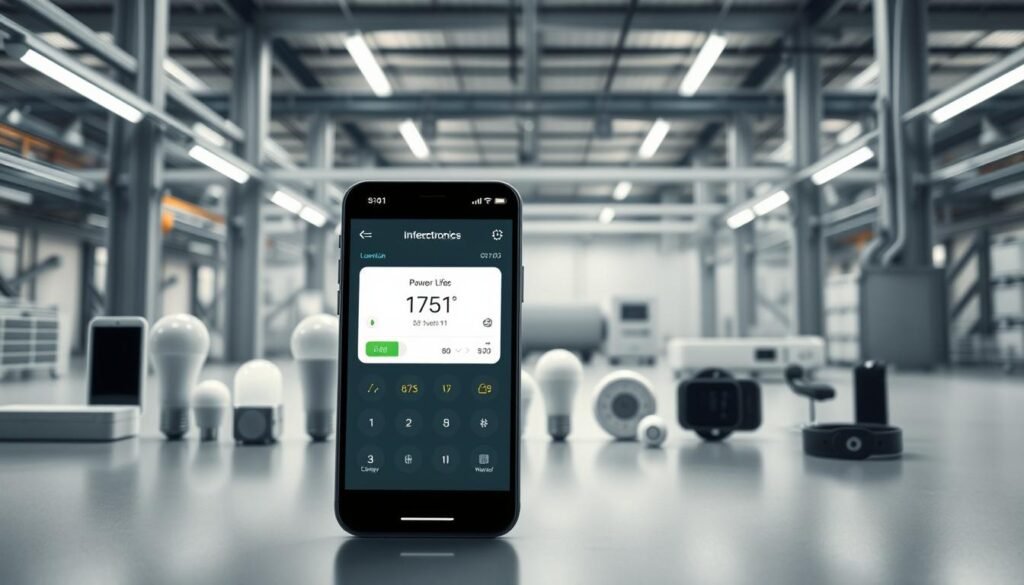
Engineers often struggle with balancing active and idle states in their devices. Our tool simplifies this process through adaptable settings that mirror real-world conditions. You'll gain precise control over energy forecasts while maintaining design flexibility.
Step-by-Step Input Guide
Start by locating your power source's capacity rating. This value typically appears on component labels or spec sheets. Our interface accepts measurements in both mAh and Ah units for convenience.
Next, enter your current draw during active states. Choose between continuous operation for always-on equipment or intermittent mode for sensors and IoT devices. The system automatically adjusts calculations based on your selected parameters.
Adjusting Settings for Sleep Mode and Continuous Use
For devices cycling between active and idle states, configure three critical values:
- Awake duration per operational cycle
- Sleep interval between active phases
- Energy consumption during low-power mode
These inputs let you compare different usage scenarios side-by-side. Remote monitoring tools benefit particularly from seeing how sleep intervals impact total runtime. Our calculations account for fluctuating load patterns, giving you realistic projections for field deployments.
Procurement teams can back component decisions with data showing how different power sources perform under specific conditions. Adjust settings multiple times to find the optimal balance between performance demands and longevity requirements.
Advanced Calculation Techniques and Use Cases

Modern devices rarely operate at constant power levels. We’ve engineered our system to handle fluctuating energy demands through dynamic modeling that reflects real-world usage patterns.
Calculating Average Consumption in Mixed Mode
Mixed-mode systems require weighted calculations to account for active and sleep phases. Here’s how we determine average current draw:
- Multiply awake-phase consumption by its duration
- Repeat for sleep-mode energy use
- Divide total by combined cycle time
This formula: (Consumption₁ × Time₁ + Consumption₂ × Time₂) / Total Time creates accurate baselines for precise runtime forecasts. Industrial controllers using 120mA active/5mA sleep modes show 40% longer operational spans than basic estimates suggest.
Three environmental factors refine predictions:
- Temperature impacts on chemical reactions
- Discharge rate variations across charge cycles
- Aging effects reducing capacity over time
Cold environments decrease available power by 15-20% in lithium-based units. Our models automatically adjust for these conditions, helping you design long battery solutions that withstand field challenges.
For solar-powered systems, we incorporate daylight availability and energy storage thresholds. These advanced features enable reliable runtime projections across seasons – critical for remote infrastructure and agricultural sensors.
Practical Examples and Real-World Applications
Design teams across industries need concrete data to validate their energy strategies. We’ll explore how our methods apply to everyday devices and specialized infrastructure.
Consumer Electronics: From Pockets to Briefcases
A smartphone with 4500 mAh capacity typically runs 6 hours under 1A consumption. This matches common usage patterns:
- 5G connectivity increases current draw by 30% vs. standby
- Screen brightness adjustments alter lifespan projections
- Background apps create variable power demands
Laptops require different calculations. A 60Wh unit powering a 15W processor achieves 4 hours continuous use. Our power draw analysis tool simplifies these comparisons across devices.
Mission-Critical Infrastructure Solutions
Industrial systems demand precision. Consider a 3300mAh backup for medical equipment:
"Reliable power supplies prevent life-support failures during outages."
Three sectors benefit most from advanced modeling:
- Solar installations balancing charge/discharge cycles
- IoT sensors achieving 18-month lifespan through 99% sleep time
- UPS units maintaining 48-hour runtime for data centers
Renewable energy applications show how storage capacity interacts with environmental factors. Remote weather stations using 12V supplies demonstrate 23% longer runtime when paired with efficient converters.
Conclusion
Effective power management begins with precise forecasting tools. Our runtime estimation system transforms how teams approach energy planning across development cycles and field deployments.
You now possess actionable methods to balance component specs with operational demands. By analyzing capacity, consumption patterns, and environmental factors like temperature fluctuations, you can optimize designs during prototyping phases. This prevents costly redesigns while meeting strict performance thresholds.
Procurement specialists gain particular value from comparing power sources under mixed-use scenarios. Whether sourcing materials for IoT sensors or industrial controllers, our models account for sleep cycles and peak draw requirements. These insights help select components that deliver reliable operation across seasons.
We’ve streamlined complex conversions between mAh ratings and real-world runtime expectations. Our expertise in component distribution ensures you access parts that align perfectly with calculated energy needs. Apply these tools confidently during maintenance planning and upgrade evaluations.
Every device deserves power solutions matching its unique operational profile. Let data-driven decisions replace guesswork in your next manufacturing project.
FAQ
How accurate are runtime estimates from power consumption tools?
Results depend on precise input values like capacity (mAh/Ah) and device load. We factor in voltage conversion losses and typical discharge curves, but real-world variables like temperature or aging components may cause deviations of 10–15%.
Can these tools account for devices switching between active and standby modes?
Yes—advanced calculators let you input mixed usage profiles. Specify active/sleep mode durations and corresponding current draw to calculate weighted average consumption for hybrid operational scenarios.
Why do industrial IoT systems require specialized calculation methods?
Sensors and edge-computing devices often use irregular duty cycles or ultra-low-power states. Our models integrate pulsed load profiles and efficiency losses in voltage regulators, critical for renewable energy or remote monitoring applications.
How do I convert milliampere-hours (mAh) to watt-hours for solar-powered setups?
Multiply capacity (mAh) by voltage (V), then divide by 1,000. For example, a 12V 10Ah pack stores 120Wh. We include automatic unit conversions in our tools to simplify sizing solar panels or backup power supplies.
Does ambient temperature significantly impact lithium-based cell performance?
Extreme heat accelerates chemical degradation, while cold temporarily reduces usable capacity. We recommend derating calculated runtime by 20–25% for environments below 0°C or above 45°C to ensure reliable system operation.
What components most frequently cause discrepancies between estimates and actual device runtime?
Voltage regulators, wireless modules (Wi-Fi/Bluetooth), and display backlights often consume more power than datasheet averages suggest. Always validate calculations with real load testing, especially for custom PCB assemblies.
