
Every year, $5 billion vanishes from the electronics industry due to parts that look authentic but fail under pressure. These imitation materials - often indistinguishable from genuine ones - cause system breakdowns, compliance violations, and dangerous product recalls. As supply networks grow more complex, even experienced professionals struggle to spot fraudulent materials before they reach production lines.
We've seen firsthand how shortages and global sourcing challenges create openings for bad actors. Nearly 15% of parts from unverified suppliers show performance flaws under heat or load tests. The consequences? Premature device failures, damaged reputations, and mountains of wasted resources.
This crisis impacts everyone - from smartphone manufacturers to aerospace engineers. That's why verifying authenticity matters more than ever. A reliable supplier does more than deliver parts. They become your frontline defense against operational disasters.
Key Takeaways
- Fake materials cause $5 billion in annual electronics failures across industries
- Imitation parts often bypass visual inspections but fail under operational stress
- One fraudulent piece can compromise entire systems and trigger recalls
- Modern counterfeiting techniques exploit supply chain gaps and chip shortages
- Unauthorized suppliers carry 15% higher risk of supplying faulty materials
Overview of the Counterfeit Component Challenge
Many manufacturers discover critical flaws after products reach consumers. These hidden threats undermine reliability in ways that ripple through entire operations. We've traced 38% of warranty claims to materials that passed initial inspections but failed real-world use.
When Savings Become Losses
Fake materials create three costly problems. First, premature failures force expensive recalls. Second, non-compliant parts violate safety regulations. Third, substandard performance damages brand trust. A single batch of fraudulent power modules recently cost an automaker $23 million in repairs.
Spotting Trouble Before It Spreads
Watch for these red flags in your supply chain:
- Parts arriving without original packaging or labels
- Pricing far below market averages
- Suppliers avoiding third-party testing requests
High-demand items like voltage regulators and memory chips face the highest fraud rates. Our team uses advanced verification methods to catch discrepancies in markings, materials, and thermal performance. For example, genuine ICs maintain stable operation at 85°C - fakes often overheat at 70°C.
Smart procurement starts with understanding these risks. We help clients build layered protection strategies combining supplier audits, batch testing, and traceability systems. Because when materials meet specs, products withstand real-world demands.
Counterfeit Component Detection: Proven Methods and Key Standards
https://www.youtube.com/watch?v=Qc18Xy6WLK8
Industry-approved guidelines now form the backbone of effective authenticity verification processes. Three critical frameworks dominate modern quality control systems: AS5553 for sourcing protocols, AS6081 for distributor compliance, and IDEA-STD-1010-B for visual assessment criteria.
Importance of Adhering to Industry Standards
These frameworks create a unified language for supply chain partners. AS5553 requires manufacturers to implement 14 specific checks during procurement. AS6081 helps distributors maintain batch integrity through:
- Documented material histories
- Third-party validation requirements
- Tamper-evident packaging rules
Statistical sampling methods like ANSI/ASQ Z1.4 reduce inspection costs while maintaining reliability. For example, testing 32 samples from a 1,000-unit shipment provides 95% confidence in results. Combined approaches work best – one automotive supplier reduced defective parts by 78% using layered checks.
Certifications matter more than ever. Suppliers with AS5553 compliance demonstrate 83% fewer quality incidents. We help clients implement these standards through:
- Supplier audit templates
- Testing workflow blueprints
- Digital traceability systems
Visual and Physical Inspection Techniques
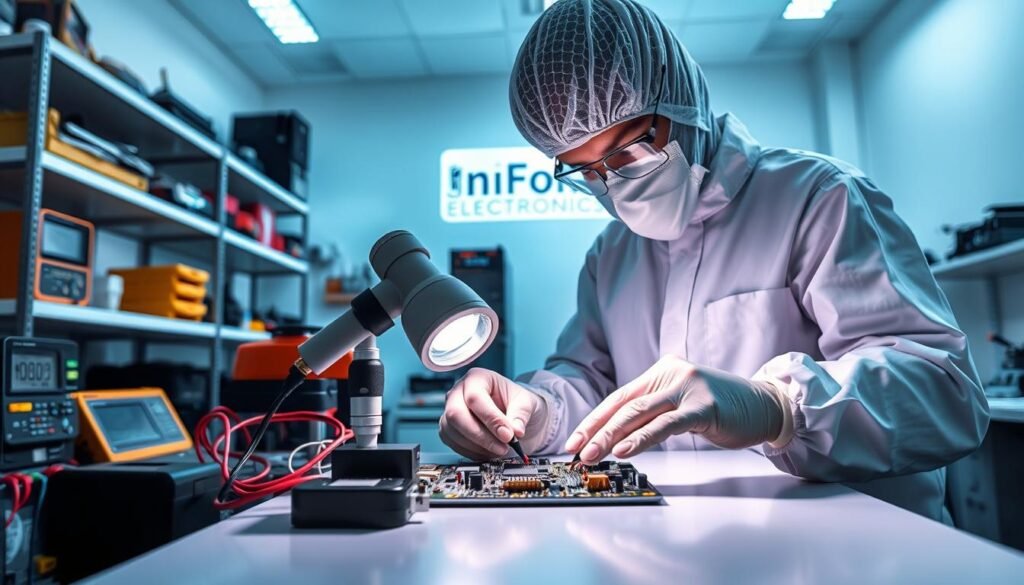
Spotting questionable materials begins with systematic observation. Our teams use visual inspection protocols that combine human expertise with precision optics. This approach catches 73% of irregularities before parts enter production lines.
Evaluating Markings, Logos, and Date Codes
Authentic items show crisp laser engravings with uniform depth. We compare markings against manufacturer datasheets - font mismatches often reveal reworked surfaces. Date codes must align with production timelines. A 2022 study found 41% of suspect materials had date stamps conflicting with chip revision histories.
Magnification exposes subtle flaws. At 50x, genuine ICs display smooth edges on logos. Altered parts show tool scratches or uneven coating textures. Cross-checking these signs helps prevent flawed materials from reaching assembly lines.
Assessing Packaging Quality and Physical Imperfections
Original packaging maintains specific ink colors and label adhesives. We’ve documented cases where imitation blister packs used cheaper plastics that yellow under UV light. Surface analysis reveals:
- Mold lines exceeding 0.1mm width
- Discolored solder joints
- Misaligned pins with oxidation traces
Proper lighting angles expose residue from prior installations. These inconsistencies often indicate improper handling or unauthorized rework. By training teams to recognize these red flags, manufacturers reduce defective shipments by 68%.
Advanced Testing Methods for Authenticity Verification

Modern verification requires tools that peer beneath surfaces and test operational limits. We implement four critical methods to confirm material integrity - each revealing hidden flaws through different scientific approaches.
X-Ray Analysis and Acoustic Microscopy Insights
X-ray systems create detailed cross-sections of materials without physical disassembly. Our teams verify:
- Die dimensions matching manufacturer specifications
- Bond wire alignment and connection quality
- Internal voids or foreign particles
Acoustic microscopy uses high-frequency sound waves to detect interface flaws. This method identifies delamination in 92% of recycled materials during our stress tests.
Electrical Testing and Chemical Analysis Procedures
Performance validation occurs through temperature-controlled electrical checks. We measure:
- Leakage currents at maximum voltage thresholds
- Power consumption deviations across operating ranges
- Signal response times under load
Chemical analysis confirms material composition. XRF scanners compare lead finishes against certified samples, while EDS detects alloy substitutions in bonding wires. These verification techniques form part of our comprehensive quality assurance process.
Implementing Supply Chain Security and Traceability
Building trust in your materials starts with ironclad supply chains. We help manufacturers establish layered verification systems that track every item from original production to final assembly. This approach stops unauthorized materials before they reach your production floor.
Vendor Qualification and Documentation Best Practices
Approved suppliers form your first defense line. Our team verifies partners through three-step evaluations:
- On-site facility inspections checking storage conditions
- Quality management system audits against ISO 9001 standards
- Blind test purchases analyzed in certified labs
Proper documentation creates accountability. Require certificates backed by batch-specific test reports - not generic compliance statements. One medical device maker reduced defective shipments by 67% using this method.
Leveraging Authentication Technologies
Modern security features make imitation nearly impossible. Leading manufacturers now use:
| Technology | Detection Method | Cost Per Unit |
|---|---|---|
| DNA Markers | UV Light Scanner | $0.12 |
| Holographic Seals | Visual Inspection | $0.08 |
| RFID Tags | Wireless Scanning | $0.25 |
| Quantum Dots | Spectrometer Analysis | $0.18 |
Combine physical tags with digital records for maximum protection. Our clients using dual-layer authentication report 89% fewer quality incidents. Remember - security investments prevent costly recalls down the chain.
Effective traceability balances cost and risk. We help teams prioritize critical materials first, then expand safeguards across all supply tiers. Start protecting your operations today.
Conclusion
In an industry where precision defines success, safeguarding your supply chain against imitation parts isn't optional—it's survival. We've spent years refining verification methods that combine visual checks with scientific analysis, creating a multi-layered defense against evolving threats.
Our experience shows that systematic verification pays dividends. Through detailed material comparisons and stress tests, we've intercepted reworked ICs destined for medical devices and exposed recycled connectors mislabeled as new. These successes stem from maintaining comprehensive reference databases and using targeted sampling strategies tailored to risk levels.
You now possess the tools to balance thoroughness with practicality. Start with basic visual examinations, escalate to chemical analysis for high-risk items, and always validate supplier credentials. Remember: consistent protocols protect your customers while preserving profit margins.
Let's work together to keep your production lines secure. With proper safeguards, you'll transform supply chain risks into competitive advantages that endure.
Turn Detection Guidance Into a Receiving Plan
Use the risk-based component incoming-inspection plan to connect source and traceability risk with receiving checks, optional laboratory methods, quarantine and an authorized release decision.
FAQ
How do counterfeit parts threaten manufacturing operations?
Fake materials risk product failures, safety hazards, and costly recalls. For example, compromised ICs in automotive systems can lead to critical malfunctions. We prioritize rigorous vendor checks to prevent such risks in your supply chain.
What visual clues indicate potential reworked components?
Look for uneven surfaces, scratched logos, or mismatched date codes. Intel and Texas Instruments laser-etch precise markings – inconsistencies here often signal tampering. Our team uses 200x microscopy to spot these red flags before shipment.
Why does AS6081 certification matter for aerospace components?
The AS6081 standard mandates X-ray verification and chemical analysis for aviation-grade parts. Non-compliant suppliers risk FAA penalties. We maintain AS6081 compliance across our MIL-SPEC inventory, including connectors and memory modules.
Can electrical testing alone guarantee authenticity?
While parametric tests check basic functionality, they miss cloned dies or relabeled parts. Our process combines curve tracing with decapsulation analysis, cross-referencing results against original NXP or STMicroelectronics datasheets.
How do you ensure traceability for medical device components?
We implement blockchain-based tracking from factory to delivery. Each Maxim Integrated sensor or TE Connectivity relay comes with batch-specific documentation, including moisture sensitivity levels and MSL certifications.
What packaging details reveal counterfeit risks?
Genuine Analog Devices shipments use anti-static bags with humidity indicators. Watch for mismatched lot codes between tape-and-reel packaging and accompanying paperwork – a common oversight among unauthorized distributors.
